Cloud-Based Database: The Foundation of Modern Business Scalability
Harash Jindal
Jul 16, 2026
What is a Cloud-Based Database?
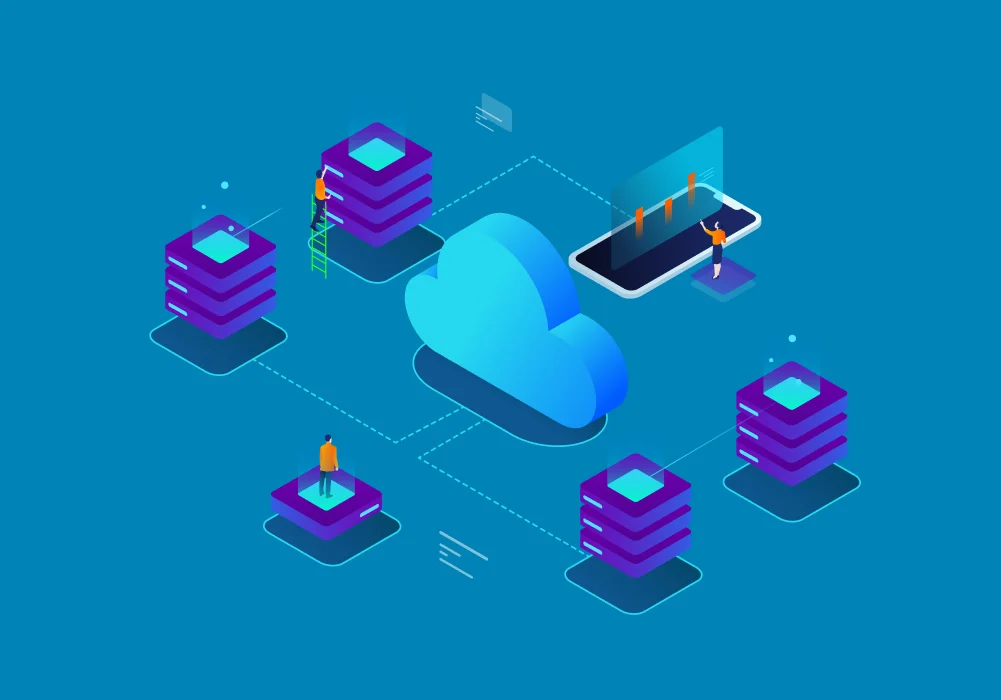
A cloud-based database is a storage solution delivered via cloud computing platforms. With these, you no longer need to invest in expensive hardware and can easily access, manage, and scale your data online. All you have to do is decide if you wish to let your cloud provider handle everything or have a self-managed platform where you have more control but also more responsibility.
This cloud model will help you make better decisions and facilitate innovation. One classic example is Slack, which hosts its metadata in Amazon Aurora. This is also why it offers excellent availability on a global scale and lets you collaborate in real time.
The benefits don’t stop here! This blog will help you better understand cloud-based databases and how they can promote ease of scale for businesses.
The Role of Scalability in Business Growth
If you are not scaling your business, you allow competitors to lead the market. However, you must remember that scaling fast does not mean sacrificing performance or user experience. The idea is to handle increasing workloads while maintaining quality and not burning a hole in your business finances. It is crucial for:
- E-commerce brands that deal with peak holiday traffic.
- SaaS brands that deal with thousands of new users every month.
- Fintech platforms that process thousands of transactions per second.
- Healthcare providers need to store growing volumes of patient data securely.
If your current infrastructure lags, it will inevitably lead to performance issues and a dip in customer satisfaction. Globally, companies are shifting to cloud databases as they realize the need for cost control and elastic scalability.
Expert Insight
How does cloud database agility translate into business advantage?
“Cloud databases aren’t just infrastructure—they’re strategic assets, fundamentally transforming how businesses approach growth. During my tenure overseeing cloud architecture for multinational organizations, I’ve observed that companies leveraging elastic cloud database solutions can respond to market demands 8-10x faster than competitors with traditional infrastructure. The real innovation isn’t the technology itself, but the business agility it enables when properly implemented within your operational framework.” — Abhi Garg
Key Considerations Before Migrating to a Cloud Database
While migrating to a cloud-based database is a smart move. However, not making a roadmap can lead to downtime and integration issues. Don’t let that happen to your business. Here are some factors you must take care of.
- Audit your current ecosystem to see what is cloud-ready and needs to be reengineered.
- Are you seeking improved performance, global reach, cost reduction, or better security? If you have not yet decided, it is time to set your goals as they will shape your cloud-based database architecture.
- While the cloud is known to reduce CapEx, hidden costs can quickly add up if you are not careful enough. Thus, performing a Total Cost of Ownership (TCO) analysis is best.
- You must choose a cloud provider that meets regulatory requirements and fulfills data protection needs.
- Legacy systems can quickly become a menace. It is better to check beforehand if your tools support the chosen cloud database or require APIs and connectors.
- Phased migration is an ideal strategy for minimizing operational disruptions. Moreover, you also need to test with a staging environment before full deployment.
Read More: Cloud Cost Management
BuzzClan Cloud Consulting Services: What’s Included?
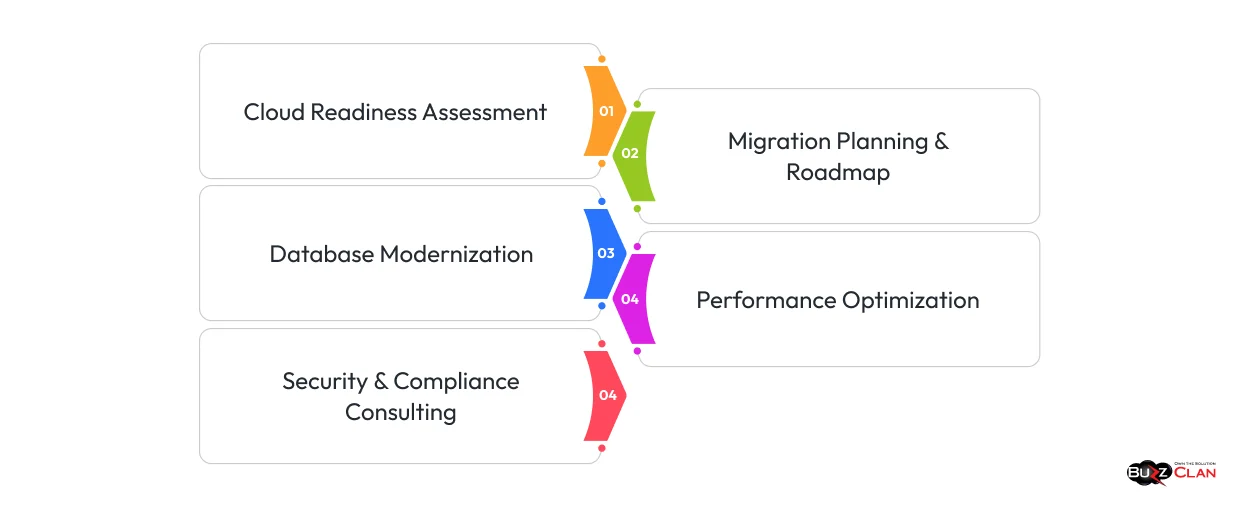
BuzzClan helps businesses ensure a seamless transition to cloud-based databases. Our clients have seen a sharp decline in risks and costs while accelerating digital transformation. Here is what we offer:
- We assess your current infrastructure, compliance posture, and databases to determine cloud compatibility.
- Post that a detailed plan is created with clear timelines, strategies, milestones, and budgets.
- If your systems are incompatible with the cloud, we will modernize them to make them compatible.
- The next step is optimizing queries, fine-tuning indexes, and implementing caching for top-notch performance.
- We ensure enterprise-grade cloud security, end-to-end encryption, exhaustive audit trails, and documentation support to help you stay ahead of the curve.
- With 24/7 support, patching, monitoring, and automated scaling, you can look forward to focusing on core business functions.
Top Cloud Database Providers in 2025
The cloud-based database market is ever-changing, and the top providers are leading the wave in 2025.
| Provider | Key Databases | Strengths | Best For |
|---|---|---|---|
| AWS | RDS DynamoDB Aurora Redshift |
Scalability, integration, global reach | Enterprises E-commerce Startups |
| Azure | SQL Database Cosmos DB Synapse |
Security, hybrid cloud, Microsoft ecosystem | Finance Healthcare Government |
| Google Cloud | BigQuery Cloud SQL Firestore Spanner |
Analytics, AI/ML, real-time data | Media SaaS Data-driven businesses |
| Oracle Cloud | Autonomous DB Exadata Cloud |
Performance, automation, legacy support | Large enterprises Manufacturing firms |
| IBM Cloud | DB2 on Cloud Cloudant |
AI-integrated analytics, secure architecture | Banking and legal firms |
Future Trends of Cloud-Based Databases
Data needs keep evolving at lightning speed. Here is what will shape the next wave of cloud databases.
Rise in Serverless Databases
Serverless computing is the key to eliminating the complexities of provisioning and scaling. As they can handle variable workloads, serverless databases will see a steep increase in the future.
AI-Driven Database Management
AI will add a layer of precision and anomaly detection to database management. Platforms like Oracle have already adopted this approach and use AI to automate maintenance and tuning. Moreover, this trend will be convenient for the manufacturing and healthcare sectors as they have massive datasets to manage.
Integrated Real-Time Data Streaming Features
Generating and acting on real-time insights can help businesses make better decisions and position themselves in their respective industries. Multiple databases integrate with stream processing tools, and the upcoming decade will see an explosion in the practice. You must use tools like Kafka and AWS Kinesis to gain that extra edge if you are not using them yet!
Shift Towards Multi-Cloud and Hybrid Architectures
Vendor lock-ins lead to data portability issues and limited flexibility. This is why businesses worldwide are looking forward to distributing workloads across platforms. This, in turn, is leading to a solid rise in hybrid and multi-cloud architectures. The trend will continue to grow in the coming years as cloud-neutral databases gain traction.
Data Sovereignty and Edge Integration
As countries impose data localization laws, cloud databases adapt to their needs. Also, when combined with edge computing, businesses can look forward to lower latency and better meet their compliance needs. In the future, cloud-based database providers will ensure these features are integrated beforehand.
Read More: Future Cloud Computing Trends
Conclusion
Cloud-based databases are much more than an IT upgrade; they are a must-have for your business. With AI-driven performance and automatic scaling, they help you innovate better and serve your customers better. And, icing on the cake is that you don’t need to deal with the menace of handling infrastructural issues. Whether you are just starting or have a full-fledged setup, the cloud offers tools for taking your journey above and beyond. At BuzzClan, our role doesn’t just end at cloud migration; we help you transform your processes and gain a solid competitive edge.
Frequently Asked Questions
While a traditional database is maintained on physical servers, cloud databases can easily be managed on cloud servers via the internet.
Relational (SQL) and non-relational (NoSQL) databases are the main types of cloud-based databases.
They are a must for modern businesses as they offer ease of scale and access while being cost-efficient and flexible.
Yes. BuzzClan offers both to help you manage and deploy applications seamlessly in the cloud.
You can reduce the maintenance burden, improve security posture, and ensure automatic updates. As a result, you can focus better on your core business functions.
Features like automated backups, failover systems, and replication across regions ensure that services are always up and running.
BuzzClan ensures data privacy through encryption, access controls, compliance with standards, and secure cloud configurations.

Get In Touch