
ETL Process Explained: How Modern Data Pipelines Drive Revenue Growth
Rahul Rastogi
Mar 6, 2026
Before ETL, accessing timely data was a slow and manual process. Teams often waited days or even weeks for reports to be compiled, and by the time the information was available, it was already outdated. Organizations that could analyze and act on data faster gained a clear competitive advantage.
Modern ETL delivers data continuously and automatically. What used to take weeks now takes minutes, which means your team can act while opportunities are still fresh.
This blog shows how to build ETL that speeds up decisions and turns slow data into a competitive advantage.
What is the ETL Process in Modern Data Architectures?
ETL stands for Extract, Transform, Load—three steps that move data from where it lives to where you need it. The process extracts data from source systems, transforms it into a usable format, and loads it into a destination where teams can analyze it.
In modern data architectures, ETL does much more than just move data around. It handles real-time information streams, works seamlessly with cloud platforms, and supports advanced analytics without slowing down. Modern ETL processes run automatically, scale as your data grows, and keep working reliably even when something breaks.
Why ETL Modernization Is Critical for Revenue Growth
Modern ETL directly impacts how fast your business can make money and keep customers happy. When data moves quickly and reliably, teams spot opportunities sooner, respond to problems faster, and make decisions based on what’s happening right now instead of what happened last week.
Speed Wins Markets
Products and campaigns launch weeks faster when teams access clean data instantly instead of waiting for manual preparation. Features that used to take quarters now take weeks, which means you capture opportunities before competitors finish planning.
Stop Losing Money in the Gaps
Slow data pipelines let revenue slip away. Orders get delayed because inventory isn’t synchronized. Billing errors happen because the customer data doesn’t match. Upsell opportunities disappear because sales don’t see usage patterns in time. Modern ETL keeps everything synchronized, which plugs the leaks.
Decisions That Actually Move Fast
Leadership makes better choices faster when everyone trusts the same numbers. Modern ETL delivers consistent metrics that eliminate weeks of debate about accuracy. Strategic pivots happen in days instead of quarters because the data foundation already exists.
Your Team Stops Firefighting
Teams waste less time on manual data work and broken pipelines. Cloud-based ETL scales automatically, so you pay only for what you use. Engineering resources shift from maintaining old integrations to building features that generate revenue.
Key Stages of the ETL Process
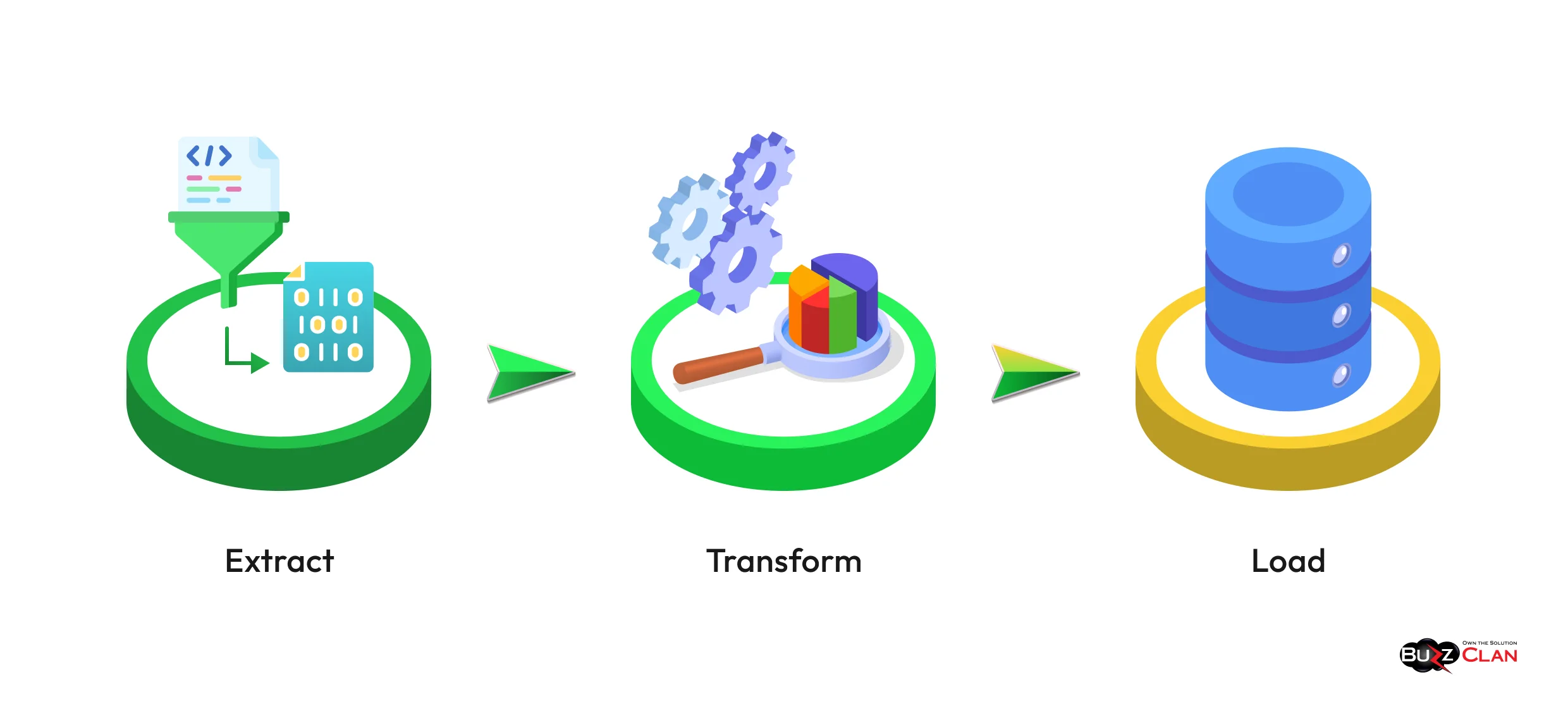
The ETL process consists of three distinct stages that work together to move data from source systems to analytics-ready destinations. Each stage serves a specific purpose and includes capabilities that ensure data arrives clean, structured, and ready for business use.
Extract
Extract pulls data from source systems without disrupting ongoing operations. This stage connects to databases, APIs, applications, and files to retrieve the information your business needs.
Key Features:
- Connects to multiple source types, including databases, CRMs, ERPs, and cloud applications
- Uses change data capture (CDC) to identify only new or modified records
- Runs on schedules or continuously in real-time, depending on business needs
- Minimizes load on source systems to avoid performance impacts
Transform
Transform cleans, standardizes, and reshapes data into formats that analysts and business users can actually work with. This stage applies business logic and ensures data quality before it reaches your analytics platform.
Key Features:
- Removes duplicates and corrects formatting inconsistencies
- Handles missing values and validates data quality
- Joins data from multiple sources into unified records
- Applies business rules like calculations, aggregations, and metric definitions
- Masks or encrypts sensitive information to meet compliance requirements
Load
Load moves transformed data into target systems where teams can analyze it and build reports. This stage ensures data arrives in the right place at the right time without overwriting critical information.
Key Features:
- Supports full loads that replace entire datasets
- Enables incremental loads that add only new or changed records
- Delivers real-time streaming for immediate data availability
- Handles large data volumes efficiently without pipeline failures
- Maintains data integrity during the loading process
How to Build a Modern ETL Pipeline
Building a modern ETL pipeline requires a clear approach that balances business needs with technical capabilities. The process involves defining requirements, selecting the right tools, and establishing practices that keep pipelines running reliably as your data grows.
Start with Clear Data Requirements
Identify which data sources drive business decisions and how often information needs to be refreshed. Understanding requirements upfront prevents building pipelines that don’t solve actual problems. Map out where data lives today, who needs access, and what quality standards matter most for your use cases.
Pick the Right Tools for Your Stack
Choose data engineering tools that integrate with your existing platforms and match your team’s expertise. Cloud-native solutions scale automatically and reduce operational overhead, while open-source options provide customization when needed. The best tool is one that your team can implement and maintain without constant external support.
Build Quality Checks into Every Stage
Design validation rules that catch errors as data moves through the extraction, transformation, and loading phases. Automated quality monitoring prevents data quality issues from reaching analytics and corrupting business decisions. Establish clear handling procedures for bad data—reject it, flag it, or apply defaults based on business impact.
Design for Scale from Day One
Modern pipelines handle growth without requiring complete rebuilds. Cloud infrastructure scales processing power independently from storage, which means you can adapt to volume increases without moving data. Partition large datasets for parallel processing and use streaming patterns where real-time insights matter.
Monitor Pipeline Health Continuously
Track processing time, error rates, and data volume to spot problems before they impact decisions. Configure alerts that notify teams immediately when pipelines break, so fixes happen fast. Following data pipeline best practices means building observability into workflows from the start rather than adding it after problems emerge.
Traditional ETL vs Modern Data Pipelines
Traditional ETL and modern data pipelines solve the same core problem—moving data from sources to destinations—but they approach it in fundamentally different ways. Understanding these differences helps organizations choose the right architecture for their current needs and future growth.
| Dimension | Traditional ETL | Modern Data Pipelines |
|---|---|---|
| Processing Speed | Fixed schedules, typically overnight batches. The data is hours old. | Real-time streaming and batch options. Data arrives as events happen. |
| Transformation | Transforms before loading. Requires upfront structure planning. | Loads raw data first, transforms later. Flexible as needs change. |
| Scalability | Scales vertically. Hits limits and needs downtime for upgrades. | Scales horizontally. Adds capacity automatically without downtime. |
| Schema Changes | Breaks when schemas change. Needs manual fixes. | Handles schema evolution automatically without breaking. |
| Infrastructure | On-premises servers require maintenance and capacity planning. | Cloud-native managed services. Infrastructure scales automatically. |
| Data Quality | Quality checks after transformation. Bad data often gets through. | Validation at every stage. Catches errors before they spread. |
| Cost Model | High upfront costs. Pay for peak capacity even when idle. | Pay-as-you-go. Costs match actual usage. |
| Monitoring | Manual troubleshooting. Teams hunt through logs for problems. | Built-in observability with automated alerts showing exact failures. |
Modern pipelines address the limitations that made traditional ETL difficult to maintain and slow to adapt. Organizations building new data infrastructure today typically start with modern approaches, while those with legacy ETL gradually migrate components to gain flexibility without disrupting existing workflows.
Challenges in ETL Process
Even modern ETL pipelines face obstacles that slow implementation and create operational friction. Understanding these challenges upfront helps teams plan realistic solutions rather than discovering problems after pipelines reach production.
Data Quality and Consistency Issues
Source systems contain duplicates, missing values, and formatting inconsistencies. When bad data flows unchecked, it corrupts analytics and leads to wrong decisions. Building validation rules that catch problems without blocking legitimate data requires deep business context understanding.
Complex Data Transformations
Business logic involves nested calculations, multi-step aggregations, and conditional rules that vary by segment. Translating these requirements into transformation code that performs well at scale challenges even experienced engineers, especially when logic exists only in someone’s head.
Managing Multiple Data Sources
Enterprise data lives in dozens of systems—CRMs, ERPs, databases, APIs, and files. Each source has different connection methods, authentication requirements, and data formats. Coordinating extraction across all sources while respecting their constraints creates significant complexity.
Performance Bottlenecks
Pipelines that work with small datasets slow dramatically as volume grows. Inefficient joins, unoptimized queries, and single-threaded processing create bottlenecks that delay data delivery. Identifying performance issues before they impact production requires careful architecture planning.
Schema Changes Breaking Pipelines
Source systems evolve constantly—new fields get added, column names change, and data types shift. Pipelines break when schemas change unexpectedly, requiring manual fixes. Building flexibility to handle schema evolution without constant maintenance remains a persistent challenge.
ETL vs ELT: Choosing the Right Data Integration Method
The difference between ETL and ELT comes down to where the transformation happens. ETL transforms data before loading it into the warehouse, while ELT loads raw data first and transforms it inside the warehouse. This seemingly small change has major implications for flexibility, speed, and how teams work with data.
| Aspect | ETL (Extract, Transform, Load) | ELT (Extract, Load, Transform) |
|---|---|---|
| Transformation Timing | Transforms data before loading into the warehouse. | Loads raw data first, transforms inside the warehouse. |
| Processing Location | Transformation happens on separate ETL servers. | Transformation uses warehouse compute power. |
| Data Storage | Only transformed data reaches the warehouse. | Raw and transformed data are both stored in the warehouse. |
| Flexibility | Hard to change logic after loading. Requires reprocessing. | Easy to retransform data without re-extracting from sources. |
| Time to Insights | Slower. Must wait for the transformation before analysis. | Faster. Analysts query raw data immediately if needed. |
| Infrastructure Costs | Needs a dedicated ETL processing infrastructure. | Leverages existing warehouse compute, no separate servers. |
| Data Governance | Sensitive data gets masked before reaching the warehouse. | Raw data lands first, requiring warehouse-level security controls. |
| Use Cases | Best for on-premises systems with limited warehouse power. | Best for cloud warehouses with strong compute capabilities. |
| Schema Requirements | A strict schema is needed upfront before loading. | Schema-on-read allows exploration before defining structure. |
| Historical Reprocessing | Difficult. Must re-extract from sources to retransform. | Easy. Raw data already available for new transformations. |
When to Choose ETL
ETL works best when you need to mask sensitive data before it reaches the warehouse, when working with legacy on-premises systems that can’t handle transformation workloads, or when warehouse compute costs are prohibitively expensive. It’s also the right choice when data sources have strict access windows, and you can only extract once.
When to Choose ELT
ELT makes sense for cloud-native architectures where warehouses like Snowflake, BigQuery, or Redshift provide massive compute power. It’s ideal when business questions evolve rapidly, and teams need flexibility to retransform data without re-extracting. ELT also works better when you want to preserve complete historical raw data for compliance or future analysis.
Most modern organizations building new data platforms choose ELT because cloud warehouses now have the power to transform data efficiently. However, hybrid approaches are common—using ETL for sensitive data that needs masking and ELT for everything else.
ETL Modernization Challenges (and How to Overcome Them)
Modernizing ETL infrastructure means moving from legacy batch processes to flexible, scalable pipelines. Organizations face specific obstacles during this transition, but proven strategies help navigate them successfully.
Legacy System Dependencies
Older source systems weren’t built for modern data extraction patterns. They lack APIs, impose strict query limits, and struggle with concurrent connections. Some critical data exists only in mainframes or databases that predate cloud architecture entirely.
How to Overcome: Start with data integration strategies that work with existing systems rather than requiring immediate replacement. Use change data capture (CDC) to minimize load on legacy databases, implement queuing to respect rate limits, and build adapters that translate between old protocols and modern pipelines. Prioritize extracting data from the most business-critical systems first while planning gradual migration paths for others.
Skills Gap in Modern Tools
Teams experienced in traditional ETL tools often lack expertise in cloud-native platforms, streaming frameworks, and infrastructure-as-code. Learning new technologies while maintaining existing pipelines creates pressure, and hiring specialists with modern data engineering skills is competitive and expensive.
How to Overcome: Invest in training for existing team members who understand your business context and data landscape. Start with managed services that reduce operational complexity so teams can focus on transformation logic rather than infrastructure management.
Data Governance During Transition
Modernization creates periods where data flows through both old and new pipelines simultaneously. Maintaining consistent security, access controls, and compliance requirements across dual systems is complex. Teams worry about sensitive data exposure when moving to cloud platforms with different security models.
How to Overcome: Establish clear data governance frameworks before migration begins. Define data classification rules, access policies, and encryption standards that apply across both environments. Implement automated scanning to detect sensitive data and enforce masking consistently. Run parallel systems only as long as necessary to validate accuracy, then cut over completely to avoid prolonged dual maintenance.
Proving ROI and Getting Buy-In
Leadership questions the cost and disruption of modernization when existing pipelines technically still work. Quantifying benefits like faster insights, reduced maintenance, and improved scalability feels abstract compared to concrete migration costs and temporary productivity dips.
How to Overcome: Start with a high-value pilot that demonstrates clear business impact quickly. Choose a use case where current pipelines create obvious pain—slow refresh times, frequent failures, or blocked analytics initiatives. Measure concrete improvements like time savings, error reduction, and new capabilities enabled. Use pilot success to build momentum and justify broader investment in cloud migration of data infrastructure.
Best Tools for Building ETL Pipelines
Choosing the right ETL tools determines how quickly teams can build pipelines, how easily they scale, and how much maintenance they require. The modern ETL landscape includes cloud-native managed services, open-source frameworks, and enterprise platforms that each serve different needs.
| Tool | Type | Best For | Key Strengths |
|---|---|---|---|
| AWS Glue | Cloud Managed | AWS-focused organizations | Serverless, auto-scaling, deep AWS integration |
| Azure Data Factory | Cloud Managed | Microsoft Azure users | Visual design, hybrid connectivity, low-code pipelines |
| Google Cloud Dataflow | Cloud Managed | Real-time analytics on GCP | Unified batch and streaming, auto-scaling |
| Apache Airflow | Open Source | Complex workflow orchestration | Flexible scheduling, extensive integrations, and community support |
| Apache Spark | Open Source | Large-scale data processing | Distributed computing, batch and streaming, multiple languages |
| dbt | Open Source | SQL-based transformations | Warehouse-native, version control, testing, and documentation |
| Informatica PowerCenter | Enterprise | Legacy system integration | Enterprise-grade support, extensive connectors, mature platform |
| Talend | Enterprise | Visual ETL development | Graphical design, hundreds of connectors, flexible deployment |
| Fivetran | SaaS | Automated data replication | Pre-built connectors, zero maintenance, fast setup |
| Stitch | SaaS | Simple cloud replication | Quick SaaS integration, minimal configuration |
ETL Tools Supporting Data Modernization
As organizations modernize their data infrastructure, ETL tools must support cloud migration, real-time processing, and integration with modern analytics platforms. The right tools accelerate modernization rather than creating new technical debt.
| Tool | Modernization Strength | Best For |
|---|---|---|
| Fivetran | Automated cloud replication with zero-maintenance connectors | Organizations moving SaaS data to cloud warehouses quickly |
| Airbyte | Open-source with 300+ connectors and custom integration support | Teams needing flexibility and control over data replication |
| Matillion | Cloud-native ETL built specifically for Snowflake, BigQuery, and Redshift | Organizations with established cloud warehouse investments |
| Apache Kafka | Real-time event streaming and data pipeline backbone | Enterprises building event-driven architectures at scale |
| Databricks | Unified analytics platform with Delta Lake for lakehouse architecture | Teams modernizing to lakehouse patterns with AI/ML workloads |
| AWS Glue | Serverless ETL with automatic scaling and AWS service integration | AWS-focused organizations modernizing their data infrastructure |
| dbt | SQL-based transformations with version control and testing | Analytics engineering teams transforming data in modern warehouses |
| Prefect | Modern workflow orchestration with Python-first design | Data engineers building flexible, observable pipelines as code |
| StreamSets | Hybrid and multi-cloud data integration with drift detection | Enterprises managing data across multiple cloud and on-prem systems |
Key Modernization Priorities
Organizations modernizing data infrastructure should evaluate whether tools genuinely support cloud-native patterns, real-time processing, and DevOps workflows, or simply run legacy approaches on cloud servers. True modernization tools accelerate transformation rather than recreating old limitations in new environments.
Focus on platforms that reduce manual maintenance, scale automatically with data growth, and integrate naturally with your target cloud architecture. The best modernization tools make migration easier and unlock capabilities that weren’t possible with legacy systems.
Best Practices for Building Revenue-Driven Modern ETL Pipelines
Building ETL pipelines that directly support business outcomes requires more than technical implementation. These best practices ensure pipelines deliver reliable data that teams trust and use to drive revenue growth.
Design with Business Outcomes First
Start by understanding which business decisions depend on data and work backward to pipeline requirements. Align pipeline design, refresh frequency, and data quality standards to actual business impact rather than building generic infrastructure.
Build Data Quality into Every Stage
Validate at extraction to catch source system issues early, during transformation to ensure business rules apply correctly, and before loading to prevent corrupted data from reaching production. Automated quality checks that fail fast save hours of downstream troubleshooting.
Implement Comprehensive Monitoring
Track data volume trends, processing latency, and data freshness. Following data observability best practices means knowing about problems before business users report missing or incorrect data.
Document Transformation Logic Clearly
Document why transformations exist, what business definitions they implement, and who owns the logic. Clear documentation accelerates onboarding and helps teams understand data lineage when questions arise.
Optimize for Cost Efficiency
Process only changed data instead of full refreshes, schedule heavy transformations during off-peak hours, and right-size cluster resources to match workload needs. Regular cost reviews identify waste and keep spending aligned with value delivered.
Enable Self-Service Data Access
Build pipelines that land clean, documented datasets where analysts can find and query them directly. Self-service access democratizes data and removes bottlenecks that slow decision-making.
Key Considerations When Choosing an ETL Solution
Selecting an ETL solution impacts how quickly teams deliver insights, how easily pipelines scale, and how much maintenance they require long-term. These considerations help organizations choose platforms that align with business needs and technical constraints.
Integration with Existing Infrastructure
Evaluate how well ETL tools connect to your current data sources and target platforms. Native integrations reduce development time and improve reliability. Tools requiring custom connectors for key systems create ongoing maintenance burdens.
Team Skills and Learning Curve
Consider your team’s existing expertise. SQL-based platforms let analysts build pipelines without learning new languages, while code-first tools require programming skills but offer more flexibility. The best tool is one your team can actually use effectively.
Scalability and Performance Requirements
Understand current and projected data volumes. Tools that work for gigabytes may struggle with terabytes. Evaluate whether solutions scale horizontally and whether processing speed meets business needs—batch overnight loads differ from real-time streaming requirements.
Total Cost of Ownership
Look beyond licensing fees to include infrastructure costs, operational overhead, and engineering time. Managed services cost more upfront but reduce maintenance. Open-source tools appear free but require expertise to operate reliably.
Security and Compliance Capabilities
Assess built-in security features like encryption, access controls, and audit logging. Verify the platform supports compliance requirements specific to your industry—HIPAA for healthcare, GDPR for European data, and SOC 2 for enterprise SaaS.
Conclusion
Modern ETL has evolved from technical plumbing into a strategic asset that directly drives revenue growth. Organizations that modernize their data pipelines respond faster to market changes, make better decisions, and outpace competitors still waiting for yesterday’s data.
The path forward is clear: identify where slow or broken data pipelines cost your business the most, start with high-impact use cases, and expand as value becomes evident. Legacy batch processes, manual workflows, and disconnected systems create friction that compounds into lost opportunities. Modern ETL removes that friction.
FAQs

Get In Touch
Follow Us