Agentic Workflow: Turn High-Value Workflows Into AI Agents
Abhi Garg
Sep 10, 2026

A process can waste hundreds of employee hours every month and still be a poor candidate for an AI agent.
If the work follows predictable rules, traditional automation may handle it perfectly well. An agent becomes more useful when the process depends on context: someone has to interpret information, decide what should happen next, work across different systems, handle exceptions, and adjust when the usual path no longer applies.
This distinction is easy to miss when companies start looking for agentic AI use cases. The obvious targets are often the processes with the most manual work or the highest volume. But volume tells you how valuable automation might be. It does not tell you what kind of automation the process needs.
Finding the right agentic workflow requires looking deeper into how the work actually happens. Where does human judgment enter the process? What information is needed to make a decision? Which systems need to be accessed?
Answering those questions before building an agent helps separate workflows that simply need automation from those where an AI agent can genuinely take on more complex, multi-step work.
What Is an Agentic Workflow?
An agentic workflow gives an AI agent a goal and a set of tools, then allows it to determine how to move the work forward based on the information it encounters.
Unlike traditional rule-based automation, which follows a rigid script and breaks the moment something unexpected happens, an agentic workflow can reason through exceptions and adjust its next action based on what it encounters.
Agentic Workflows vs. Traditional Automation
Not every workflow needs an AI agent.
Traditional workflow automation works well when the process can be mapped in advance: if this happens, perform this action; if a condition is met, move to the next step. RPA can also automate repetitive interactions with applications where the steps and rules are relatively stable.
Agentic workflows are useful when the path through the work is harder to prescribe upfront.
Let’s take an IT service request as an example. A conventional workflow can route a ticket based on predefined fields, assign it to the appropriate queue, and trigger an approval when certain conditions are met.
An agentic workflow can take on work that requires more interpretation. The agent might read the request, gather relevant context from available systems, determine which tools or information it needs, choose an appropriate next action, and ask for human approval when the decision falls outside its authority.
The difference is not simply that one uses AI and the other does not. It is how much of the path has to be defined before the workflow runs.
| Traditional Automation | Agentic Workflow |
|---|---|
| Follows predefined process paths and rules | Can determine the next step based on context and intermediate results |
| Works best when inputs and outcomes are predictable | Better suited to workflows with variability and exceptions |
| Actions and system interactions are usually defined in advance | Can choose from permitted tools and actions as the workflow progresses |
| Handles decisions through predefined conditions | Can evaluate information to support context-dependent decisions |
| Escalates according to configured rules | Can request human input when it reaches defined limits or lacks sufficient information |
This distinction matters when prioritizing AI projects. A predictable process should not become an agentic workflow simply because an AI agent can perform it. Adding an agent introduces additional considerations around model behavior, permissions, monitoring, evaluation, and governance.
The better question is whether the workflow contains enough interpretation, variability, and decision-making to justify that additional complexity.
Where Agentic Workflow Selection Goes Wrong
The workflows that consume the most employee time tend to attract attention first. This makes sense from a cost perspective, but workload alone does not tell you whether an AI agent is the right solution.
A 10,000-step-per-month process governed by stable rules may be an excellent automation opportunity and a poor agentic AI opportunity. A lower-volume process where employees repeatedly interpret documents, gather context from several systems, and decide what happens next may be far more suitable for an agent.
Several factors can distort that decision.
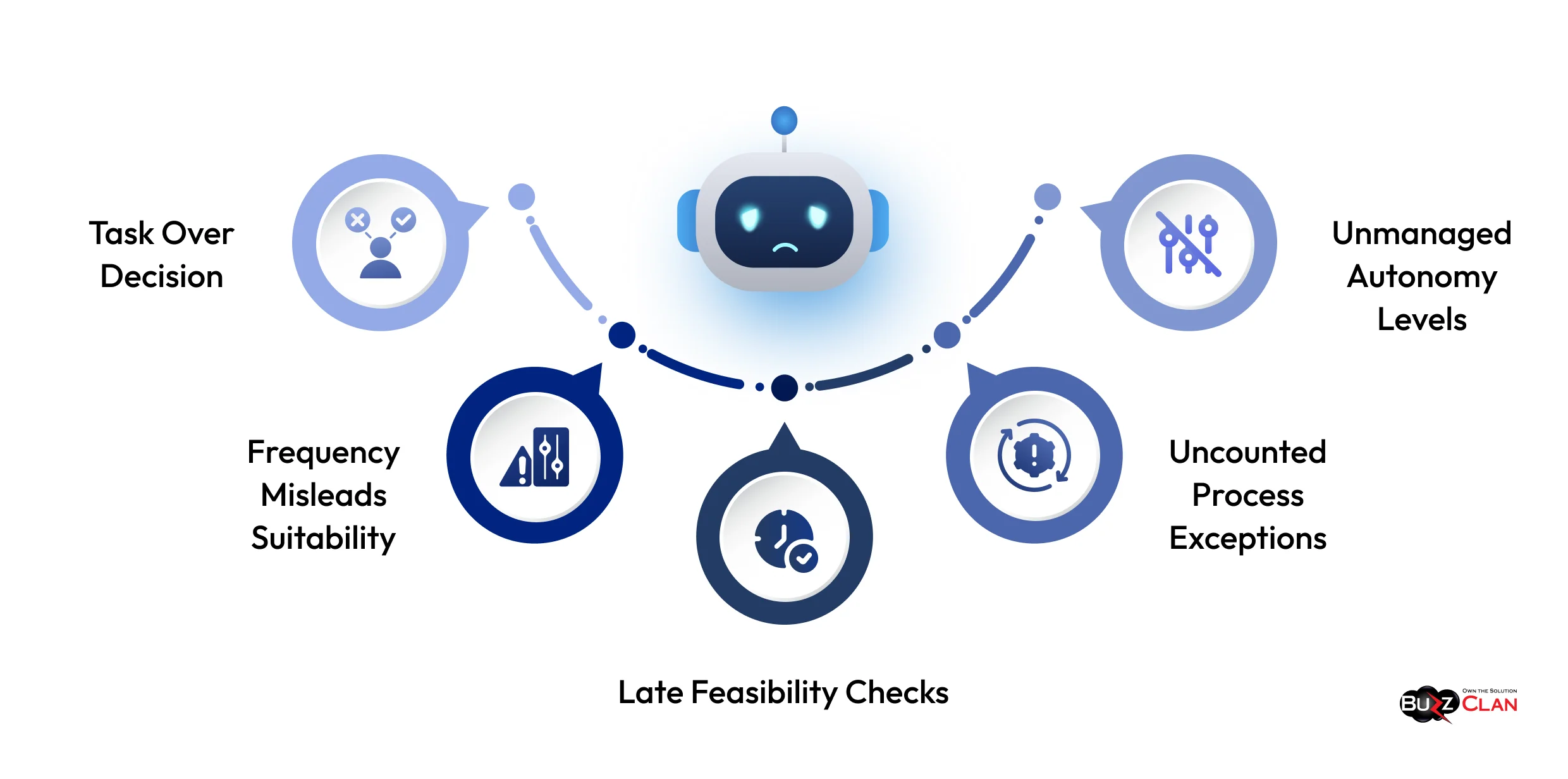
The Visible Task Gets Prioritized Over the Decision Behind It
Teams often identify activities such as entering information, updating records, or moving requests between systems because those tasks are easy to see and measure. The more valuable opportunity may sit one step earlier, where someone has to understand the information and decide what should happen to it.
Process Frequency Gets Mistaken for Agent Suitability
Volume helps establish potential business value. It does not establish the need for an AI agent. Teams also need to examine how much judgment, variability, and context the workflow contains.
Technical Feasibility Gets Evaluated Too Late
An agent may need information from a CRM, service management platform, document repository, internal database, or another enterprise system before it can act. If that information is incomplete, poorly structured, inaccessible, or protected by permissions the agent should not have, a promising use case can quickly become impractical.
Exceptions Are Treated as Edge Cases When They Are Part of the Process
A workflow may look predictable until teams examine how frequently people deviate from the documented path. Those exceptions need to be understood because they determine what the agent should handle, what should be escalated, and where human judgment still belongs.
Autonomy Becomes the Starting Point, Not a Design Decision
An agent does not need permission to complete every action independently for the workflow to create value. It can gather information, prepare a recommendation, or propose the next action while a person retains approval. The appropriate level of autonomy depends on the consequences of getting the decision wrong.
Choosing an agentic workflow therefore requires more than finding expensive manual work. Teams need to understand where judgment occurs, how much the process varies, what systems the work depends on, and how much decision-making authority an agent can safely receive.
What Makes a Workflow a Good Candidate for Agentic AI?
A good candidate usually contains work that is difficult to capture as a fixed sequence of rules, but structured enough for an agent to operate within clear boundaries.
Look for a combination of these characteristics:
People Have to Interpret Information Before They Can Act
The workflow involves reading emails, documents, tickets, reports, or other information and understanding what it means before choosing the next step. This is different from simply extracting a field and copying it somewhere else.
The Next Step Depends on Context
The process does not follow the same path every time. Different inputs, customer situations, exceptions, or intermediate results can change what needs to happen next.
Work Spans Several Systems or Tools
Employees repeatedly gather information from one system, use it to make a decision, and then take action somewhere else. An agent may be useful when it can work across those systems through controlled access to APIs, applications, databases, or other tools.
The Workflow Has a Clear Goal, Even if the Path Varies
An agent needs to know what successful completion looks like. The individual steps can change, but the expected outcome should be specific enough to evaluate.
Decisions Can Be Evaluated
Teams need a way to determine whether the agent made an acceptable decision or completed the task correctly. If nobody can define what a good outcome looks like, evaluating the agent will be difficult too.
Exceptions Occur Often Enough to Matter
A process with frequent variations may benefit from an agent that can evaluate the situation and select from permitted actions. Those exceptions still need boundaries. Situations the agent cannot safely handle should have a clear path to human review.
A workflow does not need every characteristic on this list. The strongest candidates usually combine meaningful business value with enough judgment and variability to justify an agent instead of simpler automation.
A Practical Framework for Prioritizing Agentic Workflows
Once several candidate workflows have been identified, evaluating them only by potential time or cost savings can produce the wrong priority list.
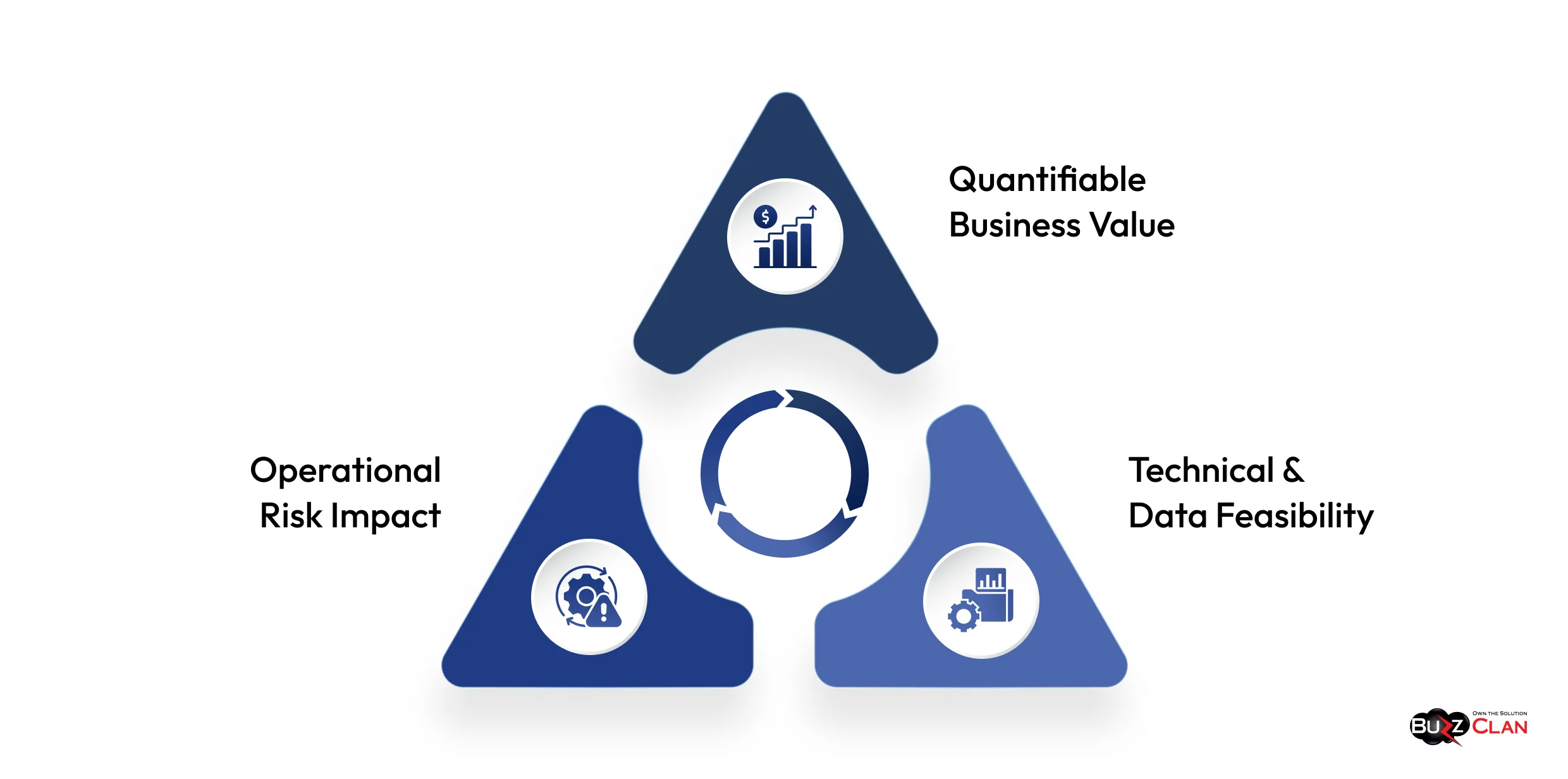
A more useful assessment looks at three things together: business value, technical feasibility, and operational risk.
Business Value
Start with the cost of the workflow as it operates today.
Consider:
- How frequently does the workflow occur?
- How much employee time does each execution require?
- Where do delays or backlogs occur?
- How much time is spent gathering information or coordinating handoffs?
- What happens to customers, employees, or operations when the process slows down?
- Would improving this workflow create a meaningful enough benefit to justify building and maintaining an agent?
This establishes whether the workflow is worth improving. It does not yet establish whether agentic AI is the right way to improve it.
Technical Feasibility
Next, examine what the agent would need to complete the work.
Map the information it needs, the systems it must access, and the actions it would need permission to perform. Check whether those systems offer reliable integration points and whether the underlying data is accurate and accessible enough to support the workflow.
Technical feasibility also includes the parts of the process that currently happen outside formal systems. If an employee relies on information buried in an inbox, an undocumented spreadsheet, or knowledge held by one experienced team member, that dependency needs to be addressed before expecting an agent to handle the workflow reliably.
Operational Risk
Finally, consider what happens when the agent gets something wrong.
An incorrect product recommendation and an incorrect financial approval do not carry the same consequences. Neither should receive the same level of autonomy.
Evaluate the potential financial, security, compliance, customer, and operational impact of an incorrect action. Also consider whether an action can be easily reversed and whether a human can review it before it affects another person or system.
The result does not have to be a simple yes or no decision. A high-value workflow with strong technical feasibility may still be worth pursuing even when the risk is high. The design may simply require tighter permissions, more approval points, or an agent that recommends actions rather than executing them independently.
Looking at all three dimensions helps teams separate valuable workflows from feasible agentic workflows, and feasible workflows from those that are ready for greater autonomy.
From Workflow Assessment to Implementation
Identifying a promising agentic workflow is only the beginning. The workflow still has to be translated into something an AI agent can execute reliably.
This means defining the agent’s role, the information it can use, the tools and systems it can access, the actions it is permitted to take, and the conditions that require escalation. Integrations need to work reliably, permissions need to reflect the agent’s responsibilities, and performance needs to be evaluated before greater autonomy is introduced.
BuzzClan’s Agentic AI Development Services can help organizations move from identifying agentic AI opportunities to designing and implementing agents around real business workflows.
The starting point should remain the workflow itself. Understand how the work happens, determine whether agentic AI is the appropriate technical approach, and define how much responsibility the agent should have. Development decisions become much clearer once those questions have been answered.
Have a workflow in mind for agentic AI?
BuzzClan can help you evaluate the use case and determine what it would take to turn it into a working AI agent.
Conclusion
The best agentic AI opportunities are not always the processes with the most manual work. They are the workflows where judgment, context, system access, and business value come together in a way that makes an agent useful.
Workflow selection deserves as much attention as agent development. Before building, understand how the work actually happens, where decisions are made, what information the agent would need, and what an incorrect action could cost.
Some workflows will turn out to be better suited to traditional automation. Others may need better data or integrations before they are ready. The strongest candidates will give you a clear reason for using an AI agent rather than simply proving that one can be used.
Getting this decision right gives everything that follows, from agent design to implementation, a much stronger foundation.
Stop Guessing Which Process to Automate First
Every business has a handful of processes that seem like obvious automation candidates, but not all of them will deliver real value. Let’s map your actual workflows and find out which ones are genuinely worth automating.
Frequently Asked Questions
Traditional RPA follows a fixed script and breaks when it encounters something unexpected. An agentic workflow can reason through exceptions, make decisions, and adjust its next step, which makes it better suited to processes with variability rather than perfectly uniform tasks.
Look for high-volume, repetitive tasks with clear inputs and outputs, existing APIs or structured data, and points where manual handoffs currently slow things down. If a process lacks reliable data or system access, it likely needs feasibility work before automation makes sense.
No. The safer approach is running the agent in observation mode first, where it operates alongside human decisions so its accuracy can be validated before it’s given real autonomy.
Governance defines clear approval gates, especially for high-stakes decisions, so an agent’s autonomy grows gradually based on demonstrated performance rather than being assumed from the start.
This depends on how many processes are being evaluated and how well they’re already documented, but process discovery and scoring can usually be completed in a few weeks. Feasibility checks and observation-mode pilots take longer, since they need real usage data to validate accuracy.
Yes. BuzzClan’s Agentic AI Development Services include a structured process audit that maps your actual workflows, scores them by potential value, and confirms technical feasibility before recommending where to begin.
Both. BuzzClan’s approach starts with process discovery and scoring before any agent gets built, since choosing the wrong process to automate undermines even the best-built agent.
Yes. A failed pilot often points to the wrong process being chosen or a feasibility gap that wasn’t caught early. BuzzClan can reassess the original workflow, identify what went wrong, and recommend a better-fit candidate process.
BuzzClan works across industries where repetitive, high-volume processes with structured data exist, including finance, healthcare, retail, and enterprise operations, tailoring each engagement to the specific systems and workflows already in place.
BuzzClan builds approval gates and observation-mode testing into every engagement from the start, so agents earn autonomy gradually based on demonstrated accuracy rather than being deployed with full independence on day one.

Get In Touch
Follow Us

Table of Contents
- What Is an Agentic Workflow?
- Agentic Workflows vs. Traditional Automation
- Where Agentic Workflow Selection Goes Wrong
- What Makes a Workflow a Good Candidate for Agentic AI?
- A Practical Framework for Prioritizing Agentic Workflows
- From Workflow Assessment to Implementation
- Conclusion
- Frequently Asked Questions