
Top 10 Generative AI Tools Enterprises Need to Know in 2026
Dhiraj Chhabra
Jan 16, 2026
Two years ago, if someone told you AI could write your content, you probably rolled your eyes.
And honestly?
You had every right to.
Early attempts at AI-generated content felt like reading instruction manuals translated through three different languages, technically accurate, maybe, but completely missing the human touch.
But something quietly changed over the last eighteen months. The tools stopped sounding like robots pretending to be people. They got better at reading the room, matching your tone, and understanding context.
More importantly, they started producing drafts you could actually work with—the kind that saved you hours instead of creating more cleanup work.
Here’s what really matters, though: enterprises figured out how to use these tools without breaking their security policies or keeping their legal teams up at night. The compliance frameworks caught up. The integration headaches got solved. The “but what about data privacy?” questions finally have real answers.
So now, in 2026, the companies deploying generative AI tools aren’t just the scrappy startups willing to take risks. They’re hospitals, banks, and enterprises with compliance officers who say “no” to everything by default.
In this blog, you’ll discover ten generative AI tools enterprises are actually using in 2026. They’re not driven by hype, but proven through security approvals, procurement checks, and measurable ROI.
What Makes a Generative AI Tool Truly Enterprise-Ready in 2026?
Most AI tools look impressive in demos. They generate responses quickly, automate tasks, analyze information, and promise to transform how teams work. But when enterprises try to deploy them at scale, real issues surface.
Your security team can’t get answers about data safety. Your compliance team finds missing paperwork. Your IT team recognizes that the tool won’t connect to your current systems. What seemed like an easy win becomes a months-long review that goes nowhere. The tools that actually work are the ones built for how businesses actually operate.
Here are the key requirements that separate tools built for enterprises from those designed for individual users:
Security That Protects Your Data
Regular AI tools handle data loosely. They save what you type on their servers. They might use your information to make their system smarter. This works fine for personal use, but it’s a major problem for companies handling sensitive information.
Enterprise artificial intelligence tools work differently. Your data stays inside your own systems, where you control it. Everything gets encrypted—both when it moves and when it’s stored. The tool connects to your existing login system, so people don’t have to remember another password. Most importantly, it tracks who viewed what information and when, making compliance checks much faster and easier.
Compliance That’s Already There
Here’s what happens often: A team finds an AI tool that solves their exact problem. They love it and want to start using it. Then the legal team checks and finds out the tool doesn’t meet GDPR rules, has no HIPAA approval, and can’t guarantee where the data lives. The project stops, and no one uses that tool.
The best generative AI tools already have these certifications ready. They let you choose which countries your data stays in. They automatically delete old information when you tell them to. These aren’t bonus features—they’re basic requirements that decide if your company can even consider using the tool.
Integration That Fits Your Workflow
Workflow disruption is one of the fastest ways for an AI initiative to fail. Tools that operate independently of core systems may show early promise, but they rarely survive in the real world. Without tight integration, adoption declines and ROI becomes hard to justify.
Good generative AI software connects with what your teams already use—your content systems, customer databases, and project tools. It works with the login system you have. It runs on your cloud infrastructure without making your IT team build new setups from scratch.
Pricing That You Can Predict
Consumer pricing seems simple at first. Maybe $20 per person looks reasonable. But multiply that by 500 employees, and you’re suddenly spending $10,000 every month before you even know if it helps.
Business pricing needs to be predictable. The best tools offer discounts when more people use them.
They let you pay upfront for a year at a better rate. They cap the maximum you’ll spend so your finance team can plan the budget. They show you exactly where money goes, which helps with cloud cost optimization and shows which teams get the most value.
Support That Actually Helps
When a personal app stops working, you just wait. When a business tool that runs important work goes down during the day, money stops coming in, customers get upset, and leadership wants answers fast.
Business agreements promise 99.9% uptime or better, and if they miss that, they pay you back. You get direct support lines with guaranteed quick responses, not ticket systems where your urgent problem waits behind hundreds of others. You get expert teams who’ve already solved these problems before.
These features aren’t extras that make adoption harder. They’re what separates tools that actually get used from expensive test projects that never grow beyond a small group.
Ready to implement generative AI the right way?
BuzzClan helps enterprises deploy AI solutions that deliver measurable results from day one. We handle security, integration, data preparation, and training so your teams can focus on using AI instead of fighting it.
Top 10 Generative AI Tools You Need to Know in 2026
The AI tools landscape has matured significantly, with platforms now offering genuine enterprise capabilities rather than just consumer features packaged for business. Here are the ten tools that organizations are actually deploying at scale.
| Tool | Primary Use Case | Best For | Key Enterprise Feature | Integration Strength |
|---|---|---|---|---|
| ChatGPT Enterprise |
|
|
|
Connects with Slack, Microsoft Teams, and custom apps. |
| Jasper |
|
|
|
Works with WordPress, HubSpot, and content calendars. |
| GitHub Copilot |
|
|
|
Built into VS Code, JetBrains, and GitHub. |
| Gemini for Workspace |
|
|
|
Native Google integration across all apps. |
| Microsoft Copilot |
|
|
|
Built into Teams, Outlook, Word, Excel, and PowerPoint. |
| Glean |
|
|
|
Connects Slack, Drive, SharePoint, Confluence, and more. |
| Synthesia |
|
|
|
Exports to LMS platforms and embeds anywhere. |
| Coveo |
|
|
|
Integrates with Salesforce, Zendesk, and knowledge bases. |
| Writesonic |
|
|
|
Connects to WordPress and social platforms. |
| Elastic AI |
|
|
|
Links with data warehouses and cloud management tools. |
These tools work in enterprise environments because they protect your data, offer predictable pricing, integrate with what you already use, and provide real support when problems happen. Your choice depends on what work needs the most help, which tools your teams already use, and what problems cost you the most time right now.
Key Challenges Enterprises Face When Scaling the Latest AI Tools
Deploying an AI tool for a small group is relatively straightforward. Scaling that same tool across hundreds or thousands of users introduces challenges that rarely appear during pilot programs.
In most cases, the technology performs as expected, but the friction arises from enterprise realities such as legacy systems, governance requirements, and established ways of working.
Data Quality and Preparation Issues
The effectiveness of generative AI is directly tied to the quality and accessibility of enterprise data. Disparate systems, inconsistent, and siloed ownership restrict the AI’s ability to generate accurate insights. Over time, unreliable outputs reduce confidence and adoption, undermining the value of the deployment.
Enterprises that delay data normalization and integration frequently encounter stalled AI programs, discovering too late that data readiness is a prerequisite—not a follow-up task.
Security and Governance at Scale
AI security challenges rarely surface during pilots but become critical at scale. As usage expands, organizations must account for human error, data sensitivity, and governance complexity. Without structured policies, AI deployments either become overly restrictive or introduce material risk—both of which undermine enterprise value.
Clear governance frameworks defining what data AI systems can access, process, and generate are fundamental to secure, sustainable deployment.
Integration With Legacy Systems
Many enterprises rely on legacy systems that were never designed to integrate with modern AI tools. These systems often store data in outdated formats and lack native connectors, requiring custom integration solutions.
Building these connections can consume significant time and resources, often more than anticipated. Without seamless integration, employees are forced to duplicate work, reducing adoption and limiting the AI’s impact on day-to-day operations.
Change Management and Adoption
Simply purchasing an AI tool doesn’t guarantee adoption. Employees need role-specific training, real-world practice, and ongoing support to integrate AI into daily workflows. Successful enterprises designate departmental champions who provide guidance, reinforce usage, and continuously improve adoption.
Cost Management and ROI
Paying for a small group of AI users may seem manageable, but scaling to hundreds can quickly become costly and unpredictable. Finance teams need clarity on total spend, savings, and departmental allocation. A strong cloud strategy sets usage limits, monitors adoption, and tracks results to ensure AI delivers measurable business value.
Performance and Reliability
AI tools that perform well in small pilots can struggle at enterprise scale, leading to slowdowns, outages, and reduced adoption. Even temporary performance issues can erode trust and impact productivity. Ensuring SOC 2 compliance and strong vendor SLAs is critical to maintain reliability and drive consistent usage.
Scaling AI successfully requires careful planning and change management—not just installing software.
BuzzClan’s Proven Approach to Scaling AI Across Organizations
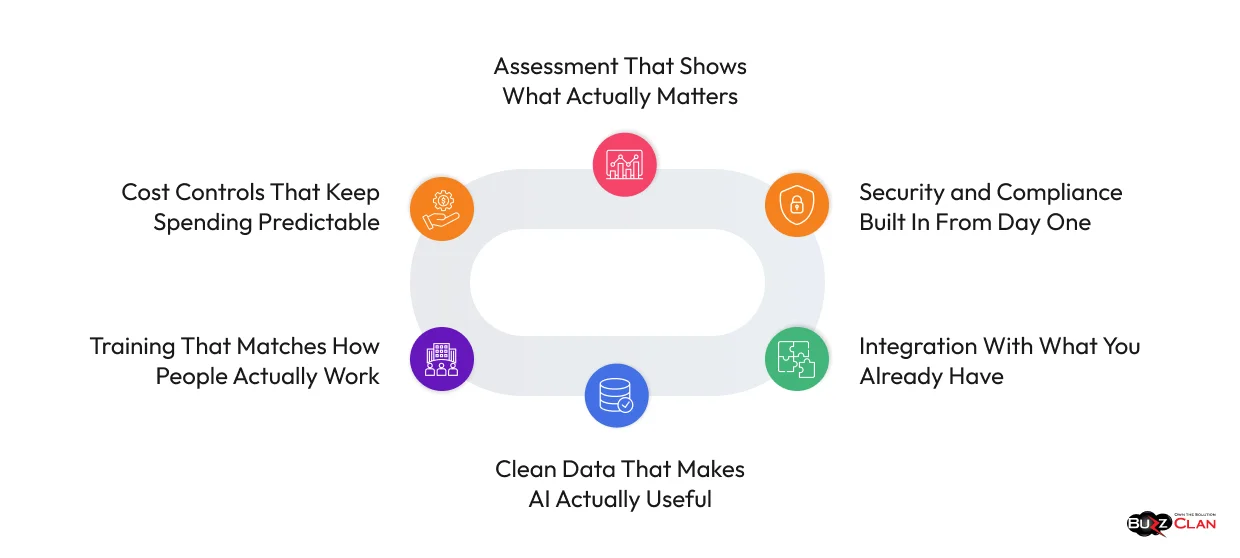
Deploying AI across an entire organization comes with real challenges—from data quality and security to workflow integration and user adoption. BuzzClan helps enterprises navigate these complexities with a structured, end-to-end approach.
Assessment That Shows What Actually Matters
We start by understanding what problems cost your company the most time and money right now. Instead of pushing you toward the newest AI tool, we look at where your teams spend hours on repetitive work, where mistakes happen most often, and which processes create the biggest bottlenecks. This assessment identifies which AI tools will deliver measurable results fast rather than sitting unused after the initial excitement wears off.
Security and Compliance Built In From Day One
AI implementation is handled with built-in security and compliance, so your legal and security teams remain fully supported. We build proper security controls from the beginning, ensuring data stays where it should and access follows your existing rules. Every AI deployment follows compliance-driven cloud networking principles, meaning we design the system to meet your regulatory requirements automatically rather than trying to add compliance later as an afterthought.
Integration With What You Already Have
We connect AI tools to your current systems, even those built 20 years ago. Our data integration tools approach means your teams don’t need to switch between different platforms or manually copy information around. The AI works inside the workflows people already use daily, which dramatically increases adoption because it helps rather than creates extra steps.
Clean Data That Makes AI Actually Useful
Before deploying any AI tool, we help fix your data quality problems. We connect data silos so the AI can see complete information, clean up inconsistencies that create unreliable results, and establish standards that keep data organized going forward. This preparation work ensures the AI gives answers people can trust, which is essential for long-term adoption.
Training That Matches How People Actually Work
Generic AI training doesn’t prepare your teams for real situations. We create role-specific training showing exactly how each department should use AI for their specific work. Customer support learns different use cases than marketing teams. Engineers get different examples than the finance staff. This targeted approach means people see immediate value for their actual job rather than theoretical possibilities that might apply someday.
Cost Controls That Keep Spending Predictable
We implement spending limits and usage tracking from the start so your finance team can predict costs accurately. Our approach follows FinOps principles, meaning we continuously optimize which teams use which tools, identify waste before it becomes expensive, and show clear ROI connecting AI usage to business results that leadership cares about.
With BuzzClan, you get clear timelines, predictable costs, and results you can measure, turning AI from an expensive experiment into a competitive advantage that delivers value every single day.
Conclusion
Two years ago, generative AI looked interesting but risky. Today, enterprises across healthcare, finance, and manufacturing use it daily to solve real problems. The shift happened because the technology matured and organizations figured out how to deploy it safely with proper security, clear compliance answers, and integration patterns that work with existing systems.
The tools handle repetitive work that eats up hours. Documentation that took three hours now takes one. Reports that required days are generated in minutes. This frees your teams for work that actually needs human judgment and creativity. But technology alone doesn’t deliver these results. You need clean data, proper security, workflow integration, role-specific training, and ongoing optimization.
The competitive advantage goes to companies that implement AI thoughtfully rather than rushing to deploy without preparation.
FAQs

Get In Touch
Follow Us