Who Needs SOC 2 Compliance? A Practical Guide for Modern Companies
Deepak Dube
Oct 24, 2025
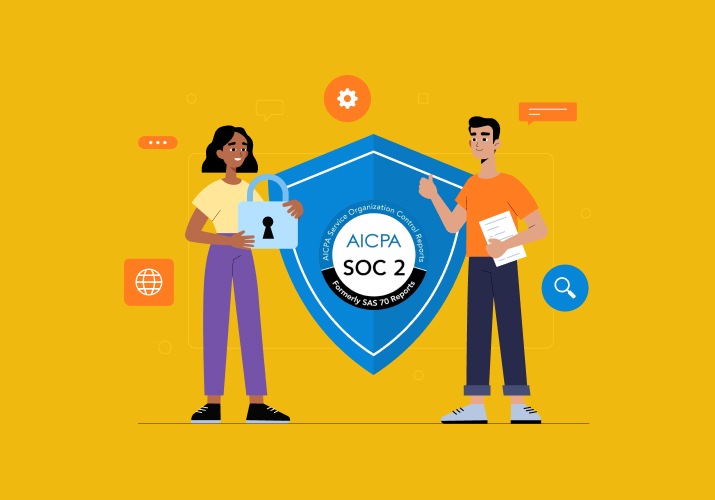
Enterprise procurement teams have fundamentally shifted their vendor selection criteria. Today, SOC 2 reports are often required to secure mid-market and enterprise deals, with many large organizations making SOC 2 compliance a prerequisite for vendor engagement to reduce third-party risks.
With data breaches now costing U.S. companies an average of $9.44 million per incident, security frameworks have evolved from regulatory checkboxes to business-critical competitive requirements.
For businesses handling sensitive customer data, particularly those in healthcare, financial services, and technology, SOC 2 compliance has emerged as the definitive security standard. SOC 2 shifts your approach from fixing breaches after the fact to preventing them entirely, and it signals to customers that you take their trust seriously.
In this blog, we’ll explore what SOC 2 compliance really means. We’ll also learn how AI-powered security controls help your organization meet SOC 2 requirements efficiently while keeping compliance sustainable.
What is SOC 2 Compliance (and Why It Matters)?
SOC 2 isn’t just paperwork. It’s an audit that proves you can protect customer data consistently over time.
As organizations began running critical operations and storing sensitive data in the cloud, customers and partners needed more than promises—they needed verifiable proof that providers could protect their information.
That’s where SOC 2 comes in. Developed by the American Institute of Certified Public Accountants (AICPA), SOC 2 is an auditing framework that evaluates how service providers manage and safeguard customer data. Unlike rigid compliance standards, SOC 2 is flexible, allowing businesses to align their controls with the Trust Services Criteria most relevant to their operations and customer expectations.
The framework centers on five “Trust Service Criteria:”
- Security (mandatory): Protects systems and data from unauthorized access
- Availability: Ensures systems remain operational and accessible when needed
- Processing Integrity: Guarantees systems function correctly and deliver accurate data
- Confidentiality: Safeguards sensitive business and client information
- Privacy: Protects personal data according to privacy regulations
Why SOC 2 Has Become Non-Negotiable
Three factors have made SOC 2 essential:
- Enterprise procurement requirements: Buyers won’t sign contracts without seeing SOC 2 reports. It’s become a qualification criterion, not a nice-to-have.
- Third-party risk management: Companies face liability for their vendors’ security failures. SOC 2 provides the independent validation they need.
- Competitive differentiation: When security capabilities are similar, SOC 2 certification breaks ties and wins deals.
Industries & Situations Where SOC 2 is Expected
SOC 2 compliance has evolved from optional to essential across multiple industries, particularly those handling sensitive data or providing critical services to other businesses.
Technology and SaaS Companies
Software-as-a-Service providers face the strongest SOC 2 expectations. Enterprise buyers often require a SOC 2 Type II report before finalizing contracts, making certification a direct revenue enabler. For cloud hosting providers, data platforms, and collaboration tools, SOC 2 proves that security and reliability aren’t just promised—they’re independently validated.
Healthcare Organizations
Healthcare companies that handle protected health information (PHI) need more than HIPAA compliance. Electronic health record providers, telemedicine platforms, and analytics firms use SOC 2 to demonstrate security practices that go beyond regulatory minimums, giving partners and patients greater confidence in how sensitive data is protected.
Financial Services
In financial services, the stakes are higher than almost anywhere else. Fintechs, payment processors, and data providers are prime targets for fraud and cybercrime, while regulators demand airtight compliance at every level. A single lapse can trigger fines, lawsuits, and lasting damage to customer trust.
SOC 2 compliance gives financial organizations the third-party validation they need to prove resilience under scrutiny. It’s not just a compliance checkbox—it’s often the deciding factor in securing partnerships with banks, credit unions, and institutional investors that demand verifiable proof of strong controls.
E-Commerce & Retail
E-commerce platforms and online retailers process huge volumes of payments and personal data, making them prime targets for breaches that can cripple both revenue and brand reputation. SOC 2 compliance reassures customers, payment processors, and retail partners that data is protected end-to-end—often a requirement before integrations or partnerships move forward.
Professional Services
Consulting firms, law practices, and accounting providers manage highly sensitive client data where confidentiality is non-negotiable. Today, enterprise clients increasingly expect SOC 2 compliance as proof that vendors can be trusted with their most critical information.
By achieving SOC 2, professional service firms don’t just check a box—they gain a competitive edge in winning RFPs, securing long-term contracts, and proving they uphold the same security standards as regulated industries.
What are the SOC 2 Reports?
SOC 2 reports come in two distinct types, each serving different business purposes and audit scopes.
SOC 2 Type I Reports
Type I reports provide a snapshot of your organization’s security controls at a specific point in time. These reports evaluate whether controls are designed appropriately, but don’t test their operational effectiveness over time. Type I audits typically take 4-8 weeks and cost less than Type II engagements.
SOC 2 Type II Reports
Type II reports examine both control design and operational effectiveness over a specified period (typically 12 months). These comprehensive audits test whether controls function consistently and effectively throughout the entire review period. Type II reports carry more weight with enterprise customers and partners because they demonstrate a sustained commitment to security practices.
Report Components Include:
- Management’s Assertion: The organization’s formal statement that it has designed and maintained adequate controls aligned with the chosen Trust Services Criteria.
- Independent Auditor’s Opinion: A CPA firm’s professional judgment on whether those controls are adequate. This third-party validation is what gives the report its credibility with customers and partners.
- System Description: An overview of the organization’s systems, processes, and controls—explaining how data flows, where responsibilities lie, and what the scope of the audit covers.
- Control Objectives & Controls: A detailed mapping that shows how specific controls address each Trust Services Criteria requirement, with explanations of how they operate in practice.
- Tests of Controls & Results: Evidence from the auditor’s testing, including methods used, results, and any exceptions found—along with their potential impact and remediation steps.
Documentation Requirements:
SOC 2 auditors require extensive evidence, including policy documents, access logs, incident reports, training records, and system configurations. Organizations must maintain continuous evidence collection throughout the audit period, not just during the formal audit engagement.
Where Traditional Security Falls Short for SOC 2
Most organizations struggle with SOC 2 because their security wasn’t designed for continuous audit requirements.
- Manual processes don’t scale: Tracking access reviews, change approvals, and incident responses manually creates gaps that auditors will find.
- Basic monitoring misses threats: Simple log collection without intelligent analysis leaves blind spots in your security posture.
- Reactive approaches fail audits: Fixing problems after they happen doesn’t meet SOC 2’s prevention requirements.
- Evidence collection nightmares: Scrambling to gather 12 months of logs and documentation during audit season creates stress and increases the risk of failure.
Struggling to gather the comprehensive audit evidence SOC 2 requires?
Discover how robust SIEM capabilities provide the continuous logging and monitoring evidence that auditors demand.
How AI-Powered Security Controls Enable SOC 2 Success?
SOC 2 compliance can be challenging because it requires continuous monitoring, evidence collection, and operational rigor across multiple security domains. Modern AI-powered security platforms address these challenges by protecting sensitive data, automating key controls, and enabling ongoing compliance with less manual effort.
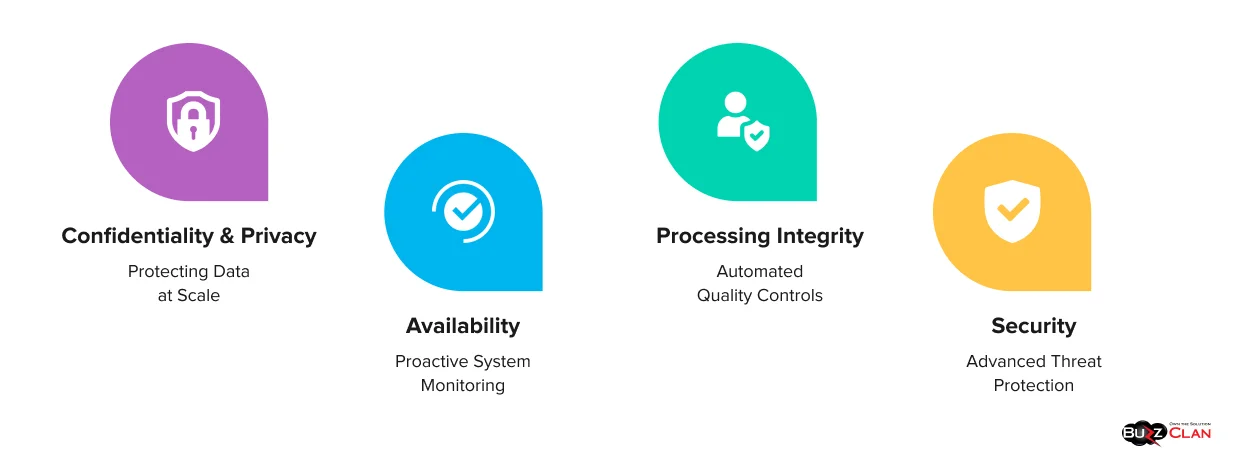
Security: Advanced Threat Protection
Protecting systems from unauthorized access is critical. AI-driven behavioral analytics and machine learning automatically detect unusual access patterns and advanced threats. Automated incident response and continuous monitoring contain risks before they impact operations, while generating detailed logs that auditors require.
Availability: Proactive System Monitoring
AI helps ensure systems remain operational and accessible. Predictive analytics anticipate outages, automated failover systems maintain continuity, and real-time monitoring tracks performance metrics, reducing downtime and supporting uninterrupted service delivery.
Processing Integrity: Automated Quality Controls
Maintaining accurate system operations is simpler with AI. Automated data validation, anomaly detection, and change management tools ensure system modifications are tracked and compliance configurations are continuously verified, reducing errors and operational risks.
Confidentiality & Privacy: Protecting Data at Scale
Safeguarding sensitive information is critical for SOC 2. AI platforms automate data classification, manage encryption keys, enforce least-privilege access, and prevent unauthorized sharing, ensuring confidentiality and compliance with privacy regulations.
The Evidence Collection Advantage
SOC 2 audits require massive amounts of evidence. Smart security platforms make this manageable:
- Centralized logging: All security events, access attempts, and system changes flow into one platform
- Automated documentation: Policies, procedures, and training records stay current without manual work
- Historical analysis: AI-powered platforms maintain detailed audit trails going back months or years
- Real-time reporting: Generate compliance reports on demand instead of scrambling during audits
How to Make SOC 2 Sustainable, Not Just Achievable
The biggest SOC 2 challenge isn’t passing the first audit. It’s maintaining compliance year after year as your business grows and changes.
AI-powered security platforms make ongoing compliance manageable:
- Adaptive controls: Security automatically adjusts as you add new systems and users
- Continuous evidence: Logs and reports are generated automatically without manual effort
- Proactive gap identification: AI identifies potential compliance issues before auditors do
- Scalable processes: Security workflows grow with your business without adding overhead
Don’t let security gaps derail your SOC 2 audit
Explore how advanced behavioral analytics strengthen control effectiveness and audit readiness.
Conclusion
In today’s data-driven world, trust is essential for business relationships. SOC 2 compliance has become a benchmark for organizations to demonstrate that they can securely manage sensitive data, mitigate risks, and maintain operational reliability.
But achieving it with traditional security approaches is expensive, time-consuming, and often unsuccessful. Modern, AI-powered security controls change the equation entirely. They provide the comprehensive monitoring, automated documentation, and proactive threat detection that make SOC 2 achievable and sustainable.
Ready to build a security foundation that supports both protection and compliance?
Connect with our security experts today and discover how proven implementation strategies accelerate your path to certification.
FAQs
Get In Touch

Table of Contents
- What is SOC 2 Compliance (and Why It Matters)?
- The framework centers on five “Trust Service Criteria:”
- Why SOC 2 Has Become Non-Negotiable
- Industries & Situations Where SOC 2 is Expected
- What are the SOC 2 Reports?
- Where Traditional Security Falls Short for SOC 2
- How AI-Powered Security Controls Enable SOC 2 Success?
- The Evidence Collection Advantage
- How to Make SOC 2 Sustainable, Not Just Achievable
- Conclusion
- FAQs