How Zero-Trust Data Security Prevents Costly Data Breaches in Enterprises
Priya Patel
Jul 8, 2026
For decades, enterprise security relied on a simple assumption. The network could be trusted. Threats came from outside.
That model worked when users, applications, and data mostly lived inside company-controlled environments.
Then cloud adoption expanded. SaaS became standard. Remote work became permanent.
The traditional security perimeter did not disappear overnight, but it stopped reflecting how enterprises actually operate.
Today, employees connect from unmanaged networks. Critical workloads run across multiple clouds. Applications exchange data outside traditional boundaries. Yet many environments still grant broad trust after a successful login.
This gap creates a real security risk. Stolen credentials, compromised accounts, insider threats, and lateral movement can turn a single entry point into a costly data breach.
Zero-trust data security addresses this reality directly. It removes implicit trust from the access model. Every request is verified. Every session is continuously evaluated. Access decisions depend on identity, behavior, device posture, and real-time context.
This guide explores how zero-trust data security helps enterprises reduce breach risk, limit unauthorized access, and protect sensitive data in modern environments.
Why Enterprises Are Investing in Zero Trust Data Security Solutions
The average cost of a data breach reached $4.88 million in 2024 before settling at $4.44 million in 2025, with U.S. organizations averaging $10.22 million per incident. Most enterprises are not losing data because attackers cracked the perimeter. They’re losing it because someone already inside had too much access and nobody noticed in time.
Here is what is driving investment in zero-trust data security solutions right now:
- Perimeter security has structural gaps: Cloud workloads, SaaS applications, and remote endpoints all live outside the traditional boundary. Legacy security tools were never built for environments where the perimeter doesn’t exist.
- Credential-based attacks dominate breach reports: Stolen or misused credentials are the top initial attack vector. Traditional security verifies identity once at login. Zero trust verifies it continuously throughout the session.
- Insider threats are undercounted: Insiders, both malicious and negligent, are behind a significant share of enterprise breaches, and they are the hardest to catch when your security model treats internal access as automatically safe.
- Regulatory pressure is intensifying: GDPR fines can reach 4% of global annual turnover. SEC disclosure rules now require material breach reporting within four business days. Compliance frameworks across every major regulated industry increasingly expect demonstrable access controls and audit trails.
- Breach costs drop significantly with zero trust: Enterprises with mature zero trust programs consistently report lower per-incident costs, faster detection times, and smaller blast radii when incidents do occur.
- The move to hybrid and multi-cloud has created visibility gaps: Security teams often lack a unified view across cloud, on-premise, and SaaS environments. Zero trust provides a consistent policy layer that spans all of them.
What Is Zero Trust Data Security and How Does It Work in Enterprise Environments?
Zero-trust data security is a security model built on one core principle: never trust by default, always verify access. It doesn’t matter if a user is connecting from inside the corporate office or from a coffee shop halfway across the world. Every access request goes through the same verification process.
In simple terms, the zero-trust security model answers three questions before granting access:
- Who is requesting access? Verified through strong identity checks, multi-factor authentication, and behavioral signals
- What are they trying to access? Evaluated against least-privilege policies that give users only what they need, nothing more
- Is the context safe right now? Analyzed using device health, location, time of request, and risk signals in real time
What makes this different from traditional access control is that verification is continuous, not just one-time at login. A session that starts clean can be reassessed mid-stream if something changes, like a device suddenly behaving differently or a user requesting data they’ve never touched before.
For enterprise environments specifically, zero trust data protection addresses three failure modes that perimeter security cannot: compromised credentials being used freely, lateral movement after a breach, and third-party access that no one is watching closely. These are the three most common pathways in modern attacks, and zero trust is designed to block all of them.
Benefits of Zero Trust Data Security
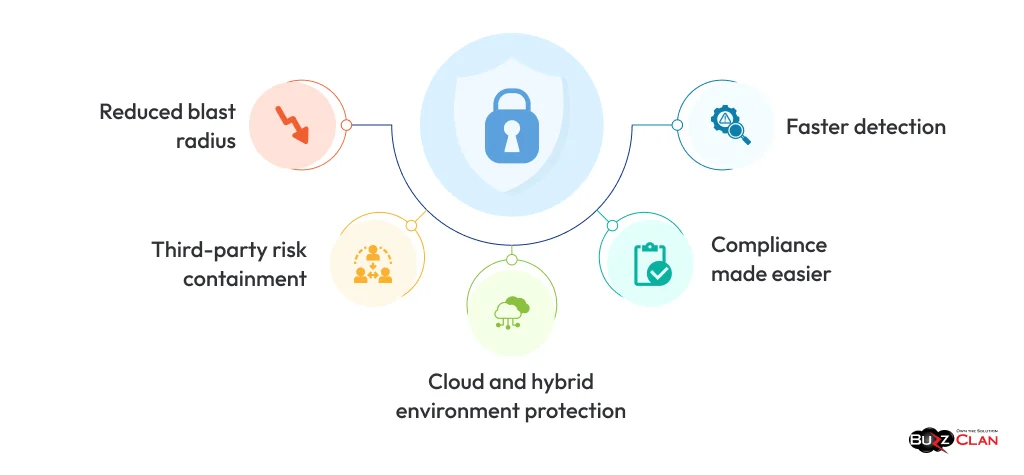
The case for zero trust isn’t just theoretical. Enterprises that implement it see real, measurable changes in how they detect threats, how quickly they respond, and how much damage any single incident can actually cause.
- Reduced blast radius: When access is micro-segmented, a compromised account cannot roam freely. The attacker is confined to a small slice of the environment rather than having keys to the entire building.
- Faster detection: Continuous verification creates continuous visibility. Anomalies surface faster because every request is being evaluated, not just flagged after someone notices something looks off.
- Compliance made easier: Zero trust naturally produces the audit trails, access logs, and policy documentation that regulators require. SOC 2 compliance, HIPAA, GDPR, and other frameworks align well with zero trust principles because both require demonstrating who accessed what, when, and why.
- Cloud and hybrid environment protection: As organizations move workloads to the cloud and adopt hybrid cloud environments, perimeter security becomes structurally inadequate. Zero trust scales across cloud, on-premise, and hybrid infrastructure without requiring the environment to fit a fixed boundary.
- Third-party risk containment: Vendors, contractors, and partners often have access to enterprise systems. Zero trust scopes that access tightly and revokes it automatically when no longer needed, removing one of the most consistently overlooked attack surfaces in enterprise environments.
Key Business Risks of Data Breaches That Drive Zero Trust Adoption
Understanding what’s actually at stake helps put the investment in context. Data breaches carry three distinct categories of cost, and enterprises that look only at immediate remediation expenses consistently underestimate the real exposure.
- Financial losses: Direct costs include incident response, forensic investigation, customer notification, credit monitoring for affected individuals, and legal fees. For enterprises in regulated industries, these costs arrive fast and compound quickly. The cost of enterprise data breach management has grown steadily, driven in part by regulatory penalties that now scale with the number of records exposed and the speed of disclosure.
- Regulatory fines and legal exposure: Under GDPR, a single breach can result in fines of up to 4% of global annual turnover. In the U.S., HIPAA violations carry fines up to $1.9 million per violation category per year. Financial institutions face additional scrutiny under SEC disclosure rules that require prompt public reporting of material cybersecurity incidents. Data breach risk management solutions that can demonstrate access controls and audit trails are now a compliance requirement, not just a best practice.
- Reputational damage: This is the hardest cost to calculate and often the most lasting. Enterprise buyers do their due diligence. A publicly disclosed breach affects vendor evaluations, partner relationships, and customer retention for years. The damage is especially acute in healthcare, financial services, and any sector where clients are trusting the organization with sensitive personal data.
Core Components of a Zero Trust Data Security Framework
A zero-trust framework is not a single product. It is a set of integrated capabilities that work together to ensure no implicit trust exists anywhere in the environment. Understanding what those components actually do in practice helps avoid the common mistake of purchasing a zero-trust solution that only addresses one layer.
Identity and Access Management
Identity is the foundation of zero trust. The zero-trust security architecture starts here: every user, service account, and machine identity must be verified before access is granted.
Modern authentication and authorization frameworks require multi-factor authentication as a minimum, but mature zero-trust programs go further. They implement Privileged Access Management (PAM) for high-risk accounts, continuous behavioral analysis that flags deviations from established patterns, and automatic session termination when risk thresholds are exceeded.
BuzzClan demonstrated this in practice by helping a large enterprise with over 10,000 employees implement a role-based Birthright Matrix that automated access provisioning and reduced provisioning time from 7 days to 1 day. The system used Azure AD and Power Automate to standardize permissions across departments and create audit-ready workflows, exactly the kind of access governance that zero-trust identity management requires.
Endpoint Security and Device Trust
In a zero-trust data center, the device is as important as the user. A verified user on a compromised device is still a threat. Zero trust requires every device to pass health checks before it can access corporate resources.
This means endpoint detection and response (EDR) tools are running continuously, device compliance is checked at the point of every access request, and non-compliant devices are either blocked or routed to restricted environments. For enterprises managing bring-your-own-device (BYOD) policies or large remote workforces, this layer closes a gap that identity-only controls cannot.
Data Encryption and Monitoring
Zero trust data protection requires that data is encrypted in transit and at rest, with encryption keys managed separately from the data itself. This ensures that even if an attacker gains access to storage, they cannot read what they find.
Monitoring in a zero-trust environment goes beyond network logs. It tracks who accessed what data, how much was transferred, and whether access patterns match the user’s historical behavior.
User and entity behavior analytics (UEBA) tools sit at this layer, providing the signal needed to catch insider threats and compromised accounts that are behaving abnormally but haven’t triggered a rule-based alert.
Network Segmentation and Micro-Segmentation
Traditional networks are flat. Once inside, lateral movement is easy. Zero-trust network access applies micro-segmentation to break the network into isolated zones. Each zone has its own access policy, and movement between zones requires verification, not just being inside the network.
This is where zero trust directly limits breach impact. Cybersecurity threats like ransomware spread by moving laterally through connected systems. Micro-segmentation contains that movement, turning what would have been a full-network compromise into a limited, recoverable incident.
Implementing Zero Trust Data Security: Step-by-Step

Zero-trust implementation is a phased process. Trying to do everything at once is one of the most common reasons projects stall. Here is the approach that works in enterprise environments.
Step 1: Assess your current security posture
Start by mapping what you have. Every user, every device, every application, and every data asset needs to be inventoried. You cannot protect what you cannot see. This assessment should also identify your highest-risk areas, where the most sensitive data lives, who has access to it, and whether that access is appropriate.
Step 2: Define protected surfaces
Rather than trying to secure everything simultaneously, identify your most critical data, applications, and services. Zero trust implementation starts by building strong controls around these protected surfaces first, then expanding outward.
Step 3: Deploy identity and access controls
This is where most organizations start seeing immediate results. Implementing MFA, tightening privileged access, and reviewing access permissions against least-privilege principles closes the most commonly exploited gaps before deeper infrastructure changes are complete.
Step 4: Implement network micro-segmentation
Once identity controls are in place, segment the network so that access between zones requires explicit permission. This step is often where DevSecOps teams become essential, integrating security controls into the infrastructure deployment process rather than applying them after the fact.
Step 5: Deploy monitoring and analytics
Zero trust is not a set-and-forget architecture. Continuous visibility is built into the model. Deploy < a href=”/cyber-security/security-information-and-event-management/”>security information and event management (SIEM) and SOAR tools to aggregate signals across the environment and automate responses to high-confidence threats.
Step 6: Expand and mature
Roll the model out progressively across remaining systems, third-party access points, and cloud workloads. NIST’s finalized guidance SP 1800-35, released June 2025, offers 19 real-world implementation examples developed with 24 industry collaborators, giving enterprises validated starting points for each phase.
Ready to assess your security posture?
BuzzClan helps enterprises identify gaps, design zero-trust architectures, and implement controls that actually work in complex environments.
How Zero Trust Works to Protect Enterprise Data
Zero trust is not just a network concept. It applies across cloud workloads, hybrid environments, remote workforces, and third-party access points, all of which represent real exposure in enterprise environments today.
- Cloud and hybrid environments: In a cloud security context, zero trust means that cloud workloads do not automatically trust each other just because they are in the same account or VPC. Every service-to-service call is authenticated and authorized. This is especially important in microservices architectures where hundreds of services communicate continuously, and any one of them could become an entry point if not properly controlled.
- Remote and hybrid workforces: Zero-trust network access replaces the traditional VPN model by granting access to specific applications rather than broad network access. A remote worker gets access to exactly what their role requires, from whatever device they are using, with continuous verification running throughout the session.
- Insider threats: Insider threats account for a significant percentage of enterprise breaches, and they are the hardest to detect with traditional controls because the user is already trusted. Zero trust behavioral monitoring catches anomalies, like an employee accessing a dataset they’ve never touched, downloading an unusual volume of files, or logging in at an unusual time from an unusual location, and flags them before damage is done.
- Third-party and supply chain access: Vendors and contractors are one of the most consistent breach vectors in enterprise environments. Zero trust applies the same verification requirements to external parties as it does to internal users, with additional scoping that limits them to exactly what they need and nothing more.
Data governance frameworks that define data ownership and access rights integrate naturally here.
Zero-Trust Data Security vs Traditional Security Models
The distinction matters because many enterprises believe they have strong security when they have strong perimeter security. These are not the same thing.
| Dimension | Traditional Security | Zero Trust Data Security |
|---|---|---|
| Trust model | Implicit trust inside the network | No implicit trust, continuous verification |
| Access control | Broad access once authenticated | Least-privilege, session-level control |
| Lateral movement | Largely unrestricted | Blocked by micro-segmentation |
| Remote access | VPN with broad network access | Application-specific access, verified per session |
| Insider threats | Difficult to detect with rule-based tools | Behavioral analytics catches anomalies in real time |
| Cloud compatibility | Designed for on-premise perimeters | Natively compatible with cloud and hybrid environments |
| Breach impact | High, due to free movement after compromise | Limited to the micro-segment that the attacker reaches |
| Compliance posture | Manual audit processes | Continuous logs and access records built in |
The core problem with traditional security is that it was built for a threat model that no longer exists. It assumes internal traffic is safe, that users can be trusted once verified, and that the perimeter is meaningful. None of those assumptions holds in 2026.
Zero trust doesn’t just patch those assumptions. It removes them entirely and replaces them with a model that works regardless of where users, data, and workloads happen to be.
How BuzzClan Helps CIOs Implement Zero Trust Data Management
Zero trust implementation is an architectural transformation, not a procurement decision. It spans identity, network, data, and endpoint layers, and getting it right requires both technical depth and the experience to navigate a large, heterogeneous enterprise environment.
BuzzClan works with CIOs and security leaders to build zero-trust programs that match real environments, not templated frameworks. The engagement starts with a security posture assessment that maps current infrastructure, identifies the gaps that create the most exposure, and defines a phased roadmap that doesn’t require replacing everything at once.
Three things define BuzzClan’s approach:
- Customization: Architecture is designed around your actual systems, not generic frameworks that need expensive adaptation.
- Compliance expertise: SOC 2, HIPAA, GDPR, and sector-specific regulations are built into the design from day one, not retrofitted after deployment.
- Scalability: The architecture grows with your environment, accommodating new cloud workloads, workforce changes, and evolving threat conditions without requiring a rebuild.
Protecting enterprise data starts with one conversation.
Connect with BuzzClan’s cybersecurity team to discuss your current security posture and where zero trust fits in your environment.
Key Features to Look for When Buying Zero Trust Security Solutions
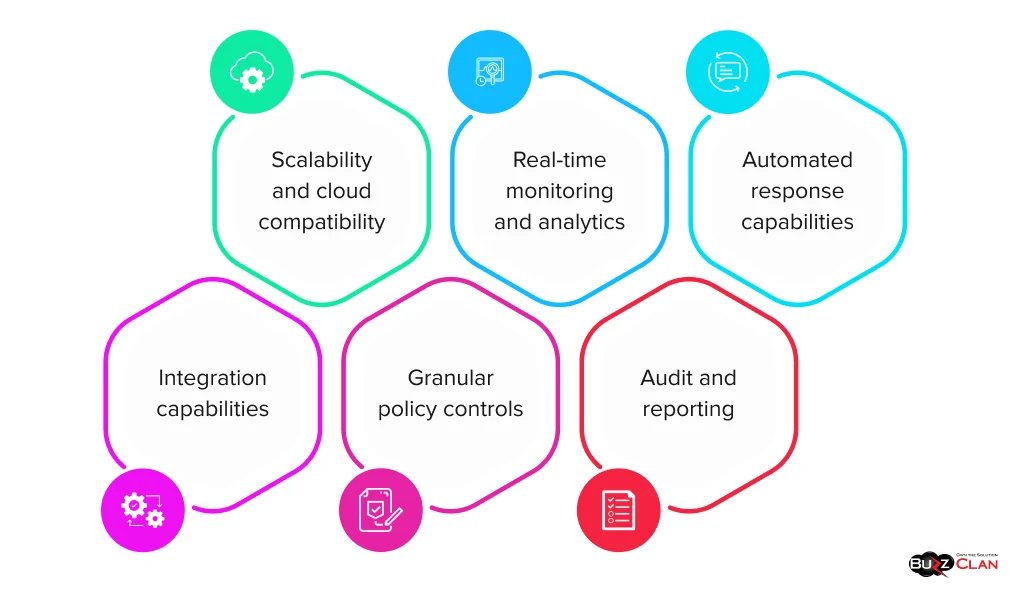
The market for zero-trust solutions is crowded, and vendors use the term loosely. These are the capabilities that actually matter when evaluating whether a solution delivers genuine zero trust protection.
- Scalability and cloud compatibility: A zero-trust platform needs to function across your entire environment, including on-premise infrastructure, public cloud, and hybrid cloud deployments. Solutions that only work in one environment create gaps that attackers will find.
- Real-time monitoring and analytics: Zero trust is active security. Behavioral analytics, continuous session monitoring, and automated alerting are non-negotiable. Without them, you have access controls but no visibility into whether those controls are being abused.
- Integration capabilities: Zero trust doesn’t replace your existing stack. It integrates with it. Look for solutions that connect with your existing identity providers, SIEM platforms, cloud governance tooling, and endpoint management systems. Loose integration means blind spots.
- Granular policy controls: The ability to define access at the application, data, and even record level, not just the network segment level, separates enterprise-grade zero trust from basic access management. Data governance requirements increasingly demand this level of control.
- Automated response capabilities: When a high-confidence threat signal appears, the system should be able to act, whether that means revoking a session, quarantining a device, or isolating a network segment, without waiting for a human to respond. SIEM vs SOAR capabilities integrated with zero trust enforcement close the gap between detection and containment.
- Audit and reporting: For compliance purposes, every access decision needs to be logged, attributable, and retrievable. Solutions that provide clean, auditable records across all access events make regulatory reporting substantially easier and reduce the risk of compliance failures during an audit.
Conclusion
Security failures don’t announce themselves. They happen quietly, through access that was never questioned, movement that was never monitored, and trust that was never earned.
Zero trust fixes the assumption problem. Not with more tools layered on top of a broken model, but by changing the model itself. Verify every request. Limit every session. Watch everything, always.
That’s not complexity. That’s how security should have worked all along. The enterprises that understand this aren’t just better protected. They’re building the kind of infrastructure that earns trust from customers, regulators, and partners in a world where that trust is genuinely hard to keep.
Frequently Asked Questions
The five pillars are identity (who is accessing), devices (the health of the endpoint making the request), networks (the path the request travels), applications (what is being accessed), and data (what information is ultimately at stake). Each pillar has its own verification and monitoring requirements, and zero trust requires controls across all five rather than treating any as implicitly safe.
Zero trust limits breach impact by removing lateral movement, enforcing least-privilege access, and monitoring continuously for behavioral anomalies. Even if an attacker compromises credentials, they can only reach what that account is authorized to access, and unusual behavior triggers alerts before significant data can be exfiltrated. Organizations with mature zero trust programs consistently report lower per-incident costs and faster detection times.
The most common challenges are legacy system compatibility, the complexity of building a complete identity inventory, and organizational resistance to re-authentication requirements. The practical solution is phased implementation. Start with the highest-risk surfaces, build quick wins that demonstrate value, and treat zero trust as an architecture to evolve toward rather than a switch to flip. Partnering with specialists who have done this in complex enterprise environments significantly reduces the time and mistakes involved.
Financial services, healthcare, government, and energy/utilities see the most direct benefit because they combine high-value data targets with strict regulatory requirements. Healthcare organizations managing patient records under HIPAA, financial institutions facing SEC disclosure rules, and federal agencies with CMMC requirements all find that zero trust architecture aligns naturally with their compliance obligations while improving actual security outcomes.
BuzzClan starts with a security posture assessment to map your current environment and identify gaps, then designs a phased zero trust implementation roadmap that works within your existing technology stack. Implementation covers identity and access governance, network segmentation, endpoint controls, monitoring, and compliance reporting. BuzzClan’s work with a global financial institution reduced security incidents by 70% and improved threat response times by 90%, with compliance built into the architecture from the start, not added after deployment.

Get In Touch
Follow Us

Table of Contents
- Why Enterprises Are Investing in Zero Trust Data Security Solutions
- What Is Zero Trust Data Security and How Does It Work in Enterprise Environments?
- Benefits of Zero Trust Data Security
- Key Business Risks of Data Breaches That Drive Zero Trust Adoption
- Core Components of a Zero Trust Data Security Framework
- Implementing Zero Trust Data Security: Step-by-Step
- How Zero Trust Works to Protect Enterprise Data
- Zero-Trust Data Security vs Traditional Security Models
- How BuzzClan Helps CIOs Implement Zero Trust Data Management
- Key Features to Look for When Buying Zero Trust Security Solutions
- Conclusion
- Frequently Asked Questions