
Compliance in Cloud Computing: A Complete Guide for Businesses
Gururaj Singh
Jan 6, 2026

Cloud compliance breaks faster than most teams expect. You can pass an audit in January and still fall out of compliance by March. This can happen without a single security incident.
Why does this happen? Because cloud environments change constantly.
New resources get deployed. Third-party tools are connected. Sensitive data ends up in the wrong region or logging is no longer set up correctly.
This happens because compliance was designed for static data centers. Cloud environments change every day. Infrastructure is rebuilt through automation, and configurations shift constantly.
Governance teams often review changes long after they are already live. By the time issues appear in an audit, compliance drift may have been happening for months.
The shared responsibility model adds another layer of complexity. Cloud providers secure the underlying platform. Your teams still own access controls, encryption, and monitoring.
They are also responsible for meeting standards like HIPAA, PCI DSS, and GDPR. Small configuration changes made for speed can slowly weaken compliance.
Relying on annual audits or periodic reviews no longer works at cloud speed. Compliance in cloud computing must keep up with engineering teams. It needs to catch issues early and continuously.
This guide breaks down what cloud compliance requires today, the challenges teams face, and how to stay compliant as your cloud environment grows.
Cloud Compliance Explained
Cloud compliance means ensuring everything in the cloud follows regulatory and internal rules—and being able to prove it at any time.
Unlike traditional data centers, cloud environments change constantly. New servers, databases, and services can appear or disappear in minutes, often through automation. This makes periodic compliance checks ineffective.
Evidence must evolve just as quickly. Mature teams log every control decision, from access approvals to deployment templates, so audits are always defensible.
Under the shared responsibility model, cloud providers secure the platform itself. Your teams are responsible for identities, encryption, and data location.
Strong cloud compliance depends on clear control, ownership, and repeatable enforcement. Cloud compliance software turns regulations into technical guardrails, while security tools continuously compare live configurations against those rules.
Leading teams also prioritize risks by business impact and tag resources by data sensitivity. This allows stricter controls to apply automatically to high-risk workloads without slowing everything else down.
Biggest Cloud Compliance Challenges Businesses Face Today
Enterprises are not struggling with a lack of cloud security features; they are struggling with the hidden operational traps that turn a compliant design into a non‑compliant reality over time.
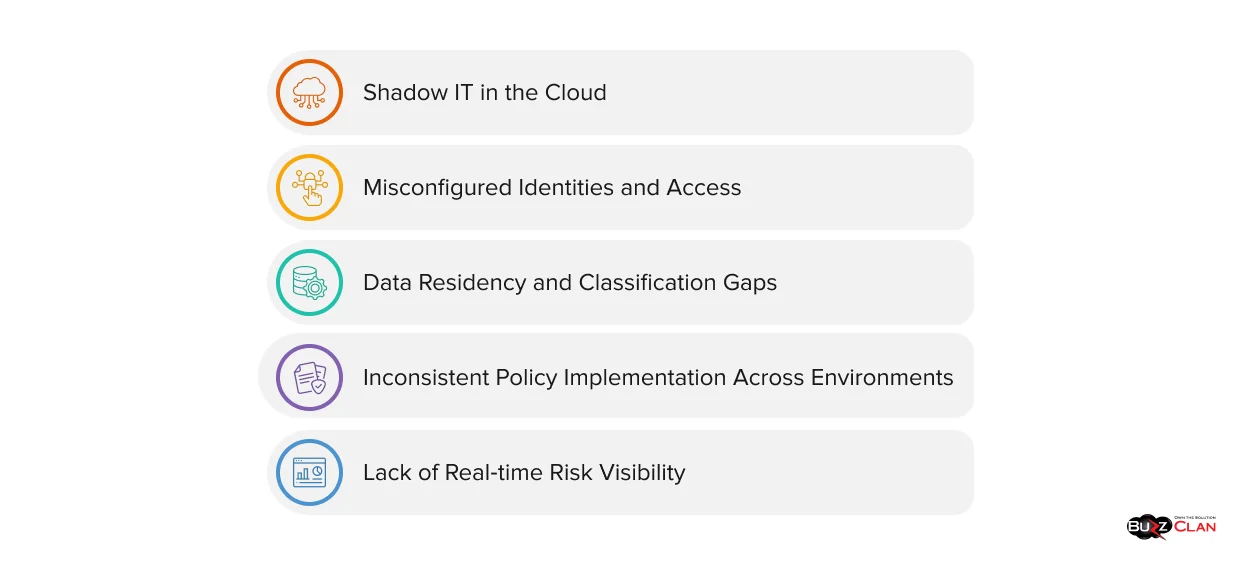
Shadow IT in the Cloud
Business teams can adopt new SaaS tools or launch cloud services in minutes, often outside formal approval workflows. Sensitive data then ends up in unmanaged systems where standard security controls and governance do not apply. These blind spots are difficult to detect during audits and even harder to govern centrally.
Misconfigured Identities and Access
Overly permissive IAM roles, shared admin accounts, and unused service principals remain common causes of cloud incidents. Access is granted quickly to keep projects moving, but it is rarely reviewed later. This breaks least-privilege principles and weakens compliance for high-risk workloads such as healthcare or financial data.
Data Residency and Classification Gaps
Cloud platforms make it easy to replicate data across regions for performance and resilience. Many organizations, however, lack a reliable way to tag and classify data by sensitivity and regulatory scope. Without this foundation, it becomes difficult to prove that regulated workloads stay in approved regions or that analytics environments do not mix regulated and non-regulated data.
Inconsistent Policy Implementation Across Environments
Enterprises often manage dozens of accounts and multiple providers, each with its own network patterns and guardrails. When the cloud computing security policy is interpreted differently by each team, controls drift quickly, and enforcement becomes inconsistent, especially in hybrid and multi‑cloud strategy setups, where shared standards are hard to enforce.
Lack of Real‑time Risk Visibility
Many organizations know their policies on paper, but struggle to answer a simple question: which issues matter most right now? Without continuous cloud security risk assessment that ranks gaps by business impact and regulatory requirement, teams either chase low-value alerts or delay remediation entirely.
Key Cloud Compliance Standards Every Business Must Know
Cloud teams do not need to know every regulation in the world, but they do need a clear map of which standards matter for their data, their industry, and their customers. The most resilient programs pick a small set of anchor frameworks, align architecture to those requirements, and then reuse the same evidence across multiple audits rather than reinventing controls each time.
ISO 27001 and SOC 2 as the Baseline
ISO 27001 and SOC 2 effectively define the minimum bar for how information security should be governed in the cloud, from access control to logging and incident response. Most major cloud providers already certify their platforms against these frameworks, which means internal teams can focus on how their own identities, workloads, and data flows inherit and extend those controls rather than rebuilding everything from scratch.
HIPAA, HITRUST, and Healthcare Workloads
For healthcare organizations and partners that handle protected health information, HIPAA and often HITRUST set expectations for encryption, access control, audit logging, and breach notification. The challenge is less about turning on basic cloud security controls and more about proving that every workload touching PHI follows the same pattern, which is where tagging, standardized deployment templates, and a strong cloud governance framework become essential.
PCI DSS for Payment Data
Any environment that processes or stores cardholder data must align with PCI DSS, which is far more prescriptive than general security frameworks. In practice, many organizations reduce scope by isolating payment workloads into tightly controlled segments, using hardened deployment patterns, and integrating continuous cloud security risk assessment so that drift inside the PCI zone is detected and corrected before it impacts audits.
GDPR, DPDP, and Global Privacy Laws
Regulations such as GDPR in Europe and India’s DPDP Act focus heavily on how personal data is collected, stored, moved, and deleted. For cloud teams, that translates into strict control over data residency, lifecycle management, and consent-driven processing, especially in analytics platforms and cloud‑based BI environments that combine data from multiple regions.
Industry and Customer-Specific Requirements
Beyond formal regulations, many enterprises now inherit requirements from customer contracts, security questionnaires, and sector guidelines such as FINRA or NIST 800‑53. The most efficient approach is to map those obligations back to a small control library, use cloud compliance software to link each control to specific checks, and then surface that evidence consistently, whether the conversation is about SOC 2, a major client RFP, or a digital infrastructure review tied to a new cloud deployment model.
Where Businesses Go Wrong
Most cloud programs fail not because teams do not care about compliance, but because everyday decisions slowly pull real-world configurations away from what the policy describes.
Treating Compliance as a Project and Not a Practice
Many organizations run a big remediation push before an audit, close issues, update documentation, and then move on until the next cycle. This start–stop pattern ignores how frequently cloud environments change, so controls that looked solid during assessment quietly drift as teams ship new features and spin up new services.
Trusting Provider Assurances Without Translation
Cloud vendors showcase certifications and strong platform security, and leadership assumes workloads are therefore compliant. The missing step is translating those capabilities into a concrete cloud computing security policy that defines how identities, networks, data residency, and logging must be configured for each type of workload.
Writing Policies that Do Not Match How Engineers Work
Many enterprises create long policy documents that live in shared drives while engineers keep deploying from CI pipelines with their own templates and shortcuts. When controls are not embedded into reusable patterns and automation, the gap between “policy on paper” and “reality in production” widens with every release.
Buying Tools Without Fixing Ownership and Scope
It is common to invest in new dashboards and cloud compliance tools and expect them to close gaps automatically. Without clear ownership for each control domain, defined SLAs for remediation, and agreement on which environments are in scope, alerts pile up and real risk remains unchanged despite the new technology.
Neglecting Non‑Production and Temporary Environments
Sandboxes, staging accounts, and “short‑lived” test environments are often treated as low risk, yet they frequently hold copied production data and relaxed access controls. Over time, configuration drift in these spaces introduces exceptions that bypass standard cloud security controls, creating easy entry points for attackers and persistent pockets of non‑compliance.
How BuzzClan Helps You Stay Compliant and Audit‑Ready
Compliance‑First Cloud Architecture
BuzzClan designs landing zones and cloud governance framework guardrails so every account, region, and workload follows the same security and compliance blueprint from day one.
Policy Embedded into Engineering Workflows
Reference templates, Terraform patterns, and automated checks ensure cloud security best practices and compliance in cloud computing are enforced inside CI and deployment pipelines, not just in documents.
Continuous Visibility and Audit‑Ready Evidence
Centralized logging and configuration histories give security and risk teams a single view of control status, making it easier to answer regulator or customer questions without last‑minute evidence gathering.
Compliance‑Aware Optimization and Scaling
Initiatives like cloud cost optimization and broader digital infrastructure modernization run on top of a platform that already respects data residency, encryption, and access requirements, so growth does not introduce new blind spots.
Turn cloud compliance from a constant fire drill into a built‑in strength for every application you deploy.
Explore BuzzClan’s enterprise‑ready cloud computing solutions and see how a
compliance‑first architecture can support your next phase of growth.
Future of Cloud Compliance
Cloud compliance is moving from periodic review to continuous assurance, where controls are checked in near real time, and evidence is generated automatically as systems run. Instead of static point‑in‑time reports, regulators and customers increasingly expect ongoing visibility into how access, encryption, and data flows are managed across the entire cloud estate.
Over the next few years, compliance will lean heavily on automation, with policy‑as‑code engines validating every infrastructure change and intelligent monitoring detecting risky behavior before it becomes a violation. Organizations will be able to prove trust on demand while still moving quickly, turning compliance into a competitive advantage rather than a speed bump.
The Bottom Line
Cloud compliance is no longer a one-time task or an annual audit exercise. In modern cloud environments, it must operate continuously and move at the same pace as engineering and regulatory change.
Organizations that treat compliance as a project tend to react late. They discover gaps during audits, delay launches, and spend time fixing issues after they cause disruption. In contrast, teams that build compliance into daily operations reduce surprises and gain more control over risk.
The most effective approach is to embed governance directly into how the cloud is designed and operated. This includes using policy-as-code, validating configurations continuously, and assigning clear ownership for each control area. When compliance is part of deployment pipelines and cloud architecture decisions, new workloads start compliant instead of being corrected later at a higher cost.
Treating cloud compliance as a continuous capability delivers practical benefits. It protects sensitive data, reduces audit fatigue, and gives teams the confidence to move faster. Most importantly, it creates a trustworthy foundation for analytics, cloud-based BI, and broader digital transformation initiatives that depend on secure and well-governed cloud environments.
Finding cloud compliance hard to keep up with? Talk to Us!
BuzzClan helps teams assess cloud risks, implement practical compliance controls, and build governance that scales without slowing delivery. For questions or to connect with our cloud compliance experts, contact us at info@buzzclan.com.
FAQs

Get In Touch
Follow Us