Cloud Security Posture Management (CSPM): Complete Guide for Secure Multi-Cloud Operations in 2026
Vaibhav Gramni
Jul 14, 2026
Cloud environments did not just grow. They fragmented.
A typical enterprise today operates across multiple cloud providers, hundreds of services, thousands of identities, and constantly changing configurations. Development teams provision resources in minutes. New workloads appear across regions and business units. Security teams are expected to maintain visibility across all of it.
That is where the challenge begins.
Most cloud security incidents are not caused by sophisticated attacks. They start with misconfigurations, excessive permissions, exposed storage, unmanaged assets, or policy drift that goes unnoticed in complex cloud environments.
Manual reviews cannot keep pace with cloud scale. Traditional security tools were not designed for a dynamic, distributed infrastructure.
This is where Cloud Security Posture Management (CSPM) steps in. It does the continuous work that no human team can do manually at scale, watching every corner of your cloud infrastructure and flagging anything that does not meet your security standards. Think of it less as a tool and more as the visibility layer your cloud environment was always missing.
This guide covers what CSPM is, how it works inside a real multi-cloud setup, and why it has become a core part of cloud security in 2026. Whether you are looking at CSPM for the first time or trying to get more out of an existing setup, everything you need is here.
Expert Insight
Why CSPM Is a Leadership Priority
“These days, cloud risk is not just about downtime anymore. It hits you where it really hurts, affecting customer trust, compliance fines, and operational continuity. In multi-cloud setups, one small misconfiguration can open up critical systems or data in minutes. As a leader, you need real-time visibility across AWS, Azure, Kubernetes, SaaS apps, and cloud-native workloads without grinding engineering to a halt. That is where CSPM comes in. It helps you continuously check configurations, scale governance, and shrink your attack surface before an issue becomes a headline. By 2026, cloud security is no longer just an IT issue. It is a board-level risk conversation.”
What Is Cloud Security Posture Management (CSPM)?
Cloud Security Posture Management (CSPM) is a type of security software that continuously watches your cloud infrastructure across AWS, Azure, GCP, and SaaS platforms. It looks for settings that are wrong, rules that are broken, and risks that have been missed, then alerts your team before any of those issues turn into something worse. Gartner first named this category in 2014, and it has grown from basic compliance scanners into smart platforms that prioritize risk based on how dangerous each problem actually is.
To understand why CSPM exists, you need to understand the shared responsibility model. When you use a cloud provider like Amazon Web Services, Microsoft Azure, or Google Cloud, the provider is responsible for keeping the physical infrastructure secure. But everything you build on top of that? That is entirely your responsibility. Every setting you configure, every permission you grant, and every service you deploy is yours to secure. CSPM is how organizations handle that responsibility when the environment gets too large to manage manually.
According to IBM, CSPM works by automatically finding all your cloud resources, then checking them continuously against security rules and compliance standards. When a setting drifts from where it should be, the platform alerts your team with a clear description of the problem and what to do about it. For common issues, it can even fix things automatically.
CSPM works across all three major cloud service types: Infrastructure as a Service (IaaS), Platform as a Service (PaaS), and Software as a Service (SaaS). This makes it relevant whether your team manages raw virtual machines, containerized applications, or enterprise SaaS tools.
Why CSPM Matters More in 2026
The way organizations use the cloud has changed dramatically. According to IBM research, 87% of organizations now use multi-cloud environments, and 72% use hybrid cloud. Every additional cloud provider brings its own configuration rules, its own access management system, and its own compliance requirements. Keeping track of all of that manually is simply not possible at scale. Here is why 2026 is a turning point.
- The average enterprise already has over 3,000 misconfigurations right now: According to CybelAngel research from 2025, this is not a small-company problem. Enterprises with dedicated security teams are running thousands of misconfigured cloud assets at any given time, simply because the environment moves faster than any team can manually review.
- Attacks targeting cloud misconfigurations jumped 37% in 2025: Attackers are not waiting for zero-day vulnerabilities. They are actively scanning for open storage buckets, exposed API keys, and misconfigured access roles, because those are easier to find and exploit than any software flaw.
- 99% of cloud failures are the customer’s fault, not the provider’s: Gartner projects that 99% of cloud security failures through 2026 will come from customers configuring things incorrectly. The infrastructure itself is not the weak link. The settings your team applies to it are.
- Misconfigurations are invisible without the right tools: A storage bucket with the wrong access settings looks identical to one configured correctly. An access role with too many permissions looks just like one scoped properly. You cannot tell the difference without checking, and checking thousands of resources manually every day is not realistic for any team.
- Compliance rules are getting stricter, not looser: Regulations like HIPAA, PCI DSS, GDPR, and newer frameworks are moving toward continuous compliance requirements instead of annual audits. A tool that only checks your environment once a quarter cannot keep up with that expectation.
- The market itself reflects the urgency: The CSPM market is forecast to grow from $5.25 billion in 2025 to over $10 billion by 2030. Organizations are not investing in CSPM because it sounds good. They are investing because the cost of not having it has become impossible to ignore.
The Football Australia breach in 2024 showed exactly what happens when nobody is watching. Developers had left plaintext access keys sitting in the website’s source code. Those keys gave access to 127 cloud storage containers holding player data, purchase records, and source code. The exposure sat there for over 700 days before anyone noticed. According to the Cloud Security Alliance, the company faced potential penalties under Australia’s Privacy Act of 1988. A CSPM solution would have flagged those exposed keys the day they were deployed. That story is not unusual. It is the norm.
CSPM vs Traditional Cloud Security
The biggest difference between CSPM and older security tools is not the features. It is timing. Traditional tools check your environment on a schedule, maybe once a week or once a month. CSPM checks constantly. In a world where developers can push new configurations in minutes, a monthly security check leaves a window wide enough to drive a truck through.
Here is how the two approaches compare side by side:
| Feature | Traditional Cloud Security | Cloud Security Posture Management (CSPM) |
|---|---|---|
| How often does it check? | Periodic scans, usually weekly or monthly | Continuous, real-time monitoring around the clock |
| What it covers | Usually, one cloud provider or specific services | AWS, Azure, GCP, and SaaS all at once in one place |
| Catching misconfigurations | Manual reviews or delayed alerts | Catches them the moment they happen |
| Compliance reporting | A snapshot from audit day, nothing more | Live compliance tracking against HIPAA, PCI DSS, SOC 2, GDPR |
| Fixing problems | Your team finds and fixes everything manually | Guided fixes and automatic remediation for common issues |
| Scaling with growth | Gets harder as the environment grows | Scales automatically via API connections to all cloud accounts |
| Alert quality | Flat list of alerts with no context about which matters most | Risk scoring based on actual exposure, data sensitivity, and how exploitable each issue is |
| Developer workflow | Security checks happen after deployment | Connects to CI/CD pipelines to catch problems before deployment |
The shift from periodic to continuous is the single most important change here. A monthly check leaves a 30-day window where a misconfiguration can sit undetected. In cloud environments where dozens of things change every day, that window is not acceptable.
Top Cloud Security Risks Without CSPM
Without something watching your cloud environment continuously, risk builds up in ways that are completely predictable. These are not hypothetical scenarios. They show up in real breach reports year after year. According to RSA Conference research from 2025, misconfiguration was ranked the number one cloud threat by the Cloud Security Alliance, ranking above zero-day attacks.
- Publicly exposed storage buckets: When access settings on S3 buckets, Azure Blob containers, or GCP Storage are wrong, anyone with the right URL can read the data inside. CybelAngel research from July 2025 found that nearly half of all AWS S3 buckets analyzed were potentially misconfigured, and more than half of those contained sensitive personal information.
- Access roles with too many permissions: When an account gets more access than it needs and nobody trims it back, attackers who compromise that account can move freely through the environment. The Cloud Security Alliance’s Top Threats 2025 report lists this as a primary attack path.
- Missing or disabled encryption: Data that is not encrypted when stored or in transit can be read if it is exposed. This is one of the most common findings in compliance audits and one of the quickest paths to regulatory penalties under HIPAA and GDPR.
- Open network ports that serve no purpose: Services that were set up for testing and left running on public-facing ports become easy entry points. These almost always come from old configurations that nobody went back to close.
- Settings that drift over time: A configuration that was secure six months ago can become a risk as the environment changes around it. Without something watching continuously, this drift goes unnoticed until something breaks.
- Test environments nobody deleted: Developers spin up test setups for short projects, finish the work, and move on. The environment stays live with relaxed security settings, and no active team is watching it. Attackers find these regularly.
Every single one of these risks can be caught and fixed automatically with CSPM in place. Without it, they pile up quietly until someone outside your organization finds them first.
What Are the Main Features of CSPM Tools?
CSPM tools continuously scan your cloud environment for wrong or risky settings, check them against security and compliance rules, and alert your team the moment something is off. The best platforms also fix common problems automatically and show everything across AWS, Azure, and GCP in one place.
How CSPM Works
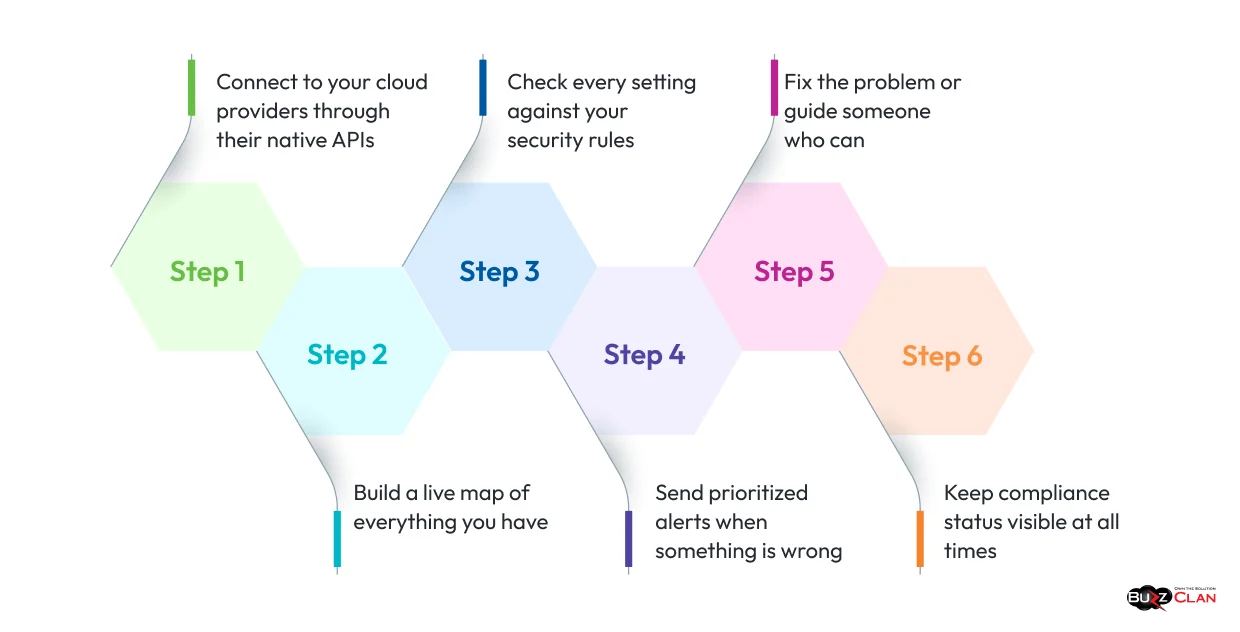
Knowing what CSPM does is useful. Knowing how it actually does it helps you deploy it better and set the right expectations for what it will and will not catch. The process is straightforward once you see it laid out step by step.
- Connect to your cloud providers through their native APIs: CSPM platforms link directly to AWS CloudTrail, Azure Event Grid, GCP Audit Logs, and other provider systems using read-only credentials. Nothing needs to be installed on individual resources. This agentless setup means the platform sees everything immediately, not just the resources where someone remembered to deploy an agent.
- Build a live map of everything you have: The platform automatically finds and catalogs every resource, including virtual machines, storage buckets, databases, serverless functions, container workloads, network settings, and access policies. This map stays updated constantly as new things are added or existing ones are changed.
- Check every setting against your security rules: Each configuration gets compared to your security policies and to industry standards like CIS Controls, ISO frameworks, and your own company requirements. This comparison runs continuously, not on a schedule.
- Send prioritized alerts when something is wrong: When a configuration falls outside policy, an alert goes out. But good CSPM does not treat all alerts the same. It factors in how exposed the resource is, how sensitive the data inside it is, and whether the issue creates a real path an attacker could use. That way, your team focuses on what actually matters instead of scrolling through noise.
- Fix the problem or guide someone who can: For common issues, the platform applies the fix automatically. For more complex ones, it sends a detailed alert with step-by-step instructions to the right team through your existing ticketing tools like ServiceNow or Jira.
- Keep compliance status visible at all times: CSPM maintains a running view of your compliance posture against regulatory frameworks. Audit-ready evidence can be generated in minutes rather than assembled over weeks before an inspection.
One thing that separates modern CSPM from older tools is attack path analysis. Instead of looking at each misconfiguration on its own, advanced platforms look at how multiple problems combine into something dangerous. A single misconfigured server is one problem. That same server with access to production database credentials, sitting on a network segment reachable from the public internet, is a critical attack path. CSPM surfaces those chains, not just the individual pieces. That is what prevents alert fatigue and helps teams spend time on the problems that actually create risk.
This continuous visibility also changes how teams think about cloud governance. When you can see the real security state of your environment at any moment, decisions about expanding to new services or adding new accounts become much easier to make safely.
Key Features Every Modern CSPM Platform Should Have

Not all cloud security posture management tools are the same. Some flood your team with hundreds of low-priority alerts that nobody has time to read. Others give you the real context you need to fix what actually matters. The difference comes down to a handful of core features. Here is what to look for.
- Continuous asset discovery: The platform must automatically find every resource across all your cloud accounts, regions, and providers and keep that inventory updated in real time. New deployments should show up and get assessed immediately, not on the next scheduled scan.
- Multi-cloud support: One dashboard covering AWS, Azure, and GCP at the same time. If a tool only works with one provider, it creates blind spots in any environment where your team uses more than one cloud.
- Security benchmarking: Every configuration should be measured against established standards like CIS Benchmarks, NIST, ISO 27001, and your own company policies. When something deviates, the platform should tell you exactly what is wrong and what to do about it.
- Live compliance monitoring: Your compliance status against HIPAA, PCI DSS, SOC 2, and GDPR should be visible at all times, not just when someone pulls a report. The platform should be able to generate audit-ready evidence on demand without any manual work.
- Risk-based alert prioritization: Not every misconfiguration is equally dangerous. A good CSPM platform scores findings based on how exposed the resource is, how sensitive the data inside it is, and how easily an attacker could exploit it. That context is what separates useful alerts from noise.
- Automated fixes for common problems: For straightforward issues like an open storage bucket, an account with too many permissions, or disabled encryption, the platform should be able to fix the problem without waiting for a human to act. More complex issues should be routed to the right team with clear instructions.
- Integration with development pipelines: The best CSPM solutions plug into infrastructure-as-code workflows and CI/CD pipelines. This catches misconfigurations in the code before anything is deployed to production, which is far cheaper than catching them afterward.
- Identity and access visibility: Accounts with too many permissions and credentials that have not been used in months are consistently among the top entry points for attackers. A good CSPM platform flags these and helps enforce least-privilege access across the board.
How Does CSPM Improve Cloud Security?
CSPM improves cloud security by watching every configuration across your cloud accounts in real time, catching risky settings the moment they appear, and fixing common problems automatically. It removes the visibility gap that lets misconfigurations sit undetected for weeks or months.
CSPM vs CNAPP vs CWPP
Cloud security has a lot of acronyms that sound similar but mean different things. Understanding where CSPM, CNAPP, and CWPP each fit helps you decide what your organization actually needs right now.
| Feature | CSPM | CWPP | CNAPP |
|---|---|---|---|
| What it focuses on | How your cloud infrastructure is configured and whether it meets security and compliance rules | Protecting the workloads actually running inside the cloud, like containers and virtual machines | Full cloud application security from the first line of code all the way to production |
| What it monitors | Cloud settings, access policies, network rules, storage permissions | What workloads are doing at runtime, threats inside running applications | Everything: settings, workloads, identities, data, and behavior at runtime |
| Compliance support | Strong: continuously tracks HIPAA, PCI DSS, SOC 2, and GDPR in real time | Workload-level compliance only | Full compliance coverage across both infrastructure and applications |
| Developer integration | IaC scanning catches issues before deployment | Limited | Full shift-left security from code commit to production |
| Identity security | Shows you how IAM is configured and flags risky permissions | Workload-level access only | Full Cloud Infrastructure Entitlement Management (CIEM) |
| Best for | Organizations building their cloud security foundation and managing compliance | Teams that need to protect containerized or serverless workloads at runtime | Cloud-mature organizations that need a single platform covering everything |
| Where the market is going | Increasingly bundled inside CNAPP platforms, standalone CSPM still has strong value for compliance-driven teams | Being absorbed into CNAPP | Gartner projects 75% of new CSPM purchases will be part of CNAPP by the end of 2025 |
The practical takeaway: CSPM is where most organizations should start. It builds the visibility and compliance foundation that every other layer of cloud security depends on. CNAPP is the destination for teams that have matured past configuration management and need workload protection, identity management, and application security to all work together in one place.
How CSPM Improves Security ROI
Security tools usually get judged on what they cost. CSPM deserves to be judged on what it prevents. The return on investment comes from multiple directions, all of them measurable.
- Faster breach containment saves real money: According to IBM’s Cost of a Data Breach 2025 Report, organizations that contained a breach within 200 days saved an average of $1.14 million compared to those that took longer. CSPM’s continuous monitoring directly supports faster detection and containment.
- Fewer incidents from misconfiguration: According to Gartner research, CSPM can reduce cloud security incidents caused by misconfigurations by 80%. Fewer incidents mean fewer investigations, less remediation time, and lower overall security costs.
- No more audit preparation sprints: Organizations that used to spend weeks gathering compliance evidence before an audit can generate the same reports in minutes with CSPM. This is especially valuable for regulated industries where audits are frequent and documentation requirements are extensive.
- One platform instead of many tools: Teams that use separate tools to monitor AWS, Azure, and GCP configurations can replace all of them with a single CSPM platform. Fewer tools means lower licensing costs, less context-switching, and a cleaner view of overall security posture.
- Cheaper to fix problems early: When CSPM connects to DevSecOps pipelines, it catches misconfigurations before code reaches production. Fixing something in code takes minutes. Fixing the same issue after it has been live in production for a week takes far longer and costs significantly more.
Running cloud workloads on AWS, Azure, or GCP?
BuzzClan helps enterprises build secure, well-managed cloud environments with the right security controls in place from day one.
Industry Use Cases for CSPM
CSPM benefits any organization running cloud infrastructure, but some industries see especially immediate results because of their compliance requirements and the sensitivity of the data they handle.
Healthcare
Healthcare organizations deal with patient data that is among the most regulated and most sensitive data in the world. HIPAA requires that this information be protected throughout its entire life in the cloud. One misconfigured storage container holding patient records can result in penalties, lawsuits, and long-term reputational damage.
CSPM gives healthcare security teams continuous visibility into whether patient data is stored in compliant configurations. It generates HIPAA audit-ready reports on demand, so compliance teams are always prepared rather than scrambling before inspections. For health systems running dozens of cloud accounts across multiple providers, this level of automated oversight is not optional. It is a compliance requirement. BuzzClan’s experience with healthcare data management transformation shows exactly how much safer these environments become with the right tooling in place.
Financial Services
Financial institutions face multiple compliance requirements at once. PCI DSS governs how payment card data is handled. SOC 2 covers data security and availability. State and federal regulations add further requirements on top. Cloud environments in financial services also tend to be among the most complex, with strict separation between production and non-production environments and multiple providers used for different workloads.
CSPM gives compliance teams a single view of all those environments so they can track configurations and prove continuous compliance without manually pulling reports from each provider. BuzzClan has worked directly with financial institutions on cybersecurity transformations that bring this kind of visibility to organizations managing complex cloud architectures.
Government and Public Sector
Government cloud environments operate under frameworks like FedRAMP and NIST SP 800-53. Misconfigurations in government systems can expose citizen data, trigger congressional scrutiny, and create national security risks. In December 2024, the US Cybersecurity and Infrastructure Security Agency issued Binding Operational Directive 25-01, specifically mandating that federal agencies secure cloud environments because widespread misconfigurations were leaving sensitive data exposed. CSPM gives government security teams the continuous monitoring capability to meet those mandates without needing to grow their teams proportionally with their cloud footprint.
Retail and E-Commerce
Retail organizations processing payment data need to maintain PCI DSS compliance continuously. During peak seasons, cloud environments scale rapidly to handle traffic spikes, which means new configurations are being deployed fast and not always reviewed carefully. CSPM monitors every new configuration automatically and flags any PCI DSS violations before they become audit findings or entry points for attackers.
Manufacturing and Industrial
As manufacturing companies move operational data and IoT systems into the cloud, the security surface expands into areas that traditional tools were never built to cover. CSPM’s agentless monitoring works across these environments without requiring agents to be deployed on edge devices, making it practical for organizations managing hybrid setups that mix cloud and industrial systems.
How to Choose the Right CSPM Partner
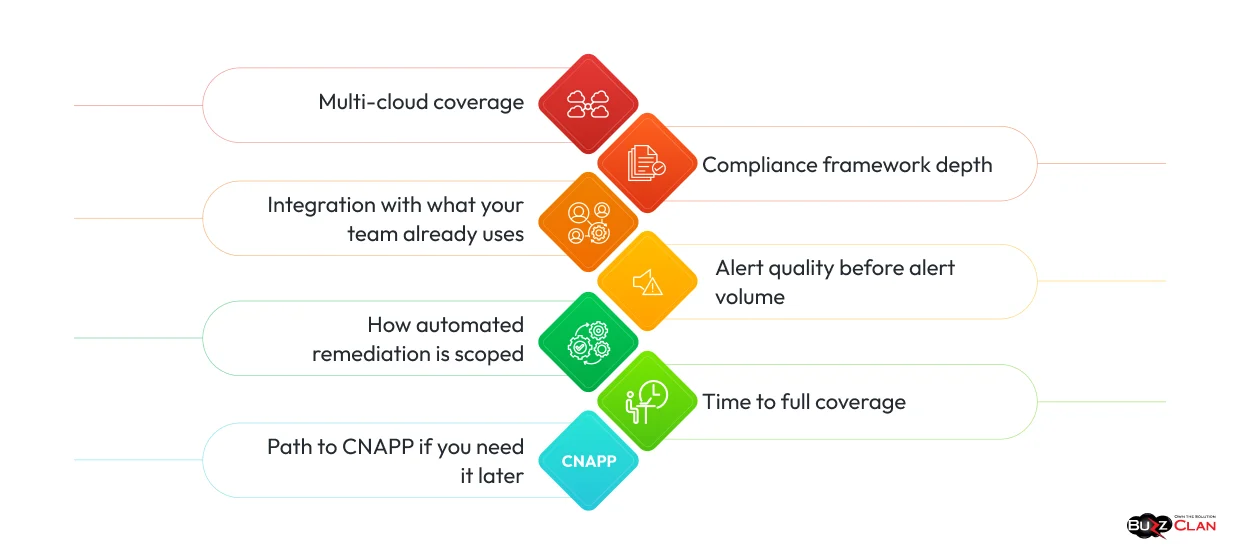
Choosing a CSPM solution involves more than picking the one with the best analyst ranking. What matters is whether it fits your specific cloud architecture, the compliance frameworks you operate under, and the capacity of your security team. Here is what to evaluate before committing.
- Multi-cloud coverage: Confirm the platform covers every cloud provider your organization uses today and any you are likely to add in the next 18 months. Partial coverage means blind spots, and blind spots defeat the purpose of continuous monitoring.
- Compliance framework depth: Check whether the platform has built-in policy packs for the specific frameworks your organization must meet. Generic compliance reporting is much less useful than frameworks specifically aligned to HIPAA, PCI DSS, or whatever your industry requires.
- Integration with what your team already uses: A CSPM platform is most useful when its findings flow directly into the tools your team already works in. Look for native connections to your SIEM, your ticketing system, and your DevOps pipeline. A platform that generates findings in a separate silo that nobody checks is not delivering real security value.
- Alert quality before alert volume: Before purchasing, ask the vendor to show you how the platform prioritizes findings. A tool that sends thousands of low-priority alerts every day trains teams to ignore alerts entirely, which is worse than no alerts at all. Risk-based prioritization with attack path context is what you actually need.
- How automated remediation is scoped: Understand clearly which problems the platform fixes automatically and which ones need human review. Automated fixes on the wrong things without proper safeguards can cause service disruptions. This balance needs to match your specific environment and risk tolerance.
- Time to full coverage: Agentless CSPM tools connect through cloud APIs and can achieve full environment coverage within days. Agent-based deployments take weeks or months to fully roll out. Given that the goal is to close visibility gaps, how long it takes to see everything matters.
- Path to CNAPP if you need it later: If your organization is likely to need workload protection and identity management in addition to posture management within the next two years, it is worth evaluating whether your CSPM choice slots into a CNAPP upgrade path now rather than forcing a full tool replacement later.
The leading cloud security posture management tools in 2026 include Wiz, Prisma Cloud by Palo Alto Networks, Microsoft Defender for Cloud, Orca Security, and Check Point CloudGuard. Each has different strengths depending on your cloud setup, existing security stack, and compliance needs.
Before selecting any tool, knowing your current exposure is valuable. A cloud security strategy assessment that establishes a baseline gives you concrete evidence of your highest-risk areas, which makes vendor evaluations much more focused and useful.
Not sure where your cloud security gaps are?
BuzzClan can run a cloud security posture assessment and show you exactly where the risks sit before an auditor or attacker finds them first.
Why Enterprises Choose BuzzClan for Cloud Security
Deploying CSPM and actually getting security value from it are two different things. A CSPM platform with default settings applied to a complex enterprise environment will produce alerts that are either too broad to act on or too narrow to capture the actual risk. Getting it right requires understanding both the technology and the specific compliance obligations of the industry being served.
BuzzClan’s cloud security practice works with enterprises through every stage of that process.
- Cloud posture assessment: Before recommending any tooling, BuzzClan conducts a structured review of existing cloud configurations to identify misconfigurations, compliance gaps, and access risks across all active accounts and providers.
- CSPM selection and configuration: Based on the assessment findings, the team recommends the platform that fits the client’s cloud environment, compliance requirements, and team capacity. Configuration is handled end-to-end, including custom policy rules and specific framework mappings.
- DevSecOps integration: BuzzClan connects CSPM findings into existing ticketing systems, SIEM platforms, and CI/CD pipelines so that security issues reach the right people through the workflows they already use every day.
- Ongoing monitoring and tuning: Cloud environments evolve constantly. BuzzClan provides ongoing support to update alert thresholds, adjust compliance policies as regulations change, and keep the CSPM configuration aligned with how the environment actually grows over time.
BuzzClan also brings hands-on experience with SOC 2 compliance and ISO compliance programs, which means the cloud security work connects into a broader zero trust security strategy rather than sitting as a standalone deployment with no connection to wider governance.
Expert Insight
Why Leaders Need Both CSPM and DSPM in 2026
“Here is the thing: you cannot secure infrastructure without knowing what kind of data lives inside it. Otherwise, you are flying blind. CSPM is great for spotting misconfigurations, exposed assets, and identity risks. However, DSPM adds the missing piece by actually finding where your sensitive business and customer data sits, and tracking who has access to it. Together, they give you a complete picture, combining infrastructure health with data intelligence. With AI, multi-cloud, and automation everywhere these days, leaders really need both. Using CSPM and DSPM together helps you prioritize smarter, stay compliant, and avoid those costly, high-impact data leaks.”
Final Thoughts
CSPM is not a complicated idea. Your cloud changes every day. Misconfigurations happen. Without something watching continuously, nobody knows until it is too late. With it, problems surface in minutes instead of months.
The Football Australia breach sat undetected for 700 days. Not because the team was careless. Because there was nothing in place to catch it automatically. That is the exact gap CSPM exists to close, and it is a gap that only gets wider the more your cloud environment grows.
If your team is still relying on periodic checks to understand how your cloud is configured, now is the time to change that. Explore the latest cybersecurity trends to see how enterprises are building continuous security programs in 2026, or read more about what cybersecurity means for cloud-first organizations today.
Frequently Asked Questions
Cloud environments are now too large for any team to monitor manually. Gartner predicts that 99% of cloud security failures through 2026 will come from customer misconfigurations, not from the cloud provider itself. CSPM watches your entire cloud setup automatically, so mistakes get caught and fixed before they turn into expensive incidents. For any organization running workloads across multiple cloud accounts and providers, that level of continuous visibility is no longer optional.
Traditional tools check security on a fixed schedule, maybe once a month. The problem is that cloud environments change every single day, so a lot can go wrong between those scheduled checks. CSPM watches continuously. The moment a setting changes in a risky way, the platform catches it right away and flags it for your team, instead of waiting weeks for the next scan to find it.
BuzzClan helps organizations pick the right CSPM tool for their specific cloud setup, connect it to existing security and development workflows, and align it with compliance frameworks like HIPAA, SOC 2, and PCI DSS. The team handles everything from initial setup to ongoing monitoring, making sure security gaps get resolved rather than just flagged and forgotten.
Yes. Modern CSPM platforms can automatically fix common problems like open storage buckets, overly permissive access roles, and disabled encryption settings. For more complex issues, the platform sends a clear alert with step-by-step fix instructions to the right team through tools like ServiceNow or Jira. The scope of automated fixes should be reviewed carefully before enabling, to avoid any unintended disruptions in production environments.
BuzzClan starts with a detailed cloud security assessment to find existing problems across all active accounts. The team then sets up security baselines aligned to CIS Benchmarks and regulatory frameworks and deploys CSPM with custom rules built for each client’s specific environment. Regular reviews keep everything aligned as the cloud grows and new services are adopted over time.
Yes. Modern CSPM tools connect directly into CI/CD pipelines and check infrastructure-as-code files before anything is deployed. Meeting compliance in cloud computing requirements becomes far easier when security gets verified at the code level, before resources ever reach production. This catches problems when they are cheap and fast to fix, instead of after they are already live.
CSPM checks how your cloud infrastructure is configured and whether those settings are secure. CWPP protects the workloads actually running inside the cloud, like containers and virtual machines, at runtime. CNAPP combines both into one platform and adds full identity management on top. Most organizations start with CSPM to get configuration and compliance visibility, then move toward CNAPP as their cloud-native workloads and security needs grow beyond what CSPM covers on its own.
Healthcare, financial services, and government see the most immediate benefit because of strict compliance requirements like HIPAA, PCI DSS, and SOC 2. That said, any organization running cloud workloads with sensitive customer or business data gets real value from CSPM, especially as the number of cloud accounts and services grows beyond what a security team can track manually.
CSPM platforms connect to cloud providers including AWS, Azure, and GCP through their native APIs. Everything shows up in one dashboard, so your team can see security settings, compliance status, and risk alerts across all accounts and providers at once, without having to log into each cloud console separately or maintain different tools for each provider.

Get In Touch