AI-Powered Cloud Governance: The Future of Automated Compliance and Security
Harash Jindal
Dec 12, 2025
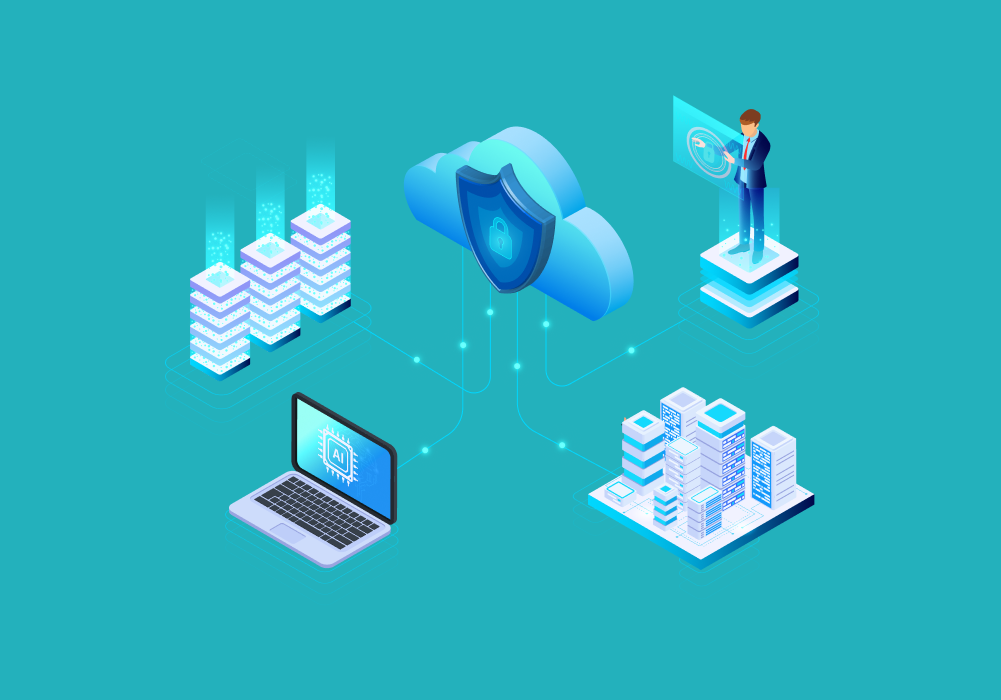
Cloud governance has undergone a significant shift over the past decade. Early governance models were built around static controls, manual reviews, and periodic audits. They worked when cloud usage was limited, workloads were fewer, and change cycles were slower.
But as organizations expanded cloud adoption across multiple teams, business units, and platforms, these traditional approaches struggled to keep pace. Environments became more dynamic, deployments more frequent, and responsibilities more distributed. The result was a governance model that could no longer provide consistent visibility, enforce standards reliably, or control cost and risk at scale.
This gap between the speed of cloud innovation and the rigidity of legacy governance is now the defining challenge for modern cloud teams.
In 2026, that gap is being addressed not by adding more processes, but by introducing AI-driven, policy-as-code governance frameworks that are built for continuous change. Rather than reacting to issues after the fact, these systems analyze environments in real time, detect policy drift automatically, flag cost anomalies, predict compliance risks, and even remediate certain issues without human intervention.
AI is turning cloud governance from a monitoring function into an intelligent, proactive layer woven directly into cloud operations. It enables guardrails that adapt as environments evolve, reduces operational burden, and helps organizations achieve both agility and control without forcing teams to slow down.
This guide explores how AI is reshaping cloud governance, the emerging capabilities to watch, and the strategies that will help organizations build governance models ready for the next decade of cloud growth.
What is AI-Powered Cloud Governance?
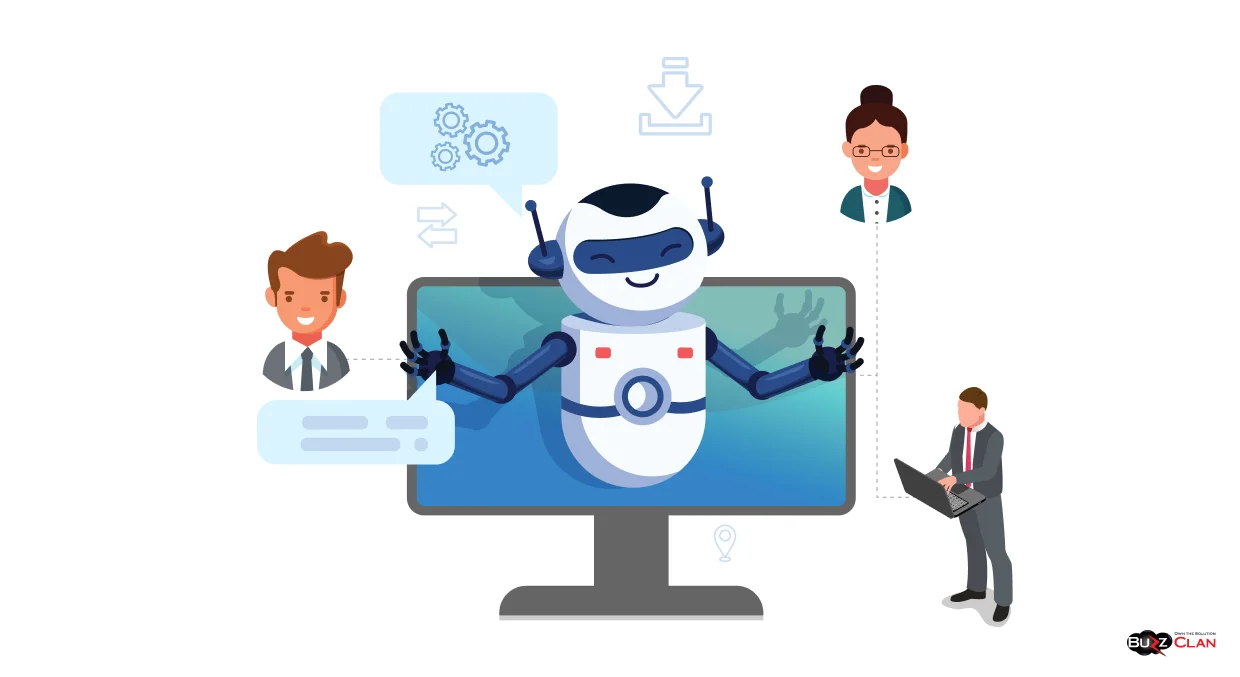
AI-powered cloud governance uses artificial intelligence to automatically enforce rules, monitor compliance, and protect your cloud resources in real time. Think of it as having a smart assistant that watches your cloud environment 24/7, learns what normal activity looks like, and immediately fixes problems before they cause damage.
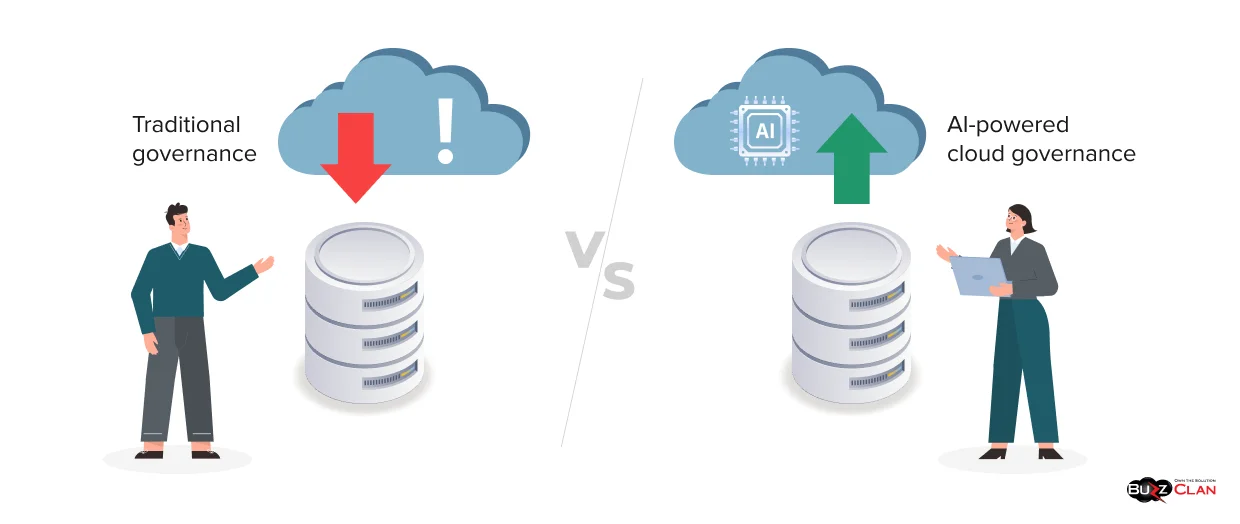
Traditional governance works like periodic inspections. Someone manually checks if policies are being followed, creates reports, and fixes issues after they’re discovered. This approach falls apart when you’re managing thousands of cloud resources that change constantly hundreds of times throughout the day.
AI governance is different from the traditional approach because it never stops watching. It spots unusual activity instantly and can either send alerts to your team or automatically fix problems based on rules you’ve set. For example, if someone accidentally makes a storage bucket public, the system detects it within seconds and takes the necessary security measures in real time.
Here’s what it does:
- Finds everything automatically: Discovers all your cloud resources and identifies which ones contain sensitive information.
- Watches constantly: Monitors who’s accessing what and flags anything unusual that could signal a security threat.
- Fixes problems instantly: Removes unnecessary permissions or shuts down resources that violate your policies.
- Handles compliance: automatically generates audit reports, helping organizations in regulated industries like healthcare and finance.
- Predicts issues: Analyzes patterns to spot potential problems before they actually happen.
The real advantage is that AI learns and gets smarter over time.
Why Traditional Cloud Governance Falls Short
Traditional cloud governance was designed for slower, more predictable IT environments. As cloud adoption accelerates and infrastructure becomes more complex, these old methods simply can’t keep up. Here are a few reasons why traditional cloud governance no longer works.
Manual Processes Can’t Scale
Traditional governance relies heavily on human review and manual checks. Teams write policies in documents, track resources in spreadsheets, and manually verify compliance. This approach worked with smaller environments, but breaks down completely when managing thousands of resources across multiple cloud platforms. By the time someone manually reviews one configuration, dozens of new changes have already occurred.
Outdated Review Cycles Limit Agility
Every infrastructure change requires human approval in traditional governance models. Requests enter queues, governance teams review them, and approvals come days or weeks later. This creates a fundamental conflict: either DevOps teams wait, and productivity suffers, or they bypass governance processes entirely and create shadow IT. Neither outcome serves the business well.
Reactive Discovery Happens Too Late
Traditional governance discovers problems through periodic audits, quarterly reviews, or after incidents occur. An exposed database might sit publicly accessible for weeks before the next audit cycle catches it. Overprivileged accounts could cause damage long before manual reviews identify the risk. You’re constantly fixing yesterday’s problems instead of preventing tomorrow’s.
Multi-Cloud Complexity Creates Gaps
Most enterprises now operate across AWS, Azure, Google Cloud, and private infrastructure. Each platform has different security models, compliance requirements, and policy enforcement mechanisms. Traditional governance tools weren’t built for this complexity, creating gaps between systems where critical issues slip through unnoticed.
Shadow IT Emerges Unchecked
When governance becomes a bottleneck, teams find workarounds. They spin up their own cloud accounts, use unapproved tools, or build separate tech stacks to avoid slow approval processes. This shadow IT operates without centralized oversight, creating security vulnerabilities, redundant infrastructure, and runaway costs.
Real-Time Visibility Doesn’t Exist
Traditional governance provides snapshots, not continuous monitoring. You know what your environment looked like during the last audit, but you have no clear picture of its current state. By the time spreadsheets get updated or reports get generated, the information is already outdated.
Organizations implementing modern cloud security best practices recognize that traditional governance fundamentally mismatches the speed, scale, and complexity of today’s cloud environments. The answer isn’t adding more manual oversight — it’s adopting AI-powered cloud governance that operates at cloud speed.
Key Advantages of AI-Powered Cloud Governance
From real-time visibility to proactive risk prevention, AI-powered cloud governance delivers several powerful benefits—here are some of the most impactful ones.
Unified Command Center Across All Platforms
Think about the typical day managing multi-cloud environments. You check AWS. Then switch to Azure. Then open Google Cloud.
Each platform has its own dashboard, its own way of showing information. AI-powered cloud governance changes this by putting everything in one place. You see all your resources, who’s accessing them, and whether they’re following the rules across your entire infrastructure.
This unified view solves a real problem. Critical security issues often hide in the gaps between platforms. When you can see everything together, those gaps disappear. Security problems that were invisible when spread across multiple dashboards become obvious when displayed side by side.
Prevent Issues Rather Than React to Them
We talked earlier about how AI spots unusual patterns. But here’s what that actually means for your organization. You stop problems before they cost you money. Security breaches get blocked before any data leaks. Compliance violations get fixed before auditors show up. Budget overruns get caught before spending spirals out of control.
Companies making this shift report something consistent. They see fewer incidents overall, lower costs when problems do occur, and genuine confidence in their security instead of crossing their fingers hoping nothing goes wrong. Prevention beats cleanup every time.
Grow Infrastructure, Not Governance Teams
The business case is simple. Your cloud can grow from 1,000 resources to 100,000 without adding governance staff. The AI handles the extra workload automatically. Real companies report 40% fewer policy violations and 85% less manual work after implementing these systems.
Modern platforms take this further by embedding controls directly into development workflows through something called Governance-as-Code. Developers get instant feedback on security and compliance instead of waiting days for manual approvals.
Recover Wasted Cloud Budget
Most organizations don’t realize this fact. The majority of companies waste cloud spending on resources they’ve overprovisioned, left idle, or don’t actually need. AI governance finds these budget drains by connecting security policies with cost management. It spots resources eating money without delivering value, suggests right-sizing opportunities, and flags security misconfigurations that also waste your budget.
The savings go beyond just cutting unnecessary resources. You also eliminate the substantial labor costs of tracking and optimizing everything manually. When governance and cloud cost optimization work together automatically, savings stack up across both operational efficiency and infrastructure spending.
Replace Audit Stress With Continuous Assurance
The audit benefit goes deeper than just fast reports. AI transforms how you think about compliance entirely. Instead of that scrambling panic before auditors arrive, you maintain audit-ready documentation automatically. The system captures detailed evidence showing what happened, when, who authorized it, and why it complied with your policies.
Healthcare and financial services organizations value this continuous assurance model particularly because regulatory scrutiny never takes a break. Companies with mature AI governance face fewer audit issues, reduce prep time, and build stronger regulatory trust by proving compliance instantly instead of rebuilding evidence later.
These advantages add up to something bigger than individual improvements. Teams stop spending most of their time on repetitive compliance checking and start contributing to projects that actually move the business forward. This transformation from overhead work to value creation represents the real competitive advantage AI governance delivers.
How AI-Powered Cloud Governance Transforms Different Industries
Financial Services Maintains Continuous Compliance
Banks operate under constant regulatory pressure from PCI-DSS, SOC, and regional banking standards. Traditional governance discovered violations during audits, often months after they occurred. AI governance changes this completely by monitoring compliance continuously instead of periodically.
For example, financial institutions create dedicated cloud environments with real-time monitoring and automated policy enforcement for sensitive payment data. These systems provide real-time breach detection, track data access, and ensure continuous compliance. Financial firms now know they’re always compliant rather than hoping auditors won’t find problems. The automation streamlines essential functions like transaction processing, fraud detection, and compliance monitoring, freeing IT teams to focus on strategic innovation.
Essential IT Services Every Dallas Healthcare Provider Needs
Healthcare organizations must protect patient information under HIPAA and GDPR while leveraging that data for AI-driven diagnostics. Traditional governance created bottlenecks where data access took weeks to approve, slowing medical research.
For example, healthcare organizations using continuous monitoring ensure patient data stays secure and anonymized, AI insights get properly tracked, and models meet regulatory standards before deployment. This proactive approach avoids compliance violations while accelerating AI adoption in healthcare. Medical teams access needed data without waiting for manual reviews, while patients gain confidence that their information stays protected. The technology enables synthetic medical data generation for research and drug discovery while maintaining strict privacy controls.
Manufacturing Gains Global Consistency
Global manufacturers operate across dozens of countries with fragmented infrastructure. Some facilities use private clouds for proprietary data while others leverage public clouds for supply chain management. Managing consistent security standards was nearly impossible with traditional tools.
For example, manufacturing organizations implementing AI governance across hybrid cloud environments gain unified visibility and control over distributed operations. They enforce consistent security policies whether resources live in private data centers or public clouds, automate compliance checks across all locations, and monitor AI systems deployed in production environments. This approach enables continuous data health monitoring that shifts governance from an occasional compliance exercise to an ongoing, proactive discipline.
E-Commerce Builds Customer Trust
E-commerce companies collect vast customer data across websites, payments, recommendations, and marketing. Customers demand transparency about data usage while regulations like GDPR and CCPA require detailed tracking.
For example, e-commerce organizations implementing end-to-end data lineage gain full visibility into data collection and usage, ensure AI decisions align with customer consent, and comply with multiple privacy regulations simultaneously. They automate processes that previously required manual intervention, reducing operational costs while building customer trust through transparent data practices. The technology enables personalized customer experiences through AI-powered recommendations while maintaining strict data governance.
Government Delivers Digital Services
Public sector organizations must protect citizen data while maintaining service availability. Legacy systems across fragmented departments created poor citizen experiences and security vulnerabilities.
For example, government agencies create unified digital platforms integrating services from multiple departments. Citizens now ask questions, log issues, and apply for services through web browsers or mobile apps instead of visiting multiple offices. Cloud solutions enhance security while improving access across stakeholders. Government services transform from fragmented offerings into cohesive digital experiences that citizens actually want to use.
The Cost of Ignoring AI Governance (What You Risk)
Organizations sometimes view governance as an optional expense that can wait. The reality tells a different story. Skipping AI-powered cloud governance creates costs that far exceed the investment in proper controls.
Financial Penalties Keep Growing
Regulatory fines for non-compliance continue escalating across industries. GDPR violations carry penalties based on annual global revenue, HIPAA breaches result in substantial fines, and PCI-DSS violations can cost organizations their ability to process payments. Without continuous monitoring, violations sit undetected until regulators discover them during audits, by which time the damage multiplies with mandatory breach notifications, legal fees, forensic investigations, and remediation costs that quickly escalate into substantial expenses.
AI Investments Fail to Scale
Without governance, AI systems cannot operationalize at scale. Organizations build models in development environments but struggle to deploy them to production safely because each deployment requires manual security reviews that take weeks. Many AI projects get abandoned due to governance gaps and data issues. This inability to scale means decreased return on AI investments as companies spend significant money building AI capabilities that never reach customers or improve operations.
Security Breaches Cause Lasting Damage
Ungoverned cloud environments create exploitable vulnerabilities through misconfigured storage buckets, overprivileged accounts, and unpatched systems. Data breaches carry substantial costs when factoring in incident response, customer notification, credit monitoring services, legal fees, regulatory fines, and lost business. Organizations also face long-term reputational damage that affects customer trust, partner relationships, and competitive positioning.
Operational Waste Multiplies Quietly
Without governance visibility, cloud waste compounds invisibly as resources remain provisioned but unused, development environments run continuously when needed only during business hours, and inefficient architectures consume excessive compute resources. Organizations waste substantial cloud spending on overprovisioned or unnecessary resources. This waste represents money that could have been invested in innovation or returned to the bottom line.
Conclusion
When your cloud environment moves quickly, relying only on manual governance leads to gaps and mounting risks. AI makes cloud governance proactive by watching everything all the time, fixing problems automatically, and adapting as your cloud grows.
By moving beyond slow audits and manual checks, organizations free up teams to focus on what’s important, strengthen security, and stay ahead as cloud complexity increases.
Curious how AI-powered governance feels in real life? Let’s talk.
Discover how our experts simplify your cloud operations, boost security, and help your business overcome today’s IT challenges. We’re here to turn cloud complexity into confidence for teams ready to grow smarter.
If you want to learn more, feel free to contact us here.
FAQs

Get In Touch
Follow Us

Get In Touch
Follow Us