MCP vs API: Choosing the Right Integration Approach for Enterprise Architecture in 2026
Sachin Jain
Jan 22, 2026
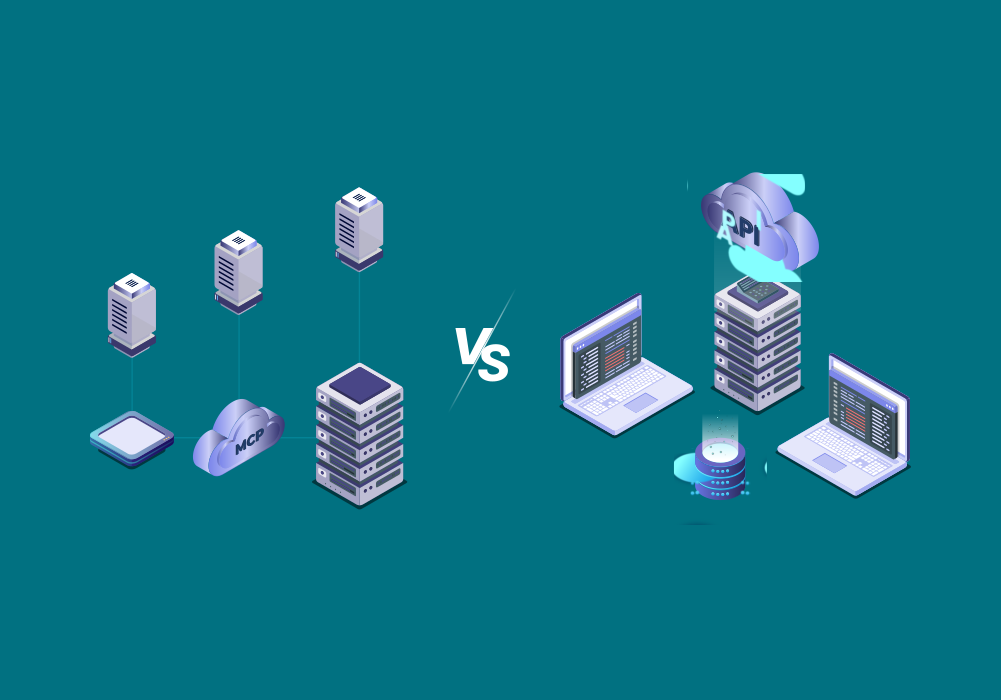
The technology landscape is witnessing a fundamental shift in how AI systems connect with external data and tools. At the center of this transformation sits a critical architectural decision: should enterprises continue relying on traditional application programming interfaces, or is it time to adopt the Model Context Protocol?
This isn’t just another technical debate. Organizations investing millions in AI infrastructure need to understand which approach delivers actual business value. Traditional REST APIs have powered enterprise integrations for over two decades, processing 92% of organizational data exchanges according to recent studies. Meanwhile, MCP emerged in November 2024 and achieved industry-wide adoption within twelve months, now handling 97 million monthly SDK downloads across production environments.
The stakes are higher than choosing between two technical standards. Your decision directly impacts how quickly your AI implementations scale, how much your development teams spend building custom connectors, and whether your agentic AI workflows can access the contextual information they need to make intelligent decisions.
Understanding Application Programming Interfaces in Modern Enterprise Architecture
Application programming interfaces serve as the backbone of modern enterprise systems, enabling software components to communicate through standardized protocols. When you submit a payment, check inventory levels, or authenticate users, APIs handle these interactions behind the scenes through HTTP requests and structured responses.
The architecture follows well-established patterns. A client sends a request to a server endpoint, the server processes that request against its resources, and returns a formatted response. This stateless design means each API call contains all the information needed to complete that specific transaction, allowing systems to scale horizontally by distributing requests across multiple servers.
REST APIs dominate enterprise environments because they offer predictable, standardized interfaces built on HTTP methods like GET, POST, PUT, and DELETE. Your developers understand how to build them, your security teams know how to protect them, and your operations teams have decades of experience monitoring them. Major technology vendors like AWS, Microsoft, and Google structure their entire cloud service offerings around REST API architectures.
However, traditional APIs weren’t designed for the challenges AI systems introduce. When you build an AI application that needs to access customer data from Salesforce, retrieve documents from SharePoint, analyze logs from DataDog, and execute queries against your data warehouse, you’re looking at building four separate API integrations. Each integration requires custom authentication, error handling, rate limiting, and data transformation logic specific to that vendor’s implementation.
The traditional approach creates what industry analysts call the “N×M problem.” If you have 10 AI applications and each needs to connect to 100 different tools and data sources, you potentially need 1,000 custom integrations. This exponential scaling of integration complexity consumes engineering resources and slows AI adoption across your organization.
The Model Context Protocol Revolution
MCP represents a fundamentally different approach to connecting AI systems with external resources. Instead of building point-to-point integrations between each AI application and each data source, the protocol establishes a universal standard that any AI model can use to communicate with any tool through a consistent interface.
Think of it as creating a USB-C standard for AI integrations. Before USB-C, every device manufacturer created proprietary connectors, forcing consumers to buy different cables for different devices. USB-C solved this by creating one connector that works with everything. MCP does the same for AI systems, replacing thousands of custom integrations with a single, standardized protocol.
The architecture uses JSON-RPC 2.0 messages transported over standard protocols, with detailed schemas that allow LLMs to understand exactly what each MCP server does and what tools it provides. When Claude, ChatGPT, or any other AI system needs to access data or execute functions, it connects to an MCP server that exposes those capabilities through clearly defined interfaces.
Development teams saw immediate value. Instead of spending weeks building custom connectors for each new data source, they implement the MCP protocol once on each side. An AI application that supports MCP can instantly connect to any of the 10,000+ MCP servers now available, ranging from database connectors to collaboration tools to specialized industry applications.
Major technology companies quickly validated the approach. Google integrated MCP into Gemini models by April 2025. OpenAI adopted it across ChatGPT and its API offerings by March 2025. Microsoft added support in Copilot and Azure OpenAI. By December 2025, Anthropic donated MCP to the Agentic AI Foundation under the Linux Foundation, with co-founding support from OpenAI, Block, Google, Microsoft, AWS, Cloudflare, and Bloomberg.
The protocol introduces capabilities specifically designed for AI workflows. MCP supports asynchronous operations, allowing AI agents to initiate long-running tasks and receive results when they complete rather than blocking on synchronous API calls. Servers can maintain stateful contexts, giving AI systems memory of previous interactions. The protocol includes native support for prompts, resources, and tools, providing a structure that aligns with how LLMs actually work.
This design enables scenarios that traditional APIs struggle to support. An AI agent analyzing your company’s quarterly performance can connect to your data warehouse through one MCP server, retrieve relevant documents from Google Drive through another, pull financial data from your accounting system through a third, and synthesize all this information into a comprehensive report – all through standardized MCP connections rather than custom API integrations.
Technical Architecture: How MCP and APIs Differ
The architectural differences between MCP and traditional APIs run deeper than interface design. Understanding these distinctions helps you evaluate which approach fits your specific integration requirements.
Traditional REST APIs organize around resources and endpoints. You define URLs representing different resources in your system and use HTTP verbs to perform operations on those resources. A typical enterprise API might expose endpoints like /api/v1/customers/ for customer data or /api/v1/orders for order management. Each endpoint requires explicit documentation that describes the expected parameters, authentication methods, response formats, and error codes.
When building AI integrations with REST APIs, your development team writes code that handles the specifics of each API. They implement authentication flows ranging from API keys to OAuth, manage rate limits that vary by provider, parse response formats that differ across systems, and build retry logic for handling failures. This custom code accumulates across your AI applications, creating technical debt that requires ongoing maintenance as external APIs evolve.
MCP takes a different approach, building on concepts from the Language Server Protocol that revolutionized IDE development. Instead of resource-oriented endpoints, MCP exposes three primary primitives: prompts (reusable templates for AI interactions), resources (structured data sources), and tools (executable functions). The protocol defines a standard way to discover an MCP server's capabilities, eliminating the need for custom parsing of documentation.
The communication model differs fundamentally. While REST APIs use simple request-response patterns, MCP supports bidirectional messaging, enabling more sophisticated interaction patterns. An MCP server can initiate callbacks to the client, support progressive result streaming, and maintain conversation context across multiple exchanges. These capabilities align naturally with how AI agents operate, particularly when executing complex multi-step workflows.
Security models present another significant difference. Traditional APIs typically implement endpoint-level authentication and authorization, where each API call includes credentials that grant access to specific resources. MCP builds on OAuth 2.0 Resource Servers with mandatory Resource Indicators, providing more granular control over what operations an AI agent can perform. The protocol includes explicit mechanisms for user consent, allowing humans to review and approve actions before AI systems execute them.
Cloud infrastructure considerations also diverge. REST APIs often require dedicated server infrastructure to handle incoming requests, implement business logic, and manage state. MCP servers can run as lightweight processes that expose capabilities without maintaining complex server infrastructure. This architectural simplicity reduces operational overhead, particularly when deploying MCP servers across distributed environments like hybrid cloud architectures.
The error handling philosophies reflect these different design patterns. REST APIs return HTTP status codes (200 for success, 404 for not found, 500 for server errors) that developers interpret to understand what went wrong. MCP provides structured error responses that AI systems can parse programmatically, making it easier for agents to recover from failures without human intervention.
Real-World Integration Scenarios and Use Cases
Consider how these architectural differences play out in actual enterprise scenarios where your teams are building AI-powered solutions.
Your customer service organization wants to deploy AI agents that can access customer history, update support tickets, retrieve product documentation, and escalate complex issues to human agents. With traditional REST APIs, your development team builds separate integrations for your CRM system, ticketing platform, knowledge base, and notification service. Each integration requires weeks of development time to handle authentication, implement error recovery, and build data transformation logic.
Using MCP, you implement the protocol once in your customer service application and connect to MCP servers that expose these capabilities. When you need to add a new data source or tool, you simply point your application to the new MCP server rather than writing custom integration code. Your AI agents can discover available capabilities programmatically and adapt their behavior accordingly.
Data engineering teams building AI-powered analytics platforms face similar challenges. Traditional approaches require custom connectors for each data warehouse, visualization tool, and analytics service your analysts use. MCP enables a more flexible architecture in which AI systems discover available data sources, understand their schemas via standardized protocols, and execute queries without hard-coded integration logic.
Financial services organizations implementing AI for risk assessment need to access data from trading systems, regulatory databases, market data feeds, and internal compliance tools. The sensitive nature of financial data means every integration requires careful security review and ongoing compliance monitoring. MCP’s built-in support for granular permissions and audit logging aligns with regulatory requirements, while the standardized protocol reduces the surface area that security teams must review.
Healthcare systems deploying AI for clinical decision support present particularly complex integration challenges. Your AI applications need to access electronic health records, laboratory systems, imaging databases, and clinical guidelines, all while maintaining strict HIPAA compliance. MCP’s ability to maintain context across multiple interactions while implementing explicit consent mechanisms helps address both the technical and regulatory requirements these scenarios demand.
DevOps teams building AI-powered automation tools represent another compelling use case. Your infrastructure-as-code workflows need to interact with cloud providers, container registries, monitoring systems, and deployment tools. Traditional approaches require maintaining separate API clients for each service, updating them as providers change their interfaces. MCP servers abstract these details, allowing your AI automation to work across different infrastructure providers through consistent interfaces.
Making the Strategic Decision for Your Enterprise
Choosing between MCP and traditional APIs isn’t about declaring one approach universally superior. Your decision should align with your specific organizational context, technical requirements, and strategic objectives.
Traditional REST APIs remain the right choice when you’re building stable, well-defined interfaces between systems that don’t involve AI components. If your integration requirements fit established patterns – synchronous request-response, resource-oriented operations, standard CRUD operations – REST APIs provide battle-tested solutions with extensive tooling and developer expertise. Your cloud migration projects that move existing applications to cloud platforms can leverage REST APIs without introducing additional complexity.
MCP makes strategic sense when AI systems are central to your integration requirements. If you’re building agentic AI workflows that need to access diverse data sources, execute complex multi-step operations, and adapt their behavior based on available capabilities, the protocol’s AI-native design provides significant advantages. Organizations deploying multiple AI applications that share common data sources see compounding benefits as each new MCP server becomes immediately accessible to all AI systems that support the protocol.
Consider the human capital implications. Your existing development teams understand REST APIs, and the ecosystem provides extensive training resources, troubleshooting documentation, and best practices. MCP represents newer technology with a growing but still-maturing ecosystem. Factor in the training investment required to bring your teams up to speed on the protocol, balanced against the long-term efficiency gains from standardized AI integrations.
Security and compliance requirements significantly influence this decision. REST APIs have well-established security patterns that your cybersecurity teams know how to implement and audit. MCP introduces new security models that require evaluation against your organization’s security policies and regulatory requirements. The protocol’s emphasis on explicit consent and granular permissions may actually strengthen security posture for AI use cases, but your security team needs time to validate this approach against your threat models.
The maturity of your AI initiatives matters. Organizations in early-stage AI experimentation may find REST APIs sufficient for initial proofs of concept. As your AI deployments scale into production and you manage dozens or hundreds of AI-powered workflows, MCP’s standardization benefits become more pronounced. The crossover point typically occurs when maintaining custom API integrations consumes more engineering resources than implementing and managing MCP servers.

Implementation Strategy and Best Practices
Organizations successfully adopting either approach follow proven implementation patterns that minimize risk while maximizing value.
Start with a clear integration inventory. Document every system your AI applications need to access, the operations they need to perform, and the data they need to exchange. This inventory reveals whether you’re facing the exponential scaling problem that MCP solves, or whether your integration requirements fit simpler patterns that REST APIs handle effectively.
For REST API implementations, invest in comprehensive API management platforms that provide consistent authentication, rate limiting, monitoring, and versioning across all your integrations. Tools like cloud-based API gateways centralize these cross-cutting concerns, reducing the burden on individual development teams while improving security and reliability.
When adopting MCP, begin with a pilot project that validates the protocol against your specific requirements. Choose a use case with moderate complexity – not so simple that you can’t evaluate MCP’s advantages, but not so complex that failure blocks critical business initiatives. Build one or two MCP servers for frequently-accessed systems, implement MCP client support in one AI application, and measure the development effort compared to traditional API integration approaches.
Establish governance frameworks that define standards for both approaches. Your API governance should specify authentication methods, versioning strategies, error handling patterns, and documentation requirements. MCP governance needs similar standards covering server implementation patterns, security models, and operational monitoring. These frameworks ensure consistency as different teams build integrations across your organization.
Invest in observability from the start. Whether you’re using REST APIs or MCP, production AI integrations require comprehensive monitoring, logging, and alerting. Your DevOps tooling should track integration performance, failure rates, and usage patterns, providing visibility into how your AI systems interact with external resources. This telemetry proves essential for troubleshooting issues and optimizing integration performance.
Consider hybrid approaches for complex environments. You don’t need to choose exclusively between REST APIs and MCP across your entire organization. Many enterprises run both, using REST APIs for traditional system integrations and MCP for AI-specific workflows. This pragmatic middle ground lets you adopt new patterns incrementally while maintaining existing integrations that work effectively.
Build expertise through internal communities of practice. Establish forums where your developers share implementation patterns, troubleshoot integration challenges, and document lessons learned. These communities accelerate learning and prevent different teams from repeatedly solving the same problems independently.
FAQs

Get In Touch
Follow Us

Table of Contents
- Understanding Application Programming Interfaces in Modern Enterprise Architecture
- The Model Context Protocol Revolution
- Technical Architecture: How MCP and APIs Differ
- Real-World Integration Scenarios and Use Cases
- Making the Strategic Decision for Your Enterprise
- Implementation Strategy and Best Practices
- FAQs