How AI Governance Monitoring Helps Reduce AI Risk
Abhi Garg
Sep 17, 2026
AI Governance Does Not End With the Policy
An organization can have AI policies, access controls, approval processes, and clear accountability in place. But that does not mean its AI environment will remain unchanged.
Six months later, new tools may appear, models may be updated, permissions may change, and AI agents may gain access to systems that were never part of the original assessment.
The governance framework still exists. The environment around it has moved on.
That is where AI governance monitoring matters.
It continuously checks whether AI systems are still operating within approved policies, risk limits, security controls, and compliance requirements.
This guide explains what AI governance monitoring covers, how it works, and how organizations can use it to reduce AI risk in practice.
What is AI Governance Monitoring?
AI governance monitoring is the ongoing process of evaluating whether an AI system continues to operate within its approved use, policies, controls, risk thresholds, and applicable requirements after deployment.
The monitoring approach depends on what needs to be governed. Some conditions can be observed through technical signals such as access logs, model telemetry, API activity, configuration changes, and agent execution traces. Others require assessments, incident reviews, documentation checks, user feedback, or human evaluation.
For example, an organization may approve an AI system for internal employee support while restricting access to customer records. Monitoring can help determine whether the system is still being used for its approved purpose, whether permissions or integrations have changed, and whether activity indicates access to data outside its approved scope.
Governance monitoring may therefore examine whether:
- The system is still being used for its approved purpose.
- Access to data and connected systems remains within approved boundaries.
- Users, permissions, integrations, or deployment conditions have changed.
- Required human oversight and approval processes are still being followed.
- Performance or system behavior has changed enough to affect risk.
- Security, privacy, or policy incidents have occurred.
- Changes to the system require additional controls or reassessment.
This is broader than model monitoring.
Model monitoring focuses primarily on the technical behavior and performance of a model or AI system. AI governance monitoring connects technical behavior with the policies, approvals, controls, responsibilities, and risk decisions governing how that system is used.
Both may use some of the same signals, but they serve different purposes.
Why AI Governance Requires Continuous Monitoring
AI systems rarely continue operating under exactly the same conditions in which they were originally assessed.
Over time, teams may introduce new data sources, expand access to additional users or business functions, connect the system to other enterprise applications, or change the permissions available to it.
Third-party model updates can also affect system behavior without the organization changing its own application.
These changes matter because the original governance decision was based on a particular use case, technical configuration, data scope, user population, and level of risk.
When those conditions change, controls that were considered sufficient during approval may no longer address the system’s current risk. Changes to regulatory requirements or internal policies can create the same problem even when the technology itself has not changed.
NIST’s 2026 research on deployed AI systems highlights why post-deployment monitoring matters. It identifies challenges including performance degradation, fragmented logging, changing policies, scaling human oversight, and uncertainty around what should be monitored and how often.
A periodic review can tell you what was true when the review happened. It cannot guarantee that the same conditions still exist today.
A useful governance monitoring process creates an operational feedback loop:
Observe → Detect → Investigate → Respond → Document → Improve
The frequency and depth of monitoring should reflect the system’s risk. An internal AI assistant working with low-sensitivity information may require relatively limited oversight.
Systems that process sensitive data, support consequential decisions, or take actions across enterprise applications typically need closer monitoring and more frequent human review.
Continuous governance monitoring should therefore be understood as ongoing oversight, not as a requirement to evaluate every governance condition in real time.
What Should AI Governance Monitoring Cover?
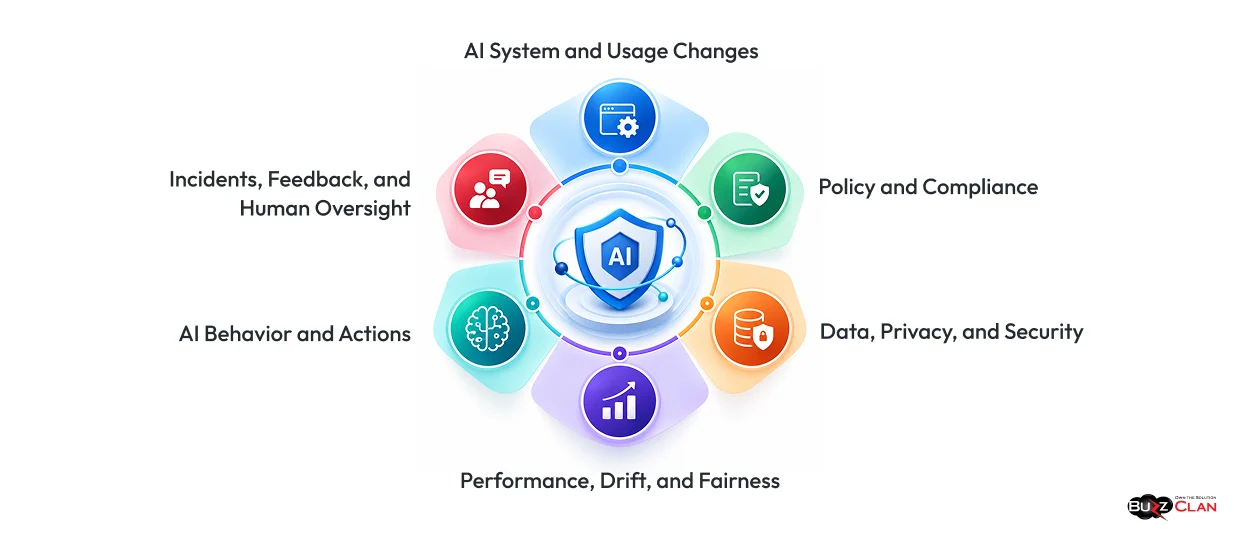
The scope of monitoring should be determined by the changes that could materially affect an AI system’s risk and by the evidence available to detect those changes.
This requires more than collecting model metrics. Governance teams may need information from application logs, identity systems, security platforms, AI gateways, governance records, incident-management systems, assessments, and human review. The combination depends on the architecture and use case.
1. AI System and Usage Changes
Track changes to:
- Model or agent versions
- Intended use
- Users and business functions
- Data sources
- Integrations and connected tools
- Deployment environments
- Geographic or business-unit expansion
A system can become higher risk without its underlying code changing.
2. Policy and Compliance
Monitor whether required governance controls are still being followed.
This can include:
- Approved-use requirements
- Required assessments and approvals
- Regulatory obligations
- Documentation status
- Policy violations
- Exceptions and unresolved findings
The goal is not simply to show that a policy exists. The goal is to produce evidence that the policy is being followed.
3. Data, Privacy, and Security
Monitor how AI systems interact with data and connected resources.
Look for:
- Unauthorized data access
- Sensitive information entering unapproved systems
- Changes in permissions
- Unexpected API or tool activity
- Security incidents
- Changes to third-party components
This becomes especially important for AI agents that can access multiple tools, databases, and business applications.
4. Performance, Drift, and Fairness
Technical signals still matter.
Depending on the use case, monitoring may include:
- Accuracy and error rates
- Data or concept drift
- Output quality
- Bias and fairness indicators
- Reliability and availability
- Human override patterns
The important point is that these signals should connect back to governance.
A performance change is not just an engineering issue if it increases business, compliance, or customer risk. NIST recommends post-deployment monitoring of performance, trustworthiness, bias, privacy, security, incidents, and user feedback as part of ongoing AI risk management.
5. AI Behavior and Actions
Traditional model monitoring becomes less sufficient when AI systems can take actions.
For an AI agent, governance monitoring may need to track:
- Who initiated the task
- What the agent was authorized to do
- Which tools it used
- What data it accessed
- Which actions changed business state
- Whether human approval was required
- Whether the final action stayed within policy
The focus shifts from only asking “Was the output correct?” to also asking “Was the action authorized?”
6. Incidents, Feedback, and Human Oversight
Monitoring should also capture what people see that automated systems may miss.
Useful signals include:
- User complaints
- Human overrides
- Near-misses
- Reported incidents
- Unexpected outcomes
- Escalations
- Feedback from affected users
NIST’s AI RMF specifically includes mechanisms for user feedback, appeal and override, incident response, recovery, change management, and decommissioning within post-deployment monitoring.
How AI Governance Monitoring Works
A useful monitoring program starts by defining the conditions under which an AI system is approved to operate. Those conditions create the reference point for deciding whether later changes are significant.
Step 1: Establish the Baseline
Document the system’s:
- Intended purpose
- System owner
- Risk classification
- Approved users
- Approved data
- Model or vendor version
- Connected systems and tools
- Required controls
- Human oversight requirements
- Acceptable risk thresholds
- Relevant regulatory or policy requirements
This becomes the reference point for future monitoring.
Step 2: Collect Relevant Signals
Bring together the information needed to detect meaningful changes.
This can include model telemetry, access logs, application events, security signals, user feedback, incident records, and governance documentation.
The objective is visibility, not data collection for its own sake.
Step 3: Compare Activity against Governance Rules
Monitoring then asks whether observed behavior still matches the approved baseline.
For example:
- Approved: Customer support agent can access support tickets.
- Observed: Agent begins querying a financial database.
That is not simply an unusual technical event. It may be a governance violation requiring investigation.
Step 4: Trigger the Right Response
A useful monitoring system should do more than raise an alert.
The alert should answer:
- What changed?
- Why does it matter?
- Which policy or control is affected?
- Who owns the issue?
- What action should happen next?
Risk-based thresholds are important here. NIST notes that monitoring cadence and methods may need to be tailored to the use case and risk level rather than applied uniformly.
Step 5: Document the Outcome
The final step is often overlooked.
The organization should be able to show:
- What was detected
- When it happened
- Which control was affected
- Who investigated it
- What action was taken
- Whether the risk was accepted, mitigated, or escalated
- Whether the governance baseline needs to change
This turns monitoring data into usable governance evidence.
How AI Governance Monitoring Helps Reduce AI Risk
The primary value of AI governance monitoring comes from reducing the period during which an important change can go unnoticed.
Without ongoing oversight, an AI system can gradually move beyond its approved scope while its governance records continue to describe an earlier version of the system.
Monitoring gives organizations a way to identify that divergence and decide whether it affects risk.
Identify Material Changes Earlier
Changes to permissions, data access, integrations, model behavior, or system use can be detected closer to when they occur rather than waiting for the next scheduled assessment.
Earlier detection does not eliminate the underlying risk, but it gives the organization more time to investigate and determine whether controls need to change.
Maintain the Connection Between Policy and Operations
A policy can specify that an AI application must not process a particular category of data, but the governance value comes from being able to determine whether that restriction continues to hold in practice.
Monitoring provides evidence from the operating environment that can be compared with the controls and conditions documented during approval.
Keep Risk Assessments Relevant
Risk assessments can become outdated when the system they describe changes.
Monitoring can identify events that invalidate or materially change assumptions in an existing assessment. This allows governance teams to reassess the system when necessary instead of relying on an approval that no longer reflects its actual use.
Establish Clear Accountability for Findings
Monitoring is useful only when significant findings reach people who can act on them.
Defining ownership for different types of findings helps organizations determine who investigates technical changes, who evaluates policy or regulatory concerns, who approves exceptions, and who decides whether a system can continue operating under changed conditions.
Maintain Governance Evidence
Monitoring creates records of changes, investigations, exceptions, decisions, and remediation that can support internal governance reviews and audits.
For certain regulated systems, ongoing monitoring can also form part of a legal obligation. Under Article 72 of the EU AI Act, providers of high-risk AI systems must establish and document a post-market monitoring system proportionate to the nature of the AI technology and its risks.
Improve Controls Based on Operational Evidence
Monitoring can also reveal weaknesses in the governance program itself.
Repeated policy exceptions may indicate that a policy no longer reflects how a system is legitimately used. Frequent false-positive alerts may show that thresholds need adjustment. Similar incidents across several AI applications may point to a broader weakness in access controls, approval processes, or employee guidance.
This operational evidence gives governance teams a basis for improving controls instead of treating policies as static requirements.
What Effective AI Governance Monitoring Requires
The monitoring process depends on several capabilities that need to exist across the organization. Without them, teams may collect large amounts of AI activity data but still struggle to determine which changes matter or who should respond.
- A reliable AI inventory: Organizations need to know which AI models, applications, and agents are in use, who owns them, and what business purposes they support. The inventory provides the scope for monitoring and helps connect technical activity to the system being governed.
- Clear ownership: Every monitored AI system should have an accountable owner, and different types of findings need defined response owners. A performance issue may require an AI engineering team, while unusual data access may involve security, privacy, or compliance teams.
- Access to the right technical signals: Monitoring depends on visibility across the systems involved in running AI. Depending on the architecture, this may require integration with AI platforms, identity systems, application logs, data platforms, security tools, APIs, and agent execution traces.
- Defined policies and risk criteria: Technical activity has limited governance value without context. Teams need documented policies, approved-use conditions, risk thresholds, and control requirements to determine whether an observed change is acceptable or requires action.
- A way to connect signals across systems: AI activity rarely exists in one platform. An agent may authenticate through an identity system, retrieve information from a data platform, invoke an external model, and perform an action in a business application. Monitoring needs enough context across these systems to reconstruct what happened and evaluate it against the agent’s approved scope.
- Human review where automation is insufficient: Some governance questions cannot be answered reliably through telemetry alone. Assessing whether human oversight remains effective, whether a new use case is appropriate, or whether an outcome creates unacceptable risk may require human judgment.
- Integration with existing governance and operational processes: Monitoring findings need to connect with incident management, risk assessments, approvals, exceptions, and change-management processes. Otherwise, monitoring can identify changes without creating a reliable path for resolving them.
These foundations determine whether AI governance monitoring provides useful oversight or simply produces another stream of alerts and metrics.
How to Get Started With AI Governance Monitoring
AI governance monitoring does not need to cover every system and risk from the start. Begin with the AI systems where changes could have the greatest impact, then expand monitoring as the governance program matures.
1. Prioritize Higher-Risk AI Systems
Start with systems that handle sensitive data, support consequential decisions, operate in regulated processes, or can take actions across enterprise applications. Use the existing AI inventory and risk assessments to determine where closer oversight is needed.
2. Define What Needs to Be Monitored
Identify the conditions that need to remain within approved boundaries, such as data access, permissions, system behavior, performance, integrations, and required human oversight. Then determine which technical signals or review processes can provide evidence for those conditions.
3. Set Triggers and Response Ownership
Define which changes require investigation and which should trigger a formal reassessment. Assign clear owners so findings reach the teams responsible for evaluating and responding to them.
4. Review and Adjust
Monitoring should evolve with the AI system. Review incidents, system changes, false positives, missed issues, and changes in risk to determine whether the existing signals, thresholds, and controls still provide useful oversight.
Starting with a focused set of higher-risk systems makes it easier to build a monitoring process that teams can operate effectively before extending it across the broader AI environment.
Build AI That Stays Accountable
AI changes fast. Your governance cannot afford to stay static. Bring monitoring, compliance, explainability, and ongoing optimization into the AI lifecycle with BuzzClan.
Conclusion
AI governance only works when it keeps pace with the AI it is meant to govern. As models, data, access, and use cases change, yesterday’s controls may no longer be enough.
AI governance monitoring helps close that gap by keeping a continuous watch on what is changing, where risk is emerging, and when action is needed.
With BuzzClan’s AI capabilities, businesses can bring governance, monitoring, compliance, and ongoing optimization together to keep AI aligned with evolving needs.
Because governing AI is not about setting the right rules once. It is about keeping them relevant over time.
Strengthen How You Govern AI
BuzzClan helps organizations build AI governance and monitoring practices around their systems, data, risk requirements, and operational environment.
Frequently Asked Questions
AI governance monitoring should begin as soon as AI moves into production or starts handling business data, decisions, or actions. Starting early makes it easier to establish a baseline before AI usage expands.
Policies can quickly fall out of sync with reality. New models, users, data sources, integrations, and AI agents may introduce risks that an initial governance assessment never covered.
Monitoring should be risk-based. Systems handling sensitive data, making high-impact decisions, or taking autonomous actions generally require closer oversight than low-risk AI applications.
Look beyond dashboards and metrics. A useful solution should connect AI inventory, policies, risk signals, security, compliance, alerts, incident response, and audit evidence so teams can move from detection to action.
No. Monitoring provides continuous visibility into changes and emerging risks, while audits provide a structured assessment at specific points in time. Used together, they provide a stronger governance approach.
BuzzClan’s AI capabilities cover areas such as AI strategy and governance, model monitoring, drift detection, explainability, compliance, and ongoing optimization.
Yes. BuzzClan supports ongoing AI oversight, including model monitoring, drift detection, governance, compliance, and optimization, helping teams stay aware of changes after deployment.
BuzzClan’s AI capabilities can help organizations establish governance and monitoring practices that identify changes, model risks, compliance concerns, and other issues earlier in the AI lifecycle. See how BuzzClan approaches AI
Yes. AI compliance and explainability are among the capabilities BuzzClan offers, helping organizations build greater visibility and accountability into their AI systems.
Start by assessing your current AI environment, identifying high-risk systems, and defining the controls that need continuous oversight. BuzzClan can help bring governance, monitoring, compliance, and optimization together across the AI lifecycle. Talk to BuzzClan about your AI needs

Get In Touch
Follow Us

Table of Contents
- AI Governance Does Not End With the Policy
- What is AI Governance Monitoring?
- Why AI Governance Requires Continuous Monitoring
- What Should AI Governance Monitoring Cover?
- How AI Governance Monitoring Works
- How AI Governance Monitoring Helps Reduce AI Risk
- What Effective AI Governance Monitoring Requires
- How to Get Started With AI Governance Monitoring
- Conclusion
- Frequently Asked Questions