Evaluating AI Compliance Solutions: 6 Capabilities to Look For
Sachin Jain
Sep 18, 2026
Choosing an AI compliance solution can seem simple until the vendor demos begin.
Almost every platform promises regulatory coverage, automation, monitoring, and audit readiness. But closer evaluation often reveals a mismatch. One tool may map regulations well but offer limited production visibility. Another may monitor models but leave compliance evidence scattered across other systems.
The real challenge is not finding a platform with the longest feature list. It is finding one that can keep compliance current, provable, and practical within your existing AI environment.
This guide breaks down the six capabilities that matter most, along with what to test before making a decision.
What Should an AI Compliance Solution Cover?
Before comparing providers, define the scope of your AI compliance program.
Start with the AI systems and use cases already operating across the organization. Identify who owns them, what data they use, where they are deployed, and which legal requirements, internal policies, standards, or voluntary frameworks are relevant.
Then determine where your current process is falling short.
Depending on your environment, you may need support for:
- AI inventory and use case discovery
- Regulatory and framework mapping
- AI risk identification and assessment
- Policy and control management
- Evidence collection and traceability
- Ongoing monitoring
- Third-party AI oversight
- Approval and remediation workflows
- Audit preparation and reporting
Not every organization needs the same combination.
A company trying to build an inventory of unmanaged AI has a different starting point from one that already has established governance processes but struggles to maintain evidence across hundreds of AI use cases.
Define the problem first. It gives you something concrete to evaluate when vendor capabilities begin to look alike.
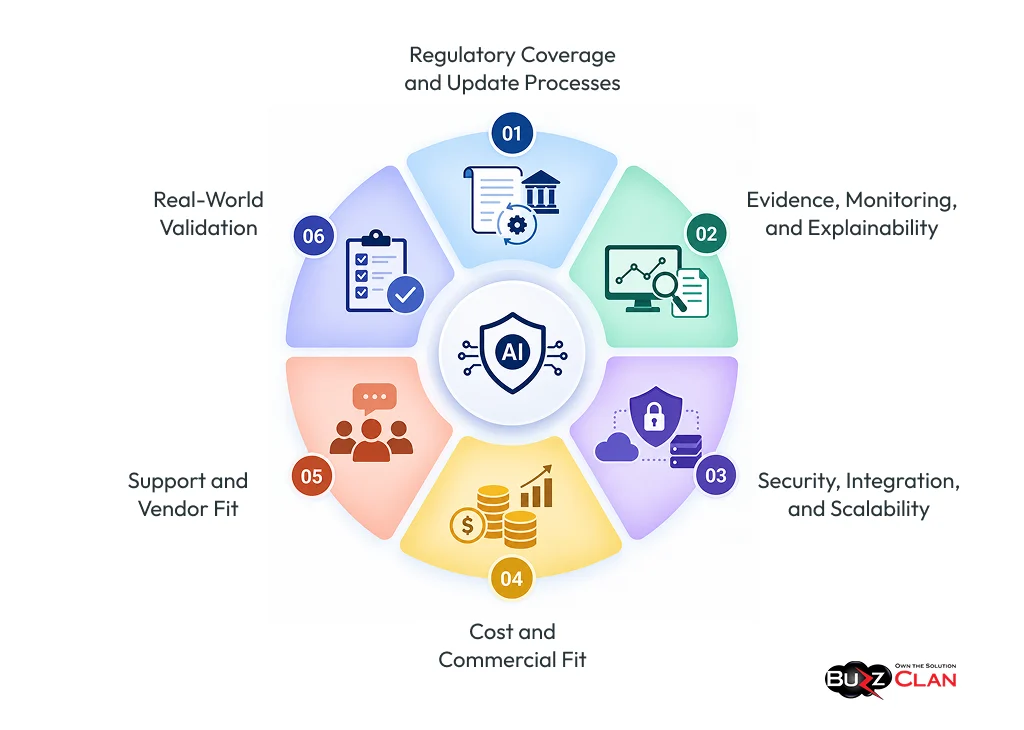
1. Regulatory Coverage and Update Processes
A platform may claim support for major AI regulations and frameworks. This statement alone tells you very little.
Look at how the platform handles the requirements behind them.
Check whether it provides:
- Regulatory and framework mapping
- Control-level requirements
- Gap assessments
- Regulatory change tracking
- Version history
- Evidence requirements linked to controls
- Coverage for the jurisdictions relevant to your business
The important question is not simply:
Ask:
That shows whether the solution can support compliance as an ongoing process rather than a one-time assessment.
Regulatory coverage tells you whether the platform understands the rules. The next question is whether it can help you prove that those rules are actually being followed.
2. Evidence, Traceability, and Ongoing Oversight
A compliance status page is useful. It is not enough.
When an auditor, risk team, or internal reviewer asks why a system was considered compliant, your team should be able to trace the answer back to relevant evidence.
Look for:
- Audit trails and evidence repositories
- Approval and review history
- Change tracking
- Assessment records
- Monitoring and alerts
- Exception and incident records
- Explainability and testing support
- Clear ownership of unresolved issues
The strongest approach connects these pieces instead of treating them as separate dashboards.
Requirement → Control → Evidence → Current Status → Action
This makes compliance easier to understand, maintain, and defend.
But even strong evidence becomes difficult to manage when it sits apart from the systems where AI is developed, deployed, and monitored. That makes the next area just as important.
3. Security, Integration, and Scalability
Compliance rarely lives in one system.
Your AI environment may involve cloud platforms, model providers, identity systems, data platforms, MLOps tools, ticketing systems, security controls, and existing GRC software.
That means integration should be evaluated as part of compliance, not as a technical afterthought.
Check for:
- APIs and prebuilt connectors
- SSO and role-based access
- Cloud and MLOps integrations
- Data protection and deployment options
- Third-party AI and vendor-risk support
- Integration with existing GRC or security workflows
- Support for growing numbers of models, applications, and users
Also look at where the platform provides control.
Some solutions focus on documentation and governance workflows. Others provide deeper visibility into production behavior. Make sure the solution matches where your actual compliance risks occur.
Once the technical fit is established, you can look at the business side of the decision and determine whether the solution makes sense to operate at its expected scale.
4. Cost and Commercial Fit
The license price is only one part of the decision.
A platform may also require implementation work, integrations, custom configuration, internal administration, training, and ongoing maintenance.
Evaluate:
- Subscription or usage-based pricing
- Implementation costs
- Integration effort
- Internal resources required
- Additional modules or features
- Scaling costs
- Contract and renewal terms
- Data portability and exit options
Think in terms of total cost of ownership, not just the initial quote.
A solution that looks affordable at the start can become expensive if it requires significant customization or manual work to stay operational.
That cost becomes easier to judge when you also understand the level of expertise, service, and ongoing support the provider brings with the platform.
5. Support and Vendor Fit
A technically capable platform can still be a poor fit if your team cannot operate it effectively.
Look at the vendor as part of the evaluation.
Ask:
- Who handles implementation?
- What onboarding and training are included?
- How quickly does support respond?
- How are regulatory updates communicated?
- Can the vendor support your industry or use case?
- Can both technical and compliance teams use the platform effectively?
- Can the provider support your expected scale?
Also ask a less obvious question:
A clear answer can tell you whether additional tools, processes, or integrations will be needed.
At this point, you should have a clearer picture of the platform on paper. The final step is to see whether that picture holds up when the solution is tested against your actual environment.
6. Test the Solution Against a Real AI Use Case
Do not make the final decision from a vendor presentation alone.
Run a proof of value using a real AI use case from your environment.
Ask the provider to demonstrate how the platform handles a realistic workflow:
- Discover and classify the AI system
- Map it to applicable requirements
- Identify a compliance gap
- Collect the required evidence
- Detect a meaningful change
- Assign the issue to the right owner
- Produce an audit-ready record
Then introduce an imperfect scenario.
Change a control. Remove evidence. Add a new requirement. Modify an integration.
See what the platform actually does.
This tests how the solution behaves in practice, not just what the vendor says it can do.
Once the providers have been tested against the same real-world conditions, the final comparison becomes much more objective.
AI Compliance Solution Evaluation Checklist
Before making a decision, use this checklist to see whether a provider covers the areas that matter to your environment:
| Area | What to check |
|---|---|
| Coverage | Relevant regulations, frameworks, and jurisdictions |
| Inventory | AI systems, models, use cases, owners, and vendors |
| Risk | Risk identification, classification, and assessment |
| Controls | Policy mapping, control tracking, and remediation |
| Evidence | Audit trails, approvals, documentation, and traceability |
| Monitoring | Changes, incidents, exceptions, and ongoing compliance status |
| Integrations | APIs, cloud, GRC, MLOps, security, and enterprise tools |
| Security | Access controls, data protection, privacy, and third-party risks |
| Workflow | Ownership, approvals, alerts, tasks, and escalation |
| Reporting | Dashboards, compliance status, and audit-ready reports |
| Support | Implementation, training, updates, and ongoing assistance |
Use the same checklist for every shortlisted provider. It makes gaps easier to spot and keeps the evaluation focused on what your organization actually needs.
Make AI Compliance Part of the Bigger Picture
Compliance works better when it is connected to how AI is built, monitored, explained, and improved. Bring those pieces together with BuzzClan’s AI capabilities.
Conclusion
Choosing an AI compliance solution is not about picking the platform with the biggest feature list.
It is about finding one that fits your AI environment, keeps regulatory requirements connected to real controls, provides evidence when you need it, and helps your teams respond when something changes.
Start with your requirements, test providers against real use cases, and use a consistent checklist to compare them.
The right solution should not just help you become compliant. It should make staying compliant easier.
Make Your AI Compliance Easier to Manage
Not sure what your current AI compliance setup is missing? Start with your requirements, your risks, and your real AI environment. We can help you turn them into a clearer path forward.
Frequently Asked Questions
Start with your actual compliance requirements, AI systems, risk exposure, and existing tools. The right solution should address those needs without creating unnecessary manual work or another disconnected system.
Test how the platform handles a real AI use case, from regulatory mapping and risk assessment to evidence collection, monitoring, issue assignment, and reporting. A real workflow often reveals gaps that a product demo will not.
They can be critical. Compliance information may already sit across cloud, security, identity, data, MLOps, and GRC systems. Strong integrations can reduce duplicate work and help keep compliance information connected.
Use the same criteria for every provider, such as regulatory coverage, inventory, risk, controls, evidence, monitoring, security, integrations, workflow, reporting, and support. Weight the criteria based on what matters most to your environment.
Not necessarily. Compare total cost, including implementation, integrations, internal effort, customization, scaling, and ongoing support. A lower license price can become expensive if the platform requires significant work to operate effectively.
BuzzClan’s AI capabilities can support areas such as AI governance, compliance, explainability, model monitoring, drift detection, and ongoing optimization.
BuzzClan can help organizations bring AI strategy, governance, monitoring, compliance, and optimization together as part of a broader AI lifecycle approach.
Yes. BuzzClan’s AI capabilities include model monitoring and drift detection, helping teams maintain visibility as AI systems and their operating conditions change.
Yes. Explainability and compliance are part of BuzzClan’s AI capabilities, helping organizations build greater visibility and accountability into their AI systems.
You can connect with BuzzClan to discuss your AI environment, governance needs, monitoring requirements, and broader AI objectives, and identify the capabilities that fit your use case.

Get In Touch
Follow Us

Table of Contents
- What Should an AI Compliance Solution Cover?
- 1. Regulatory Coverage and Update Processes
- 2. Evidence, Traceability, and Ongoing Oversight
- 3. Security, Integration, and Scalability
- 4. Cost and Commercial Fit
- 5. Support and Vendor Fit
- 6. Test the Solution Against a Real AI Use Case
- AI Compliance Solution Evaluation Checklist
- Conclusion
- Frequently Asked Questions