

The Role of AI in Enhancing DDoS Protection Strategies
Dhiraj Chhabra
Sep 4, 2026
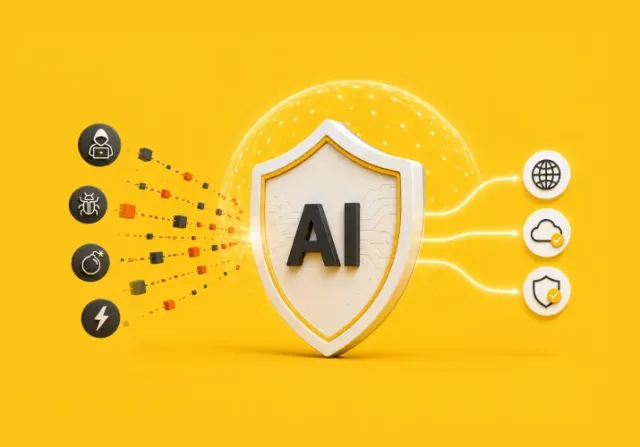
A DDoS attack can take a business offline without ever breaking into its systems. An attacker simply sends more traffic than the network, server, or application can handle, leaving legitimate users unable to get through.
The scale of these attacks makes that risk harder to ignore. Cloudflare reported mitigating more than 47 million DDoS attacks in 2025, more than twice the number recorded the previous year. At the same time, attacks are becoming more varied, with traffic patterns that can change quickly and make simple, rule-based detection less effective.
That creates a difficult problem for security teams. They need to distinguish legitimate traffic from malicious activity while an attack is already unfolding, then adjust their defenses as the attack changes.
AI can help with that process. Machine learning can learn normal traffic patterns, detect unusual behavior, and help security systems respond to threats in real time. Used alongside tools such as DNS proxies, CDNs, firewalls, and WAFs, AI can make DDoS protection more adaptive and responsive.
This article looks at how AI is being applied to DDoS protection, where it fits into existing security infrastructure, and what businesses should consider when evaluating AI-driven defenses.
Understanding DDoS Attacks
A Distributed Denial of Service attack floods a server, network, or application with more traffic than it can handle, using a network of compromised devices to overwhelm the target from many directions at once.
Unlike a single hacker trying to breach a system, a DDoS attack does not need to get inside.
It just needs to make the front door too crowded for real users to get through.
Attacks generally fall into three categories:
- Volumetric attacks that flood bandwidth
- Protocol attacks that exhaust server resources
- Application-layer attacks that target specific services like login pages or checkout systems.
Knowing which type you are facing matters, since each one demands a different kind of defense.
The Need for DDoS Protection
When a DDoS attack takes a service offline, the immediate concern is restoring access. The larger concern is what the outage costs while that access is unavailable.
Impact on Businesses
The financial damage adds up fast.
Small businesses spend an average of $120,000 recovering from a single DDoS incident, while enterprises routinely lose more than $1 million per attack once downtime, lost sales, and recovery labor are factored in.
Beyond the immediate cost, roughly 89% of attacks now last under 10 minutes, which means damage happens before most manual response teams can even react.
Legal Implications
There is a compliance angle too.
Extended outages caused by DDoS attacks can trigger breaches of service-level agreements, expose gaps in data protection compliance, and in regulated industries, invite scrutiny from regulators asking why availability controls failed.
For publicly traded companies, disclosed attacks have also been linked to short-term stock price drops, adding investor pressure on top of the operational cost.
AI Technologies in DDoS Protection

DDoS protection depends on identifying abnormal traffic before it overwhelms the systems behind a service. Traditional rules can detect known patterns, but they can struggle when traffic changes quickly or an attack does not match an existing signature. AI adds another layer by learning from traffic behavior and identifying patterns that may indicate an attack.
Three AI techniques are particularly relevant to DDoS protection: machine learning, neural networks, and predictive analytics.
Machine Learning Algorithms
Machine learning can establish a baseline for normal network traffic and flag activity that deviates from it. This allows security systems to evaluate traffic based on behavior rather than relying only on predefined rules.
Supervised models train on labeled attack data to recognize known patterns, while unsupervised models cluster traffic in real time, which lets them catch new or unusual attacks that have never been seen before.
Neural Networks for Anomaly Detection
Deep learning models, including convolutional and recurrent neural networks, go a step further by analyzing complex traffic patterns and timing relationships that simpler models miss.
Autoencoders, a popular architecture in this space, are especially good at flagging subtle deviations that indicate an attack is building before it fully lands.
Predictive Analytics
Detection tells a security system that something unusual is happening. Predictive analytics can add context by using historical and real-time data to identify patterns that may indicate an emerging threat.
This shifts defense from purely reactive blocking to proactive capacity planning, so infrastructure is scaled and ready before traffic actually spikes.
AI-Driven DDoS Protection Strategies
AI becomes useful when its detection capabilities are connected to the systems responsible for handling traffic. DNS proxies, SaaS infrastructure, firewalls, and web application firewalls all operate at different points in the traffic path, giving AI different opportunities to detect and respond to malicious activity.
Integrating AI with DNS Proxy DDoS Protection
DNS proxies sit between users and origin servers, filtering malicious requests before they ever reach critical infrastructure.
Adding AI to this layer lets the proxy adjust its filtering rules dynamically, based on live traffic behavior rather than fixed thresholds that attackers can learn to slip past.
Utilizing AI in SaaS Platforms for DDoS Security
Cloud and SaaS platforms increasingly bake AI-driven DDoS protection directly into their infrastructure, monitoring traffic across thousands of customers simultaneously.
This shared visibility means a novel attack pattern seen on one account can be recognized and blocked for every other customer almost instantly.
AI-Enhanced Firewalls and WAFs
Modern web application firewalls now use AI to adapt their rule sets as attack patterns evolve, rather than relying on static signatures that quickly go stale.
Akamai’s App & API Protector, for example, uses an adaptive security engine that learns attack behavior over time and adjusts its defenses accordingly.
Popular AI-Powered DDoS Protection Solution Providers
Several providers have built AI directly into their core offerings, each taking a slightly different approach, but all relying on the same core idea: let the system learn and adapt faster than attackers can change tactics.
- BuzzClan: Delivers AI-powered DDoS mitigation as part of its Cyber Security Services, combining 24/7 AI-augmented monitoring with threat detection tailored to a business’s specific infrastructure, rather than a one-size-fits-all setup.
- Cloudflare: Uses machine learning across its global network to detect and absorb attacks at scale, drawing on traffic data from millions of sites to spot new patterns in real time.
- AWS Shield: Applies automated anomaly detection to protect applications running on AWS infrastructure, scaling defenses automatically as attack traffic grows.
- Akamai: Combines AI-powered dashboards with an adaptive security engine that learns attack behavior over time, consolidating WAF, bot management, and DDoS defense into one system.
Strengthen Your DDoS Protection
Get AI-powered threat detection and 24/7 monitoring from BuzzClan’s Cyber Security Services.
The Future of AI in DDoS Protection
The next phase of DDoS defense is less about reacting faster and more about staying ahead of attacks before they fully form. As both attackers and defenders adopt AI, the fight is shifting from a speed contest into a prediction contest, where the side with better foresight wins.
- Anticipating New DDoS Attack Vectors: Attackers are already using AI to automate reconnaissance and test which methods slip past current defenses, with global attack volume up 127% year over year and the largest recorded attack reaching 4.2 Tbps. Defensive AI has to evolve at the same pace, or faster, just to keep up.
- Integrating AI with Cloud-Based DDoS Protection: Deeper integration between AI detection models and cloud-native infrastructure will let scaling, filtering, and rerouting happen automatically within seconds of an attack starting, rather than waiting on manual intervention.
- Self-Learning Defense Systems: The most promising shift is toward AI models that continuously retrain on live traffic without human tuning, closing the gap between when a new attack pattern emerges and when defenses actually catch up to it.
- Predictive, Pre-Emptive Mitigation: As predictive analytics matures, businesses will move from blocking attacks in progress to pre-positioning defenses based on early warning signals, effectively stopping attacks before they cause any real damage.
This is genuinely one of the most exciting frontiers in cybersecurity right now. If AI-driven prediction keeps improving at its current pace, the industry is realistically headed toward a future where most large-scale DDoS attacks get neutralized before end users ever notice a slowdown. Turning what used to be a costly emergency into a routine, invisible non-event.
Conclusion
DDoS attacks are getting bigger, faster, and harder to predict, but AI is giving defenders a genuine edge for the first time in years.
By learning normal traffic patterns, spotting anomalies in real time, and adapting defenses automatically, AI-driven protection closes the gap that static, rule-based systems simply cannot keep up with.
The businesses staying resilient are the ones treating AI-powered DDoS protection as core infrastructure, not an afterthought.
Don’t Wait for the Next Attack to Test Your Defenses
DDoS attacks now hit in minutes, not hours, and most businesses only realize their defenses were outdated after the damage is already done. Find the gaps in your DDoS protection before an attacker does.
Frequently Asked Questions
Cloudflare, AWS Shield, and Akamai are among the most widely used providers, each offering AI-driven detection built into their platforms. BuzzClan also supports DDoS protection through its Cyber Security Services, combining AI-powered threat detection with 24/7 monitoring for businesses that need managed protection rather than building it in-house.
On the defense side, web application firewalls, DNS proxies, and cloud-based scrubbing services are the core tools, increasingly enhanced with AI-driven anomaly detection. Discussing or promoting attack tools falls outside what’s useful here, since the focus should stay on building resilience, not enabling harm.
Start with a content delivery network to absorb traffic spikes, add a web application firewall to filter malicious requests, and set up rate limiting to prevent resource exhaustion. Layering AI-driven monitoring on top of these controls helps catch new attack patterns that static rules would otherwise miss.
Yes. BuzzClan’s Cyber Security Services include AI-powered threat detection, 24/7 monitoring, and DDoS-specific mitigation strategies tailored to your infrastructure and risk profile.
Yes. BuzzClan works across AWS, Azure, and other cloud environments, integrating DDoS defenses with existing cloud infrastructure so protection scales alongside your traffic rather than becoming a bottleneck.
Rule-based systems block traffic based on fixed thresholds and known signatures, so they struggle against attacks that don’t match a predefined pattern. AI-driven systems learn what normal traffic looks like for your specific network and flag anomalies in real time, which lets them catch new or evolving attack patterns that static rules would miss entirely.
Since most attacks now last under 10 minutes, AI systems are built to detect and respond within seconds rather than minutes. This speed comes from continuously analyzing live traffic rather than waiting for a human analyst to notice unusual patterns and manually trigger a response.
Most AI-driven DDoS protection is now delivered through cloud and SaaS platforms, which means businesses pay for a shared service rather than building detection infrastructure themselves. This makes AI-powered protection accessible at a much lower cost than it was even a few years ago, putting it within reach for small and mid-sized businesses too.
BuzzClan works directly with your team to prioritize fixes based on risk and business impact, then helps implement the right AI-driven monitoring and mitigation controls to close the gap. The goal is always to move from identifying a weakness to actually resolving it, rather than just handing over a report.
Gaming, financial services, and e-commerce are hit most often, since downtime costs them revenue within minutes. Government and healthcare are also common targets, usually for disruption rather than financial gain.
It can, but modern AI models learn your normal traffic patterns over time, which helps them tell a real surge apart from a malicious flood. This significantly reduces false positives compared to older rule-based systems.
Activate pre-configured mitigation right away, such as rerouting traffic through a scrubbing service or CDN, since manual changes take too long during an active attack. Notify your hosting or security provider immediately and log the attack timeline for follow-up.

Get In Touch
Follow Us


