
Data Quality Nightmares: How Poor Data Engineering Hurts Your Business Decisions
Vivek Varma
Nov 13, 2025
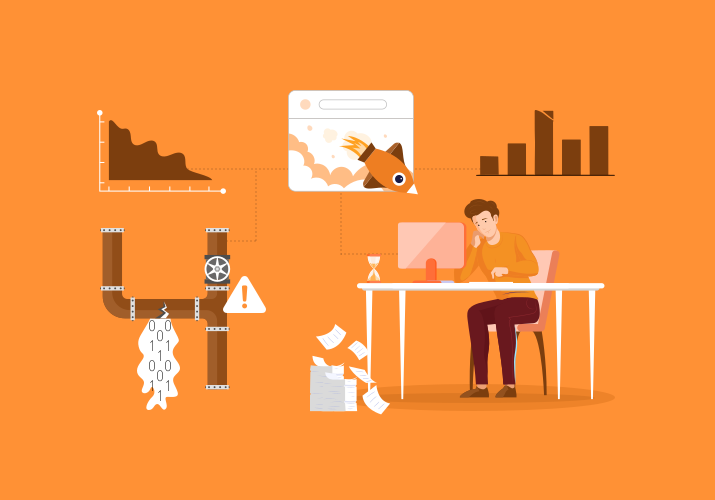
The $15 Million Question Nobody’s Asking
Organizations are spending millions on data quality tools while completely missing the point.
Poor data quality costs enterprises an average of $15 million annually. But here’s the uncomfortable truth—this isn’t a technology problem. It’s a trust problem disguised as a technical one.
Across industries, companies treat data quality like a plumbing issue—something to fix only after it breaks. They deploy validation tools, hire data cleansing teams, and wonder why the same problems resurface months later.
They’re solving symptoms while the real issue spreads unseen.
Why Traditional Data Quality Approaches Are Failing
The old playbook says: collect data, clean it later, and hope for the best.
This worked when data moved slowly, systems were siloed, and decisions took weeks.
That world is gone.
Modern enterprises operate in real-time across cloud platforms, IoT sensors, APIs, and legacy systems—all feeding interconnected pipelines. When bad data enters this web, it doesn’t just create one error. It multiplies across every connected system, creating compounding mistakes that look credible until costly failures surface.
The traditional “clean it later” approach fails because:
Scale defeats manual intervention. Data scientists spend 60% of their time cleaning information before analysis begins. Employees waste 27% of their workweek fixing bad data. At enterprise scale, you can’t hire your way out of this problem.
Distributed systems amplify errors. One incorrect customer record doesn’t stay contained—it spreads through CRM, marketing automation, billing systems, and analytics platforms. By the time someone notices, hundreds of decisions have been made on false information.
Speed demands trust. Business moves too fast for extensive validation cycles. Leaders need to trust data immediately or miss opportunities. Organizations without that trust operate in constant doubt, second-guessing every insight and slowing every decision.
Introducing the Data Trust Framework
At BuzzClan, we’ve developed what we call the Data Trust Framework—a fundamental shift from reactive quality control to proactive trust architecture. This framework recognizes that data quality isn’t an operational metric; it’s an organizational capability built on three pillars:
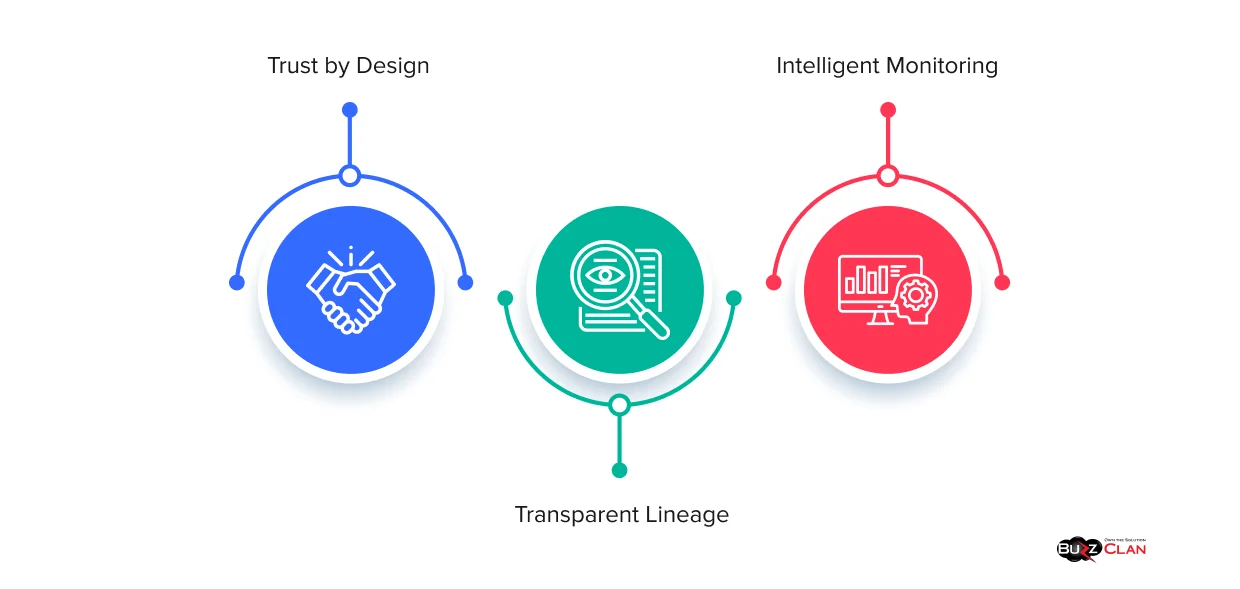
Trust by Design
Stop allowing bad data to enter systems in the first place. This isn’t about adding validation rules—it’s about architecting systems where poor quality data physically cannot propagate.
The circuit breaker principle: Design data pipelines that automatically halt when quality drops below defined thresholds. If 15% of incoming records fail validation (above a 5% baseline), the circuit breaks—protecting downstream analytics from corruption while teams resolve issues at the source.
This prevents the cascading failures that turn small data problems into enterprise-wide crises.
Transparent Lineage
When quality issues surface, organizations waste days playing detective, tracing where bad data originated, while systems continue failing. This is backwards.
Implement complete data lineage tracking that documents exactly where data comes from, how it transforms, and who touched it. When problems appear, lineage lets teams trace issues back to root causes in minutes instead of days.
More importantly, lineage creates accountability. When teams know their data feeds downstream decisions, behavior changes. Quality becomes everyone’s responsibility, not just the data team’s problem.
Intelligent Monitoring
Static validation rules are brittle. They catch known problems while missing unexpected failures. As business evolves, rules become outdated, creating false confidence while real issues slip through.
Deploy machine learning-based anomaly detection that establishes baseline behaviors and automatically flags deviations. If daily transaction volumes typically range between 10,000 and 12,000 but suddenly spike to 25,000, anomaly detection catches this immediately—whether it’s legitimate business growth or a data quality breach.
This creates an adaptive immune system that evolves as your data patterns change.
The Hidden Costs Everyone Ignores
Organizations fixate on obvious costs—employee time wasted, failed analytics projects, compliance penalties. But the real damage runs deeper:
Strategic Paralysis
When leadership can’t trust data, decision velocity collapses. Teams endlessly validate information, second-guess insights, and demand additional confirmation before acting. While competitors move fast on trusted data, you’re stuck in analysis paralysis.
Innovation Stagnation
AI initiatives fail because models can’t learn from unreliable inputs. Cloud migrations stall when dirty data moves to new platforms. Automation breaks when encountering inconsistent formats. Poor data quality doesn’t just slow current operations—it blocks future transformation.
Talent Drain
Top data scientists don’t join companies to spend 60% of their time cleaning spreadsheets. When quality problems dominate daily work, skilled professionals leave for organizations with better data foundations. You lose not just productivity, but the people who could fix the underlying problems.
Manual data processes costing your team 27% of their productivity? Automate validation, transformation, and monitoring to eliminate human error and free teams for strategic work.
Common Data Quality Issues Decoded
Let’s talk about what breaks and why it matters:
Schema drift
It happens when source data structures change unexpectedly—new columns appear, data types shift, and fields get renamed without warning. Organizations often discover drift only after reports break.
Fuzzy duplicates
They hide in plain sight. Standard deduplication catches exact copies, but “John Smith Inc.” and “John Smith Incorporated” reference the same entity while slipping through basic matching. These hidden duplicates distort analytics and confuse teams without triggering obvious errors.
Incomplete data
This type of data creates silent failures. A customer record missing an email can’t receive communications. When pipelines encounter incomplete records, they either fail loudly or fail silently, producing unreliable outputs that look legitimate.
The pattern? These aren’t random failures. They’re predictable consequences of poor data engineering practices.
How Poor Data Engineering Destroys Quality
Data quality problems stem directly from engineering failures:
Inadequate validation at entry
This allows errors to flow freely into databases. Systems that accept “ABC” as a phone number or blank email fields create downstream chaos affecting every connected system.
Poorly designed pipelines
These pipelines lack error handling, monitoring, or quality checks. When transformation logic doesn’t account for edge cases, pipelines fail silently, producing corrupted outputs that go unnoticed until business users discover broken reports.
Absent governance frameworks
This means no standards for consistency, ownership, or accountability. Different teams create conflicting formats and definitions. No one takes responsibility. Critical metadata goes undocumented. This data governance vacuum creates perfect conditions for quality issues to multiply unchecked.
Manual data processes
A.K.A. heavy reliance on manual data entry, spreadsheet transfers, or copy-paste operations introduces human error at scale. Every manual touchpoint is an opportunity for typos, misinterpretations, or format inconsistencies. As data engineering teams struggle with manual processes, quality degrades faster than they can fix it.
Insufficient monitoring and testing
This makes your systems incapable of detecting quality degradation in real time. Schema changes, data drift, or integration failures remain invisible until they cause visible problems. Without automated testing of data quality rules, organizations operate blind to deteriorating information reliability.

Building Sustainable Data Quality
Here’s how to implement the Data Trust Framework:
Start with Entry-Point Validation
Implement semantic validation that understands business context. A birth date field shouldn’t just accept dates—it should verify dates make business sense (not in the future, not before 1900). This multi-layered validation prevents 70-80% of common issues.
Establish Governance
Define standards for naming conventions, formats, and data definitions. But don’t stop there—implement technical lineage tracking that makes accountability traceable and actionable.
Automate Intelligent Monitoring
Deploy ML-based anomaly detection that adapts as data patterns evolve. This creates an early warning system catching problems before they impact business operations.
Build Quality Into Pipelines
Design data workflows with quality checks at every transformation stage. Implement circuit breakers that halt execution when quality drops below thresholds—protecting downstream systems from corruption.
Profile Continuously
Use automated profiling to analyze dataset characteristics, distributions, and relationships. Modern platforms can profile millions of records in minutes, revealing hidden patterns that guide improvement efforts.
The Path Forward
Data quality is more than a technical checkbox—it’s the foundation of business trust. Organizations that treat it as a strategic capability make faster, more confident decisions, reduce operational friction, and strengthen customer relationships.
The path forward is clear: invest in systems, processes, and governance that ensure your data is reliable, accurate, and actionable. When data becomes a trusted asset, it stops being a liability and starts driving growth.
Ready to Turn Your Data Into a Trusted Asset?
Partner with experts who understand both the technical challenges and business implications.
Connect with BuzzClan today to transform your data into quality you can trust.
FAQs

Get In Touch
Follow Us