What Is Data Lineage? A Complete Guide for Enterprises in 2026
Ananya Arora
Dec 22, 2025
In many organizations, data looks trustworthy on the surface. Dashboards are polished, metrics are clearly labeled, and reports arrive on time.
But the moment a leader asks, “Where did this number come from?” the confidence often fades.
Answers are scattered across teams, spreadsheets, and undocumented pipelines, and no one can quickly explain how raw data turned into a final metric.
This gap is exactly what data lineage is designed to close.
Data lineage provides visibility into how data moves through your systems — where it originates, how it’s transformed, and where it’s ultimately used. Instead of relying on tribal knowledge or static documentation, lineage allows teams to trace a KPI, report, or model back to its source data and transformation logic with clarity and confidence.
When people ask what data lineage is, they’re really asking for something more practical: the ability to trust numbers, respond to audits without panic, and understand the downstream impact of change. In 2026, that capability can no longer depend on manual diagrams or one-off documentation efforts.
This blog post explores why automated data lineage matters in 2026, how enterprises implement it at scale, and how to make it a practical capability rather than a governance burden.
Why 2026 Demands Automated Data Lineage
By 2026, most enterprises are working with more data, from more systems, than their teams can comfortably track. Cloud platforms, domain teams, and AI projects all add new tables, jobs, and dashboards every month, and those environments change constantly.
In this reality, static documentation quickly becomes outdated. Teams struggle to explain how critical numbers were produced, and confidence in data erodes. Automated data lineage addresses this by turning a constantly shifting environment into a live, accurate map of how data flows, changes, and supports decisions across the organization.
Several forces are accelerating this shift and making automated lineage essential rather than optional, such as:
Runaway data complexity
Today’s architectures include streaming ingestion, data lakes, warehouses, feature stores, and multiple SaaS applications that all feed the same KPIs and models.
Automated data lineage connects these pieces into one clear view, so teams can see which sources, joins, and rules sit behind each important metric or model feature.
High velocity, decentralized change
Product squads release updates frequently, pipelines are refactored, and new sources are added without a single central gatekeeper.
Live lineage maps let teams run impact analysis before a change goes live, showing which dashboards, services, and AI workloads will be affected so fixes can be planned rather than guessed.
Tightening regulatory and audit expectations
Regulators are no longer satisfied with knowing what a number is — they want to understand how it was produced, how it moved through systems, and which controls governed it along the way. Automated data lineage provides time-stamped, repeatable paths from source to report, turning audits from broad, manual investigations into precise, answerable queries.
AI governance and explainability pressures
As AI models increasingly influence clinical, financial, and operational decisions, leaders and oversight teams need clear visibility into how model inputs are created. Data lineage connects each model feature back to its source data, transformation steps, and business definitions, supporting explainability, responsible AI practices, and effective model risk management.
Operational resilience and faster incident response
As data environments grow more interconnected, identifying the downstream impact of a pipeline failure or schema change becomes increasingly difficult. Automated lineage gives teams immediate visibility into which reports, APIs, and decision processes are affected, enabling faster prioritization, targeted fixes, and quicker restoration of normal operations.
What Is Data Lineage Tracking
Data lineage tracking is the practice of recording how data moves and changes from its original source to every place it is used. It shows which systems a dataset passes through, which joins and filters are applied, and how those steps roll up into reports, dashboards, and AI models.
In modern environments, effective tracking goes beyond table level diagrams and captures column level logic, business definitions, and ownership so teams can answer three questions instantly: where did this data come from, what happened to it along the way, and what will be impacted if something upstream changes.
How Modern Data Lineage Works in Enterprises
Modern data lineage functions as a living map of how information moves through an organization. No single technique provides complete visibility on its own. Instead, enterprises combine multiple approaches to capture how data is created, transformed, and ultimately used across reports, applications, and AI models. Together, these techniques allow teams to start from a business metric and reliably trace it back to its source.
The patterns below represent the most common approaches enterprises use today. High-performing organizations apply several of them together, choosing the level of depth based on risk, regulatory exposure, and business impact.
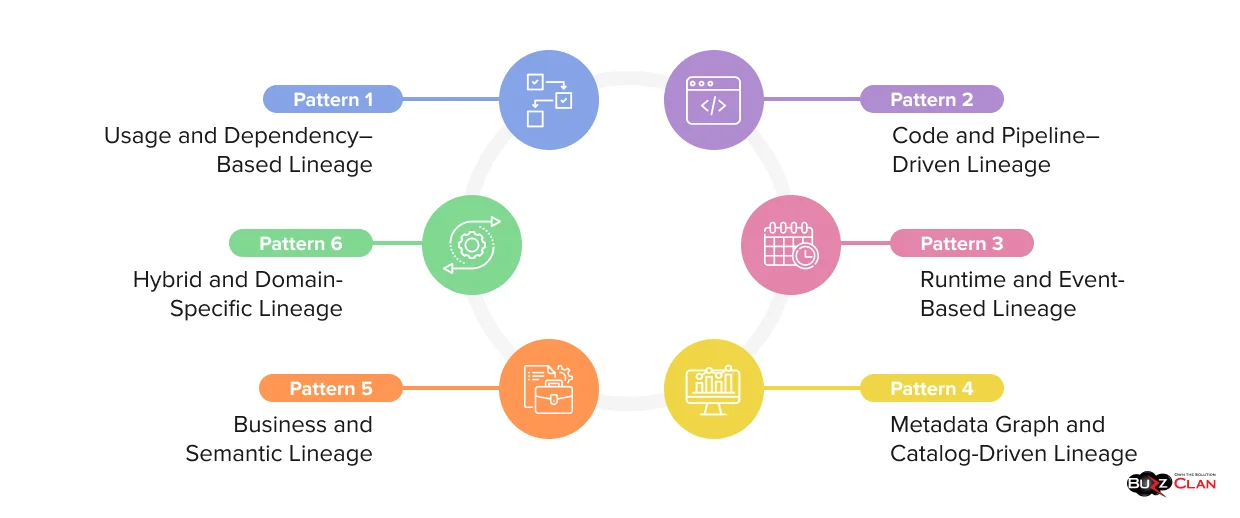
Pattern 1: Usage and Dependency–Based Lineage
This approach identifies relationships by observing how datasets are used together over time. By analyzing query logs and access patterns, lineage tools learn which tables, views, and fields consistently support the same reports or analytics.
For example, if a patient readmission dashboard repeatedly draws from the same three tables, the system establishes a dependency between them. When someone attempts to modify or remove one of those tables, lineage highlights the downstream impact, helping teams avoid breaking critical reports.
Pattern 2: Code and Pipeline–Driven Lineage
Code-based lineage captures transformation logic directly from SQL, ETL scripts, and data pipelines. Rather than inferring relationships, it reads the actual logic that defines how data is combined, filtered, and calculated.
For example, a “30-day readmission rate” metric may be derived from patient records, diagnosis codes, and discharge dates. By parsing the transformation code, lineage tools show exactly how those inputs are used, providing clear, defensible explanations when auditors or business leaders ask how a number was calculated.
Pattern 3: Runtime and Event-Based Lineage
Runtime lineage tracks data as it moves through systems in real time. By tagging records or events during execution, it allows teams to replay the exact path data followed through ingestion, processing, and consumption.
For example, heart rate data from a bedside monitor can be tracked from the moment it enters the system, through cleaning and enrichment, to the alert it ultimately triggers. If clinicians question an alert, engineers can trace the precise data journey that produced it, rather than relying on assumptions.
Pattern 4: Metadata Graph and Catalog-Driven Lineage
Metadata-driven lineage organizes relationships into a connected graph, making lineage searchable and explorable through a data catalog. This approach links datasets, dashboards, ownership, and documentation into a single navigable view.
For example, searching for “Sepsis Risk Score” in the catalog immediately reveals its source systems, transformation layers, owners, and downstream dashboards. Non-technical users can explore dependencies visually, while technical teams can drill deeper when needed.
Pattern 5: Business and Semantic Lineage
Semantic lineage connects business definitions to the technical data that supports them. It ensures that shared terms—such as KPIs, risk categories, or regulatory metrics—are consistently defined and applied across the organization.
For example, if “high-risk patient” has a specific clinical definition, semantic lineage shows every report, dashboard, and model using that definition. When the definition changes, teams can instantly identify which systems must be updated to maintain consistency and trust.
Pattern 6: Hybrid and Domain-Specific Lineage
Most enterprises use a hybrid approach, applying different lineage techniques based on domain, risk, and use case. This allows teams to balance depth, performance, and governance without overengineering every workflow.
For example, a healthcare organization may rely on usage-based lineage for general reporting, code-based lineage for regulated quality metrics, runtime lineage for ICU data streams, and a metadata catalog to unify everything into a single enterprise view. Each team sees the level of detail it needs, while leadership retains a cohesive picture of how data flows across the organization.
Data Lineage Tools for Enterprise
Choosing the right data lineage tool is not about picking the one with the fanciest visualizations. It is about finding a platform that fits into your existing workflows, scales with your data volume, and gives the right people the right level of detail without overwhelming them. Enterprise grade lineage tools need to handle complex, distributed environments while remaining practical enough that teams actually use them.
Here is what matters when evaluating data lineage software for enterprise environments:
Automatic discovery across your full stack
The best tools do not ask you to manually map every pipeline. They connect to your warehouses, data lakes, ETL platforms, BI tools, and orchestrators to discover lineage automatically. This means you get an accurate view of dependencies without spending months documenting systems that are already changing.
For example: A tool might plug into Snowflake, dbt, Airflow, and Tableau at once, building a complete map from raw ingestion through transformation layers to final dashboards, all without requiring your team to draw a single diagram.
Column level granularity
Table level lineage tells you “these two tables are connected,” but column level lineage shows exactly which fields feed which outputs. This precision is critical in regulated industries where audit teams want proof that sensitive data like patient IDs or financial identifiers are handled correctly.
For example: When a “total claims cost” metric looks wrong, column level lineage can show that it pulls from claims_detail.paid_amount, not claims_summary.billed_amount, helping teams pinpoint the exact source of a discrepancy.
Impact analysis before changes go live
A strong data lineage tool lets you ask “what breaks if I change this?” before you deploy. This turns risky releases into planned updates because you can see which dashboards, APIs, and models depend on the field or table you are about to modify.
For example: Before renaming a widely used column, the tool flags 18 downstream reports and 3 production models that will fail, allowing the team to coordinate updates or choose a safer migration path.
Integration with your existing tools
Lineage should not live in a separate silo. The best platforms integrate with data catalogs, quality monitoring, and incident management systems so lineage becomes part of daily workflows rather than something teams check only during emergencies. This is where modern data stack architectures shine, because lineage flows naturally between tools rather than requiring constant manual syncing.
For example: When a data quality monitor detects null values in a critical field, it automatically pulls up lineage to show which upstream job introduced the problem and which downstream assets are at risk.
Business friendly views alongside technical depth
Engineers need to see SQL, job names, and schema details. Business stakeholders need to see KPIs, data products, and ownership. Enterprise tools provide layered views so each audience gets what they need without forcing everyone to learn technical jargon.
For example: A finance leader can see that “operating margin” depends on “revenue recognition logic” and “allocated cost buckets” without needing to read the dbt code or Spark jobs underneath, while engineers working on those same metrics can drill into column transforms and join logic.
Governance and compliance support
For regulated industries, lineage is not optional. Data lineage tools for enterprise must support audit trails, time stamped snapshots, and role based access so compliance teams can prove how data moved and who accessed it. Integration with data governance frameworks ensures that lineage respects classification rules, retention policies, and access controls.
For example: During a HIPAA audit, the tool can generate a report showing every transformation applied to patient identifiers, which teams accessed those fields, and which downstream systems received the processed data, all with timestamps and version history.
Scalability for large, complex environments
Enterprise data platforms can include thousands of tables, tens of thousands of pipelines, and millions of column level relationships. Automated data lineage tools must handle that scale without slowing down or requiring constant manual tuning. Look for platforms that use graph databases and efficient indexing to keep lineage queries fast even as your data estate grows.
How to Implement Data Lineage in Your Organization
Implementing data lineage is not about mapping everything at once. It is about building the capability step by step, proving value quickly, and expanding coverage as teams see the benefits. Here is a practical path that works for most organizations:
Step 1: Identify your highest pain points
Start by asking where missing lineage hurts most right now. Is it during audits when teams scramble to explain metrics? During incidents when nobody knows what broke downstream? Or during migrations when dependencies are unclear? Pick one or two high value areas like regulated reporting, AI model features, or critical operational dashboards to pilot lineage implementation.
Step 2: Choose tools that fit your existing stack
Select a data lineage tool that connects naturally to the platforms you already use, such as your data warehouse, ETL tools, orchestration systems, and BI platforms. Look for automated discovery capabilities so you are not starting from scratch with manual documentation. Make sure the tool can scale as your data estate grows.
Step 3: Embed lineage in daily workflows
Integrate lineage views into the tools your teams already open, like data catalogs, incident dashboards, or CI/CD pipelines. When engineers review a pull request or analysts explore a new dataset, lineage should be right there, not hidden in a separate system they need to remember to check.
Step 4: Assign ownership and governance
Technical lineage shows connections, but you also need to show who owns what. Assign clear owners to critical data products and pipelines, and make those ownership boundaries visible in your lineage platform. This way, when a metric changes or a pipeline fails, teams know exactly who to contact.
Step 5: Automate discovery and updates
Set up automated scanning so lineage stays current as schemas evolve, new sources are added, and pipelines are refactored. Enable automated alerts for breaking changes, so teams get warnings before deployments rather than discovering problems in production. This supports the principles of designing data pipelines with built in observability.
Step 6: Train users across the organization
Lineage is valuable beyond engineering teams. Train analysts, product managers, and business stakeholders on how to read lineage views and use them for tasks like impact analysis, data discovery, and understanding KPI construction. The broader the adoption, the more use cases emerge naturally.
Step 7: Measure impact and expand gradually
Track concrete metrics like incident resolution time, audit response speed, and release confidence. Use these results to show ROI and justify expanding lineage to additional domains. Treat lineage as an evolving capability that grows with your organization rather than a one time documentation project.
Organizations that follow this staged approach build sustainable lineage practices that support innovation, compliance, and trust without overwhelming teams or requiring massive upfront investment.
Barriers to Effective Data Lineage Adoption
Even when leadership agrees that data lineage is essential, turning that agreement into a working capability is not always straightforward. Most blockers have less to do with technology and more to do with how teams, processes, and legacy systems are set up.
Fragmented data landscape
Many organizations run a mix of cloud warehouses, legacy databases, SaaS platforms, and shadow pipelines built over years.
When every team uses different tools and naming conventions, lineage platforms struggle to stitch together a clean picture, and metadata gaps appear exactly where visibility is most needed.
Incomplete or poor quality metadata
Lineage depends on reliable metadata such as table names, job configs, owners, and business terms.
If assets are poorly named, undocumented, or missing ownership, the resulting lineage graph becomes noisy and hard to trust, which discourages adoption. Investing in basic data governance and catalog hygiene is often a prerequisite for accurate lineage.
Overreliance on manual documentation
Some teams try to maintain lineage in spreadsheets, wikis, or slide decks.
These artifacts quickly fall out of date, create conflicting versions of truth, and train users to distrust lineage views. This history of stale documentation can make stakeholders skeptical when automated tools are finally introduced.
Fear of exposing technical debt
Lineage surfaces every brittle pipeline, undocumented shortcut, and inconsistent definition in one place.
Teams sometimes hesitate to roll it out widely because it reveals issues that have been quietly tolerated for years, from duplicate logic to ungoverned data products. Without a clear plan for remediation, that transparency can feel risky.
Limited integration with day to day workflows
When lineage lives in a separate portal that people only open during crises, it never becomes part of normal work.
If engineers cannot see lineage in their CI/CD tools, analysts cannot access it from BI, and governance teams cannot use it in their catalog, adoption stalls and the platform is written off as “nice to have.”
BuzzClan’s Expertise in Automated Data Lineage
BuzzClan transforms data lineage from theory into practice, helping organizations build capabilities that teams actually use daily.
What we deliver:
- Automated lineage across your full stack
- We implement solutions that integrate with warehouses, data lakes, ETL tools, and BI platforms, capturing column level dependencies and business context in one unified view.
- Modern architecture integration
- Whether you are building a modern data stack or adopting data mesh architecture, we embed lineage as the connective tissue that makes distributed ownership and rapid change manageable.
- Proven results
- Our clients achieve 100% uptime during migrations and 60% faster audit response through automated lineage that surfaces dependencies instantly.
- Knowledge transfer
- We train your teams so lineage becomes a sustainable capability you own and operate independently.
Data Lineage Shouldn’t Be Your Team’s Next Six-Month Project
BuzzClan implements automated lineage solutions that integrate with your existing stack, delivering visibility in weeks instead of quarters. We combine technical deployment with change management so lineage becomes a working capability, not another unused tool. Ready to accelerate your compliance, shorten incident response, and build trust across your data ecosystem?
Conclusion
Data lineage changes the conversation from “Can we trust this number?” to “What should we do about it?” This shift happens quietly but powerfully once teams can trace metrics back to their source without manual detective work.
The organizations implementing automated lineage today are not chasing a future trend. They are solving immediate friction: audits that take weeks instead of days, incidents that require guesswork instead of clear diagnosis, and changes that feel risky because nobody knows what might break. Every use case that gets mapped makes the next one easier, creating a capability that compounds over time.
Start with one high value area, prove the ROI, and expand as adoption grows. The tools exist, the techniques are proven, and the practical benefits show up faster than most teams expect.
FAQs

Get In Touch
Follow Us