Top 10 Generative AI Tools Enterprises Need to Know in 2026
Dhiraj Chhabra
Mar 23, 2026
Businesses today are under constant pressure to do more—faster, better, and at a lower cost.
This is where enterprise generative AI tools are starting to make a real difference.
These tools are not just for experiments anymore. Companies are using them to write emails and reports, generate code, summarize large documents, analyze data, and even automate customer responses.
Instead of spending time on manual tasks, teams can use AI to handle routine work and focus more on important, strategic activities.
But there’s a problem—there are too many tools, and not all of them are built for enterprise needs such as security, scalability, and control.
So how do you choose the right one for your enterprise?
In this blog, we will walk you through the best generative AI tools in 2026, compare what they offer, and show how businesses are actually using them. This will help you understand what works best for your organization and where to start.
Before we look at the top tools, let’s first understand what generative AI tools actually are and how they work in an enterprise setting.
What Are Generative AI Tools?
Generative AI tools are software platforms that use advanced machine learning models, especially large language models (LLMs) and multimodal models, to generate new content, insights, or solutions from user prompts or data inputs.
Unlike traditional automation software that follows fixed rules, generative AI can produce:
- Written content
- Software code
- Images and videos
- Data insights
- Automated responses
- Design concepts
In enterprise environments, these tools are used to streamline workflows, improve productivity, and support data-driven decision-making.
For example, healthcare teams use AI for documentation and data summarization, retail enterprises use it for marketing content and customer insights, and businesses use it to automate workflows and improve decision-making.
What Are the Best Enterprise Generative AI Tools in 2026?
The best enterprise generative AI tools in 2026 include platforms like ChatGPT, Microsoft Copilot, Google Gemini, Claude, and GitHub Copilot. These tools help organizations automate workflows, generate content, assist developers, and enhance decision-making through AI-powered insights. Enterprises use them across departments such as software development, marketing, operations, and customer support to improve productivity and innovation.
Types of Generative AI Tools
Enterprise generative AI tools are not all the same. They are designed for different business needs, depending on the team and use case.
Here are the main types of generative AI tools used in enterprises:
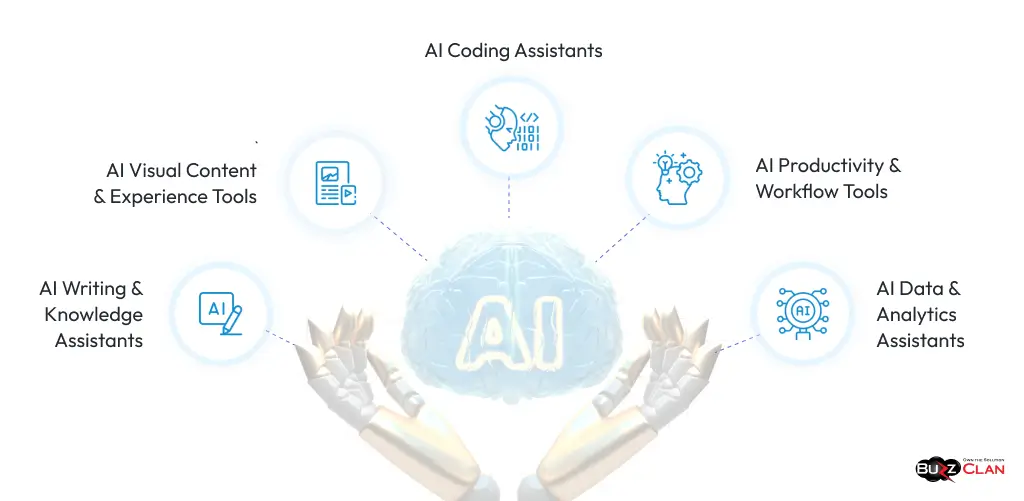
AI Writing & Knowledge Assistants
These tools help create reports, documentation, emails, and content across business functions.
Enterprises streamline documentation and make knowledge easier to access and manage.
They are especially useful in industries like healthcare, retail, and commercial enterprises, where teams handle large volumes of data and content.
Example: Healthcare teams generating patient documentation, retail enterprises creating product and campaign content, and businesses building internal reports and knowledge bases.
AI Coding Assistants
These tools support developers by writing, reviewing, and improving code.
They help reduce development time and allow teams to build and fix software faster.
Example: A developer using AI to generate code snippets or debug errors.
AI Visual Content & Experience Tools
These tools generate images, videos, and design assets to support business needs.
In enterprises, they are used to create content faster, maintain brand consistency, and support marketing, training, and customer engagement.
Example: Retail enterprises creating product and campaign visuals, healthcare organizations developing training content, and businesses designing marketing and brand assets.
AI Productivity & Workflow Tools
These tools help automate everyday business tasks and improve team productivity.
They can summarize meetings, organize notes, and manage workflows across teams.
Example: Automatically generating meeting summaries or task updates.
AI Data & Analytics Assistants
These tools help businesses understand data by turning complex information into simple insights.
They allow users to ask questions in plain language and get answers without needing technical skills.
Example: A business analyst asking AI to summarize sales performance or trends.
Expert Insight
How are generative AI tools transforming enterprises in 2026?
“We’re moving from prompt-driven interactions by individuals to enterprise-gated workflow-driven systems. Generative AI is now integrated into orchestration layers—connecting APIs, data, and business logic—to autonomously execute tasks. That’s what’s driving real enterprise impact: fewer handoffs, tighter feedback loops, and continuously improving processes.” — Sachin Jain
Top 10 Enterprise Generative AI Tools in 2026
Here are the top enterprise generative AI tools in 2026, selected based on their capabilities, scalability, and real-world business use cases.
| Tool | Best For | Key Features | Enterprise Use Case | Pricing |
|---|---|---|---|---|
| ChatGPT | Content, productivity, and knowledge tasks | Conversational AI, content generation, data analysis, coding support | Internal knowledge assistant, customer support, content creation | Free + paid plans; enterprise plan available |
| Microsoft Copilot | Workplace productivity | Integration with Word, Excel, Teams, and workflow automation | Document creation, meeting summaries, business workflows | Paid (Microsoft 365 add-on); enterprise plans |
| Google Gemini | Multimodal AI tasks | Text, image, code generation; Google Workspace integration | Data analysis, collaboration, and content generation | Free + paid plans; enterprise tiers |
| Claude | Safe and long-document processing | Large context window, strong reasoning, document analysis | Research, legal docs, compliance-heavy workflows | Free + paid plans; enterprise plans |
| GitHub Copilot | Developer productivity | Code suggestions, auto-completion, and debugging help | Faster software development and code quality improvement | Paid per user; enterprise plans |
| Midjourney | Creative image generation | High-quality AI images, artistic styles | Marketing creatives, branding, design concepts | Paid plans (no free tier) |
| Jasper | Marketing content | Brand voice, campaign generation, templates | Marketing automation, content scaling | Paid plans; enterprise options |
| Synthesia | Video creation | AI avatars, text-to-video, multilingual support | Training videos, onboarding, marketing content | Paid plans; enterprise options |
| Notion AI | Knowledge management | AI writing, summaries, task management | Internal documentation, team collaboration | Paid add-on; enterprise plans |
| Adobe Firefly | Design and creative workflows | Image generation, design tools integration | Enterprise design, marketing creatives | Included in Adobe plans; enterprise licensing |
ChatGPT
ChatGPT is one of the most widely used enterprise generative AI tools for handling everyday business tasks using simple instructions.
Overview
ChatGPT is a conversational AI tool that can generate text, write code, analyze data, and answer questions. It works like a smart assistant that understands what you ask and gives useful outputs in seconds.
Enterprise Features
- Secure enterprise environment
- Custom AI trained on company data
- Advanced data analysis
- API integrations with business tools
- Role-based access and controls
Use Cases
- Creating reports, emails, and documentation
- Automating customer support responses
- Assisting developers with code
- Answering internal business queries
Microsoft Copilot
Microsoft Copilot is designed to improve productivity by working directly inside Microsoft tools like Word, Excel, and Teams.
Overview
It acts as an AI assistant within everyday workplace applications, helping users complete tasks faster without switching tools.
Enterprise Features
- Deep integration with Microsoft 365
- Meeting summaries in Teams
- Data analysis in Excel
- Document generation in Word
- Enterprise-grade security and compliance
Use Cases
- Writing and editing documents
- Summarizing meetings and emails
- Automating reports in Excel
- Managing internal workflows
Google Gemini
Google Gemini is a powerful multimodal platform and one of the fastest-growing enterprise generative AI tools, especially for organizations already using Google Workspace.
Overview
Google Gemini can understand and generate text, images, and code. It works across tools like Google Docs, Sheets, and Gmail, making it easy for teams to use AI without changing how they work.
Enterprise Features
- Deep integration with Google Workspace (Docs, Sheets, Gmail, Drive)
- Multimodal capabilities (text, images, and code in one place)
- Real-time collaboration with AI assistance
- Access to Google Cloud infrastructure for scalability
- Enterprise-grade security and data controls
Use Cases
- Writing and editing documents directly in Google Docs
- Analyzing data and generating insights in Sheets
- Drafting emails and responses in Gmail
- Collaborating on projects with AI-assisted inputs
- Extracting insights from large datasets stored in Google Cloud
Claude
Claude is known for its strong focus on safety, accuracy, and handling large amounts of information, making it a reliable choice among enterprise generative AI tools.
Overview
Claude is designed to process long and complex documents while giving clear and structured responses. It is especially useful for tasks that require careful reasoning and detailed analysis.
Enterprise Features
- Large context window for processing long documents
- Strong reasoning and summarization capabilities
- Safety-focused AI design (helpful for regulated industries)
- Secure deployment options for enterprise use
- Ability to analyze multiple documents at once
Use Cases
- Reviewing legal contracts and compliance documents
- Summarizing long research reports
- Creating policy documents and internal guidelines
- Answering questions from large knowledge bases
- Supporting teams in finance, legal, and operations
GitHub Copilot
GitHub Copilot is one of the most widely adopted enterprise generative AI tools for software development teams.
Overview
GitHub Copilot acts like an AI pair programmer. It suggests code in real time as developers type, helping them write faster and reduce errors.
Enterprise Features
- Real-time code suggestions and auto-completion
- Integration with popular IDEs like Visual Studio Code
- Support for multiple programming languages
- Code security and policy controls for enterprises
- Collaboration features for development teams
Use Cases
- Writing code faster with AI suggestions
- Debugging and fixing errors
- Generating test cases
- Improving code quality and consistency
- Reducing development time for applications
Midjourney
Midjourney is a leading choice for enterprises that need high-quality visuals and creative assets.
Overview
Midjourney generates images based on text prompts. It is widely used by creative teams to quickly turn ideas into visuals without traditional design effort.
Enterprise Features
- High-quality, realistic image generation
- Ability to create multiple design variations
- Custom styles for branding needs
- Fast turnaround for creative production
- Community-driven workflows for inspiration
Use Cases
- Creating marketing and ad creatives
- Designing social media visuals
- Developing product concepts and mockups
- Supporting branding and campaign design
- Generating visuals for presentations and pitches
Jasper
Jasper is built specifically for marketing teams and content-heavy businesses.
Overview
Jasper helps enterprises create large volumes of content while maintaining a consistent brand voice. It is one of the most focused enterprise generative AI tools for marketing use cases.
Enterprise Features
- Brand voice customization
- Pre-built templates for marketing content
- Campaign and content planning tools
- Collaboration features for teams
- Integration with marketing workflows
Use Cases
- Writing blogs and SEO content
- Generating ad copy and landing pages
- Creating email campaigns
- Scaling social media content
- Managing multi-channel marketing campaigns
Synthesia
Synthesia helps enterprises create professional videos without the need for cameras, studios, or actors.
Overview
Synthesia converts text into videos using AI avatars and voiceovers. This makes video production faster, cheaper, and easier to scale.
Enterprise Features
- AI avatars and realistic voice generation
- Support for multiple languages
- Custom branding and templates
- Enterprise-level video management
- Easy editing and updates
Use Cases
- Employee training and onboarding videos
- Internal communication and updates
- Product demos and explainers
- Marketing and promotional videos
- Learning and development content
Notion AI
Notion AI is a simple but powerful tool for managing knowledge and improving team productivity.
Overview
Notion AI adds generative AI capabilities to documents, notes, and workflows, making it easier for teams to organize and use information.
Enterprise Features
- AI-powered writing and summarization
- Task and project management tools
- Centralized knowledge base
- Collaboration across teams
- Integration with existing workflows
Use Cases
- Creating and managing internal documentation
- Summarizing meeting notes
- Organizing project tasks
- Sharing knowledge across teams
- Improving team collaboration
Adobe Firefly
Adobe Firefly is designed for enterprises that rely on design and creative production at scale.
Overview
Adobe Firefly brings generative AI directly into Adobe tools, allowing designers to create and edit visuals faster.
Enterprise Features
- Integration with Adobe Creative Cloud
- Image and design generation
- Brand-safe AI outputs
- Advanced editing and customization
- Enterprise licensing and governance
Use Cases
- Creating marketing and advertising visuals
- Designing brand assets
- Editing images and graphics
- Scaling creative production
- Supporting design teams with faster workflows
How to Choose the Right Generative AI Tool for Your Business
Choosing the right enterprise generative AI tools is not just about features—it’s about finding what works best for your business goals.
Here are a few simple things to consider:
Start with Your Use Case
Before selecting any tool, be clear about what you want to achieve.
Ask questions like:
- Which tasks take too much time today?
- Where are teams struggling with efficiency?
- What processes can be automated or improved?
For example:
- If your teams spend hours writing content → look at AI writing tools
- If development is slow → consider AI coding assistants
- If decision-making is delayed → explore AI data tools
The best AI tools for business are chosen based on real problems, not trends.
Map the Tool to Your Team’s Workflow
A tool may be powerful, but if it doesn’t fit into how your team works, it won’t be used.
Look for generative AI platforms that:
- Integrate with your existing tools (CRM, ERP, Slack, Microsoft, Google Workspace)
- Require minimal training
- Can be used directly within daily workflows
The easier it is to use, the faster your teams will adopt it.
Focus on Security and Compliance
When using enterprise generative AI tools, your business data is involved, and that makes security critical.
Make sure the tool provides:
- Data privacy and encryption
- Role-based access controls
- Clear policies on how your data is used
- Options for private or enterprise deployments
This is especially important for industries like finance, healthcare, and government.
Evaluate Scalability
A tool that works for one team should also work across the organization.
Ask:
- Can this tool support multiple departments?
- Will it handle large volumes of data and users?
- Does it offer enterprise-grade performance?
Scalable generative AI platforms help you avoid switching tools later.
Evaluate Performance and Reliability at Scale
Some enterprise generative AI tools work well in small tests but struggle when used across the organization.
As more teams start using the tool, issues such as slow response times, downtime, or inconsistent performance can undermine productivity and erode trust in AI.
Before choosing a tool, consider:
- Can it handle multiple users and large workloads at the same time?
- Does it maintain speed and accuracy as usage grows?
- Does the vendor provide strong uptime and support?
Even small performance issues can create frustration and slow down adoption.
To get the most value from AI tools for business, enterprises need solutions that are stable, reliable, and built to perform consistently at scale.
Benefits of Using Generative AI Tools in Enterprises
Adopting generative AI isn’t just about automating tasks. It’s about changing how work gets done — faster, smarter, and at a larger scale.
Here’s what businesses are actually seeing:
Teams Get More Done, Faster
Tasks that once took hours now take minutes. Writing reports, building presentations, generating code — AI handles the heavy lifting so teams can move quickly without getting stuck in the weeds.
Result: Faster project delivery and fewer bottlenecks.
Employees Focus on Work That Actually Matters
When AI handles repetitive, time-consuming tasks, employees can focus their energy on thinking, planning, and solving real problems. That’s a better deal for everyone.
Result: Higher productivity and smarter use of skilled people.
Decisions Get Made Faster
Generative AI can process large amounts of data and surface clear insights — without waiting on manual analysis. Leaders get the information they need, when they need it.
Result: Quicker, more confident business decisions.
Consistent Quality Across the Board
Tone, format, and quality can vary a lot when different teams produce content independently. AI helps set a standard and stick to it, whether it’s a customer email or an internal report.
Result: More professional, uniform outputs across the organization.
Scale Operations Without Scaling Costs
As the business grows, AI absorbs more of the workload — without requiring a proportional increase in headcount. You do more with what you already have.
Result: Efficient growth with better cost control.
Go From Idea to Execution, Faster
Testing a concept, drafting a prototype, exploring a new approach — AI compresses the time between having an idea and acting on it. That speed is a real competitive edge.
Result: More innovation and quicker time to market.
Customers Get a Better Experience
Faster responses, more personalized communication, and better support — AI makes every customer interaction smoother. And smoother interactions build loyalty.
Result: Higher customer satisfaction and stronger retention.
Conclusion
Generative AI is no longer an experiment. In 2026, it’s a working part of how serious enterprises operate — across content, code, data, design, and customer experience.
The tools covered in this blog each solve a real problem. The right one for your organization depends on where you’re losing the most time, what your teams already use, and how seriously you need to treat security and compliance.
A few things worth keeping in mind as you evaluate options:
- No single tool does everything well — start narrow, then expand
- Free tiers are great for testing, but enterprise needs require enterprise plans
- The biggest gains come from tools embedded in daily workflows, not used occasionally
- Adoption takes more than access — teams need clear use cases to get real value
The best time to start is with one problem, one team, and one tool. Get that right before scaling across the organization.
Want to go deeper? Explore BuzzClan’s blog for more practical insights on enterprise AI, managed IT, and digital transformation.
Frequently Asked Questions
Generative AI tools are software applications that can create content such as text, images, code, or videos based on user input. These tools use advanced AI models to understand instructions and generate useful outputs, helping businesses automate tasks and improve productivity.
Generative AI in enterprise software refers to the use of AI capabilities within business applications to automate tasks, generate content, and support decision-making. Enterprise generative AI tools are designed with added features like security, scalability, and integration to meet business needs.
Generative AI focuses on creating new content such as text, images, or code. Enterprise AI is a broader concept that includes generative AI as well as other technologies like data analytics, machine learning, and automation used in business environments. In simple terms, generative AI creates content, while enterprise AI covers all types of AI used in businesses.
Some of the best enterprise generative AI tools in 2026 include ChatGPT, Microsoft Copilot, Google Gemini, Claude, and GitHub Copilot. These tools are widely used for content creation, coding, automation, and data analysis in enterprises.
The best enterprise generative AI tools are those that offer strong security, scalability, and integration with existing systems. Tools like ChatGPT Enterprise, Microsoft Copilot, Google Gemini, and Claude are commonly used by businesses to improve productivity and automate workflows.
The top 10 enterprise generative AI tools include ChatGPT, Microsoft Copilot, Google Gemini, Claude, GitHub Copilot, Midjourney, Jasper, Synthesia, Notion AI, and Adobe Firefly. These tools support a wide range of enterprise use cases such as content creation, software development, design, and workflow automation.

Get In Touch
Follow Us