

Generative AI vs Predictive AI: Key Differences, Use Cases, and When to Use Each
Abhi Garg
Apr 15, 2026
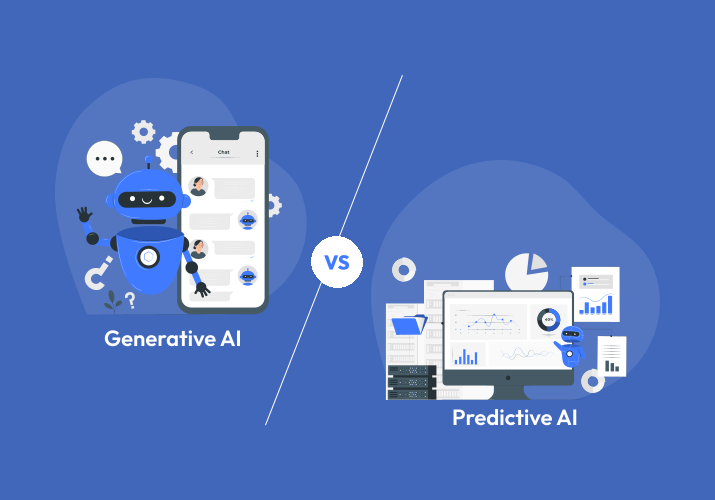
When enterprise leaders talk about AI strategy today, the question isn’t just “should we use AI?” — it’s “which kind of AI, and where?” The generative AI vs predictive AI debate sits at the center of that conversation, and getting it wrong can cost you both time and budget.
Generative AI makes headlines for creating content, code, and conversation. Predictive AI quietly powers the forecasting models, fraud detection engines, and demand planners that enterprises have relied on for years. They are not competing tools — they serve completely different purposes. But together, deployed intelligently, they represent the full spectrum of what modern enterprise AI solutions can deliver.
This guide breaks down what each type of AI actually does, where it adds the most value, and how to build a strategy that uses both to their full potential.
What Is Generative AI?
Generative AI learns from vast amounts of existing data and uses that knowledge to create new content — text, code, images, and more — on demand. For business leaders, the value is straightforward: it automates time-consuming knowledge work, accelerates decision-making, and scales output without scaling headcount.
Start exploring how generative AI can drive efficiency and growth for your organization today.
Types of Generative AI

Generative AI is not one single technology — it is a family of different model types, each solving a different kind of business problem.
- Large Language Models (LLMs) — These are the most widely used AI models today, including ChatGPT, Claude, and Gemini. Built on transformer architecture, which serves as the foundation for many modern AI systems, LLMs understand and generate human-like text. Enterprises use them for chatbots, contract drafting, email automation, coding assistance, and internal knowledge systems.
- Generative Adversarial Networks (GANs) — A class of models where two neural networks (a generator and a discriminator) are trained in opposition. This adversarial process helps generate highly realistic synthetic data, including images, videos, and product visuals.
- Diffusion Models — The technology behind tools like DALL·E and Midjourney. These models generate images by gradually removing noise from random data, guided by a text prompt. They are widely used in marketing, design, and content creation.
- Transformer Architecture — The foundational architecture behind modern AI systems. It underpins models such as LLMs and many multimodal models, providing strong context understanding and efficient generation of text, code, and structured outputs. Other models, such as diffusion models, also incorporate aspects of the transformer architecture to enhance their capabilities.
Each type has a different strength, and most enterprise AI programs end up using more than one depending on the workflow they are trying to improve.
Which AI Tools are Enterprises Actually Using in 2026?
Gain a clear understanding of which generative AI tools are being adopted in 2026. Reviewing the top 10 tools essential for enterprises is highly recommended.
What is Predictive AI?
Predictive AI analyzes historical data to forecast outcomes and identify patterns at scale. It helps businesses detect risks, predict demand, and anticipate customer behavior. With real-time processing and continuous learning, it enables faster, more accurate decision-making across operations.
Types of Predictive AI
Predictive AI covers several model types, each designed for a specific kind of business decision:
- Regression Models — Forecast numerical outcomes like revenue, demand, or pricing. Used when you need a specific number, not just a category.
- Classification Models — Sort outcomes into groups. Fraud or not fraud. Churn risk or safe. High value or low value. These are the most powerful risk and filtering systems.
- Time Series Models — Analyze patterns over time to predict what comes next. Ideal for inventory planning, financial forecasting, and seasonal demand.
- Clustering Models — Group customers, products, or behaviors by similarity without predefined labels. The foundation of most segmentation and personalization strategies.
Together, these models help businesses reduce risk, plan smarter, and make faster, more confident decisions.
Comparison Table: Generative AI vs Predictive AI
| Feature | Generative AI | Predictive AI |
|---|---|---|
| Core Purpose | Creates new content or data | Forecasts future outcomes |
| Output Type | Text, images, code, audio, video | Scores, probabilities, classifications |
| Data Dependency | Large volumes of unstructured data | Structured historical data |
| Model Examples | GPT, Claude, DALL·E, Gemini, Llama | XGBoost, Random Forest, LSTM, Prophet |
| Typical Use Cases | Chatbots, content creation, code generation, report drafting | Churn prediction, fraud detection, demand forecasting |
| Business Value | Automates content and knowledge-based tasks | Improves decision-making and reduces risk |
| Interpretability | Less transparent (black-box models) | More explainable and easier to audit |
| Compute Requirements | High (requires GPUs, LLM APIs) | Moderate (works with standard data systems) |
| Maturity Level | Rapidly evolving, growing adoption | Mature and widely used across industries |
How Generative AI and Predictive AI Work Together
Most enterprises treat these as two separate tools. The ones getting the most value are using them as one connected system.
Here is how that actually works in practice:
Stage 1 — Predict: A predictive model scans your data and surfaces a signal — a high-risk customer, an anomaly in transactions, a demand spike on the horizon.
Stage 2 — Generate: A generative AI layer picks up that signal and turns it into something actionable — a personalized retention email, a risk summary, an automated response — grounded in your actual business data.
Stage 3 — Act: The output gets pushed directly into your existing systems — your CRM, your marketing platform, your operations dashboard — without anyone having to manually trigger it.
The result is not just a smarter model. It is a fully automated business workflow that moves from data to decision to action without human intervention at every step.
This is the difference between an AI pilot that lives in a spreadsheet and an AI program that shows up on the balance sheet.
For a deeper look at how modern data infrastructure makes this kind of pipeline possible, the Azure Data Factory and Databricks case study is a practical reference.
Still Confused: Which AI is Right for Your Business?
Choosing between generative and predictive AI depends on your goals, data, and use cases. The right approach—or a combination of both—can unlock real business value.
How Each Contributes to Enterprise Analytics
Most analytics tools tell you what happened. The real value comes when your data can also tell you what will happen next — and explain it in a way every team can act on. That is what combining predictive and generative AI in analytics actually delivers.
What Predictive AI Does
- Forecasts sales, revenue, and demand by region, product, or customer segment
- Detects unusual patterns in financial data, operations, or customer behavior
- Group customers by value, churn risk, or likelihood to convert
- Runs what-if scenarios to support strategic planning
What Generative AI Does
- Turns complex dashboard data into a clear, plain-English summary
- Answers direct questions about your data in plain language
- Automatically writes weekly performance reports for leadership
- Generates compliance documents and regulatory reports from raw data
Where predictive AI finds the insight, generative AI makes it usable for everyone — not just analysts. That is how business intelligence services move beyond static dashboards and into something the whole business can work with. For more on the commercial side of this, Maximizing ROI Through Generative AI Applications in the Enterprise is worth reading.
Generative AI vs Predictive AI Examples
The best way to understand the difference is to see how they each play out in the same business scenario.
| Use Case | Predictive AI Role | Generative AI Role |
|---|---|---|
| Education | Predicts student performance and dropout risk | Generates learning materials and personalized study content |
| Financial Services | Detects fraud and predicts credit risk | Generates compliance reports and customer communication |
| Government | Forecasts service demand and risk patterns | Generates citizen service responses and policy summaries |
| Healthcare | Predicts patient risk and outcomes | Generates clinical notes and treatment summaries |
| Hospitality | Predicts booking demand and occupancy rates | Generates guest communication and service messaging |
| Manufacturing | Predicts equipment failure and demand trends | Generates maintenance reports and process documentation |
| Retail | Predicts customer demand and buying behavior | Generates product descriptions and marketing content |
For a real-world example of how this plays out in practice, see how AI-powered KYC for a digital wallet provider used predictive models to cut manual verification time from days to minutes — with generative AI handling the customer-facing communication layer on top.
Still deciding where AI fits in your business?
Let’s help you identify the right approach and build a clear roadmap.
When to Use Generative AI vs Predictive AI: A Decision Framework
Choosing between generative AI and predictive AI depends on your business goals, data maturity, and use cases. While each serves a different purpose, understanding when to use one or both can help organizations make smarter decisions and maximize the impact of their AI investments.
When to Use Generative AI
- You need to automate content at scale — contracts, reports, patient documentation, or policy briefs.
- Customer-facing teams in retail, hospitality, or financial services need personalized responses without manual effort.
- Developers need code generation, review assistance, or automated documentation.
- Government and healthcare teams need to make complex data accessible to non-technical staff.
- You want to build internal copilots, customer chatbots, or voice assistants.
When to Use Predictive AI
- Your goal is forecasting — sales in retail, patient readmission in healthcare, and equipment failure in manufacturing.
- You need high-volume classification — fraud detection in financial services, lead scoring in technology, and resource allocation in government. Real-time decisions depend on live signals — inventory reordering, dynamic pricing, and maintenance scheduling.
- Meet regulatory requirements in healthcare, finance, or government with explainable, auditable model outputs.
When to Use Both
- Integrate both AI types to predict risk and automatically generate responses within a full workflow.
- Provide retail or hospitality teams with both customer scoring and personalized outreach.
- Your analytics team needs both forecasting accuracy and leadership-ready narratives.
- Scale AI from a single department into an enterprise-wide program across education, manufacturing, or financial services.
The Right Choice isn’t Always Obvious from Use Cases Alone.
Aligning AI with your data and business goals is where real value is created.
Conclusion
Generative AI and predictive AI are not rivals — they are two halves of the same strategy. Predictive AI tells you what is coming, while generative AI helps you respond to it. Enterprises that bring both together are the ones turning AI into a real competitive advantage.
The technology is ready — the real question is whether your data, infrastructure, and strategy are ready to support it.
If you’re exploring where AI is headed next and how it fits into broader technology trends, it’s worth taking a closer look at emerging insights shaping the future of cloud and AI adoption.
Frequently Asked Questions
Generative AI creates new content like text, images, or code. Predictive AI analyzes past data to forecast future outcomes. In simple terms, generative AI creates, while predictive AI predicts.
No, they serve different purposes. Generative AI creates content, while predictive AI focuses on forecasting and decision-making. Businesses get the best results by using both together.
It depends on the need. Predictive AI is best for forecasting and decision-making, while generative AI is ideal for content and productivity. Most businesses benefit from using both together.
Predictive AI finds patterns and predicts outcomes, while generative AI turns those insights into content or actions like reports, emails, or recommendations.
Both have challenges. Predictive AI needs clean data and accuracy, while generative AI requires strong infrastructure and control. Success depends on clear goals and the right implementation approach.
There are four main types of AI: Reactive Machines, Limited Memory AI, Theory of Mind AI, and Self-Aware AI. Most of the AI we use today falls under the category of Limited Memory AI, which uses past data to help make decisions.

Get In Touch
Follow Us

Table of Contents
- What Is Generative AI?
- Types of Generative AI
- What is Predictive AI?
- Types of Predictive AI
- Comparison Table: Generative AI vs Predictive AI
- How Generative AI and Predictive AI Work Together
- How Each Contributes to Enterprise Analytics
- Generative AI vs Predictive AI Examples
- When to Use Generative AI vs Predictive AI: A Decision Framework
- Conclusion
- Frequently Asked Questions


