
What Are Generative AI Models? How They Work and Why They Matter
Abhi Garg
Feb 6, 2026

The AI-generated email went to 50,000 customers before anyone caught the mistake. It promised a product feature that doesn’t exist.
This isn’t a rare incident. It’s a pattern most companies quietly deal with. Teams deploy tools like ChatGPT, Claude, or Gemini, expecting them to verify facts before responding. But these systems don’t work that way. They generate text based on patterns, not by checking what’s actually true. The writing looks polished, and the tone sounds confident, which is exactly why teams trust it until something breaks.
The issue isn’t the tools themselves. It’s not understanding how generative AI models actually work. These models predict what comes next based on training data. When you ask a question, the generative model produces a likely-sounding response, whether the information is real or made up.
Once you understand this, your approach changes. You use these models for speed while keeping humans involved where accuracy matters.
This blog explains what generative AI models are, how they create responses, which types of businesses rely on today, and why understanding how these models work matters before deploying them into anything critical.
What Are Generative AI Models?
Generative AI models are AI systems trained on large datasets that can create new content like text, images, or code based on patterns they learned.
They do not look up verified facts when you ask a question. They generate the most likely response based on what they have seen during training, which is why they can sound confident even when they are wrong.
These models are already being used across industries in practical ways.
- Healthcare organizations use them to draft clinical documentation and summarize patient records.
- Financial services firms deploy them for report generation and customer inquiry responses.
- Marketing teams rely on them for content creation and campaign ideation.
The applications keep expanding because these models handle pattern-based tasks quickly. Even though they need human oversight for accuracy. Examples you might already know include ChatGPT, Claude, Gemini, Llama, DALL·E, and Stable Diffusion.
Why Generative AI Models Matter for Businesses
Once businesses understand what these models are, the value they bring starts making more sense.
- Faster content creation – Teams can draft emails, summaries, and reports much quicker, then review and polish them before publishing.
- Less time on repetitive tasks – Routine writing and basic analysis get done faster. Giving people more time for important work that needs human judgment.
- Quicker customer support – With proper oversight, businesses can respond to customers faster and keep answers more consistent.
- Faster development cycles – Developers get help with writing code, finding bugs, and testing ideas without starting from scratch every time.
How Do Generative AI Models Work?
Generative AI models work by learning patterns from massive amounts of training data, then using those patterns to predict what should come next. Understanding this helps you make better decisions about where these tools fit in your workflows.
Here’s what actually happens behind the scenes:
- They learn from billions of examples – These models analyze millions of texts, conversations, and documents during training. They pick up patterns in how words connect and how content is structured. The more examples they see, the better they predict what typically comes next.
- They generate responses through prediction – When you ask a question, the model builds a response word by word based on what usually follows in similar situations. This is why they handle such a wide range of tasks without being programmed for each one.
- They work incredibly fast – All this prediction happens in milliseconds. You get responses almost instantly, which makes these models practical for everyday work like drafting emails or generating code.
- They perform best with familiar patterns – When your request matches something the model saw often during training, you’ll usually get solid results. For niche topics or very recent information, having someone review the output becomes more important.
This pattern-based approach is both the strength and the limitation of generative AI. When you understand how it works, you can use these models strategically. You lean on them for speed and creativity where patterns are clear, and you keep humans involved where accuracy and specialized expertise matter most.
Types Of Generative AI Models Enterprises Use Today
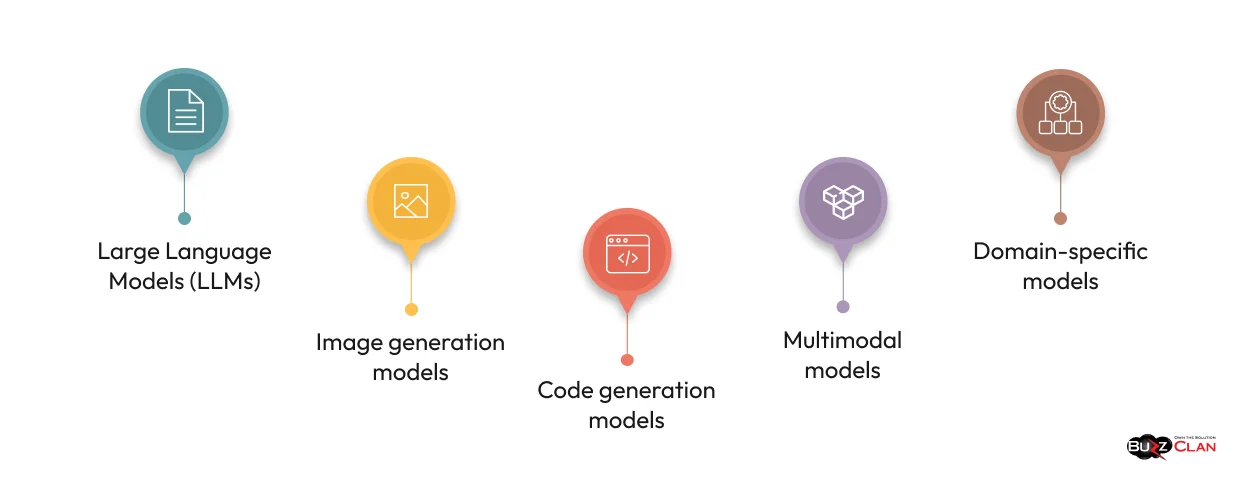
Not all generative AI models work the same way. Different types are built for different tasks, and knowing which one fits your needs matters more than most teams realize.
Here are the main types of enterprises that rely on it:
- Large Language Models (LLMs) – These handle text-based tasks like writing, summarizing, and answering questions. GPT-4, Claude, and Gemini are common examples. Businesses use them for customer support, content creation, and internal documentation.
- Image generation models – These create visuals from text descriptions. DALL·E, Midjourney, and Stable Diffusion fall here. Marketing teams use them for concept designs, social graphics, and rapid prototyping.
- Code generation models – These are specifically trained to write and understand code. GitHub Copilot and Amazon CodeWhisperer help developers write functions, debug errors, and speed up development. They understand programming patterns across multiple languages.
- Multimodal models – These work across different content types, handling text, images, and sometimes audio in one system. GPT-4 with vision and Gemini are examples. They’re useful when tasks require understanding context across formats.
- Domain-specific models – These are fine-tuned for industries like healthcare, finance, or legal. They perform better on specialized tasks because they’re trained on industry-relevant data and understand domain-specific terminology.
Choosing the right type depends on what you’re trying to accomplish and where accuracy matters most. General-purpose models work well for broad tasks, but specialized models often deliver better results when domain expertise and compliance are critical.
Further Reading
Challenges and Risks of Generative AI
Generative AI models deliver impressive capabilities, but they also come with real challenges. Understanding these risks upfront helps you deploy AI more strategically.
Here are the main challenges enterprises face:
- Hallucinations and inaccurate outputs – These models generate confident-sounding responses even when they’re wrong. They can cite sources that don’t exist. They make up statistics that sound believable. This makes fact-checking essential for anything customer-facing or compliance-sensitive.
- Data privacy and security concerns – When you feed prompts into these models, you’re sharing information with external systems. Sensitive customer data or proprietary information can become training data if you’re not using models with proper security controls. This matters especially in regulated industries.
- Consistency issues – The same prompt can produce different outputs each time you run it. This unpredictability creates problems for workflows that need reliable, repeatable results. It’s why automation without human oversight can be risky.
- Cost and resource requirements – Running these models at scale can get expensive quickly. API costs add up with high usage. Fine-tuning models for specific needs requires technical expertise and infrastructure investment.
- Bias and fairness concerns – These models learn from training data, which means they can reflect biases present in that data. This becomes a real issue in hiring, lending, healthcare, and other decisions that affect people’s lives.
These challenges don’t mean you should avoid generative AI. They mean you need a thoughtful deployment strategy. The organizations getting value from these models are the ones building guardrails, defining clear use cases, and keeping humans involved where judgment and accuracy matter most.
Why Choose BuzzClan As Your Generative AI Partner
Deploying generative AI successfully requires more than just picking a model and running prompts. It requires strategy, infrastructure, and expertise that bridges the gap between what’s possible and what’s practical for your business. BuzzClan helps enterprises implement generative AI in ways that deliver measurable results while managing risk and cost.
Here’s what sets our approach apart:
- Model selection and fine-tuning – We help you choose the right models for your use cases and fine-tune them with your industry data when needed.
- Secure and compliant implementation – We build AI systems with security, compliance, and data governance built in from the start.
- Enterprise-scale architecture – We design AI infrastructure that handles real production workloads reliably as usage grows.
- Strategic deployment guidance – We help you identify where AI adds value and where human oversight stays critical.
Companies that adopt AI with the right strategy see faster implementation and fewer costly surprises. BuzzClan bridges that gap between impressive demos and production systems that actually work.

Conclusion
The email still went to 50,000 customers. The difference now is that you understand why it happened. This understanding starts with one simple idea: generative AI predicts patterns rather than verifying truth, so hallucinations are a built-in behavior, not a bug. Once you accept that, the goal shifts from “fixing” the model to designing guardrails, checks, and workflows that expect plausible output first and add verification where it matters most. In that light, generative AI stops looking like an unreliable black box and starts becoming a deliberate piece of infrastructure you can trust, monitor, and steadily improve over time.
FAQs

Get In Touch
Follow Us